

14
Sensemaking in Safety Critical and Complex Situations
and leads. External oversight, level 3 assurance, accreditation and mentoring will
be delivered by the Chartered Institute of Ergonomics and Human Factors ( CIEHF).
The institute has already accredited a HF learning pathway for the energy sector.
There is also interest from the National Health Service in the UK, which has a Health
Safety Investigation Branch ( HSIB) employing Chartered Members of the Institute
and aspirations to deliver further CIEHF-approved training for HSIB employees.
TAKING A SYSTEMS APPROACH
HF is not about people. It is about systems and the processes used to design systems,
taking into account the ‘ human factors’ that place constraints on the design while
providing opportunities for innovation. Systems always have a human element, no
matter how automated they are, and HF is best applied when systems are designed so
that they are safe to operate. This is not to say that human behaviour falls outside the
scope of H F – far from it, what falls within the scope of HF is human behaviour in
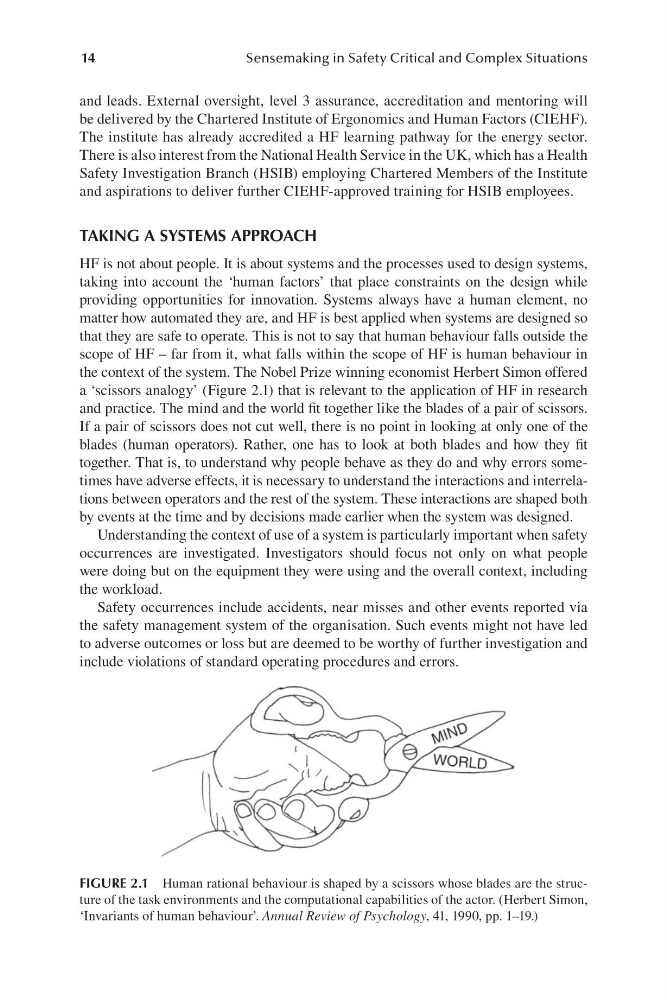
the context of the system. The Nobel Prize winning economist Herbert Simon offered
a ‘ scissors analogy’ ( Figure 2.1) that is relevant to the application of HF in research
and practice. The mind and the world fit together like the blades of a pair of scissors.
If a pair of scissors does not cut well, there is no point in looking at only one of the
blades ( human operators). Rather, one has to look at both blades and how they fit
together. That is, to understand why people behave as they do and why errors sometimes have adverse effects, it is necessary to understand the interactions and interrelations between operators and the rest of the system. These interactions are shaped both
by events at the time and by decisions made earlier when the system was designed.
Understanding the context of use of a system is particularly important when safety
occurrences are investigated. Investigators should focus not only on what people
were doing but on the equipment they were using and the overall context, including
the workload.
Safety occurrences include accidents, near misses and other events reported via
the safety management system of the organisation. Such events might not have led
to adverse outcomes or loss but are deemed to be worthy of further investigation and
include violations of standard operating procedures and errors.
FIGURE 2.1 Human rational behaviour is shaped by a scissors whose blades are the structure of the task environments and the computational capabilities of the actor. ( Herbert Simon,
‘ Invariants of human behaviour’. Annual Review of Psychology, 41, 1990, p p. 1–19.)
Sensemaking in Safety Critical and Complex Situations
and leads. External oversight, level 3 assurance, accreditation and mentoring will
be delivered by the Chartered Institute of Ergonomics and Human Factors ( CIEHF).
The institute has already accredited a HF learning pathway for the energy sector.
There is also interest from the National Health Service in the UK, which has a Health
Safety Investigation Branch ( HSIB) employing Chartered Members of the Institute
and aspirations to deliver further CIEHF-approved training for HSIB employees.
TAKING A SYSTEMS APPROACH
HF is not about people. It is about systems and the processes used to design systems,
taking into account the ‘ human factors’ that place constraints on the design while
providing opportunities for innovation. Systems always have a human element, no
matter how automated they are, and HF is best applied when systems are designed so
that they are safe to operate. This is not to say that human behaviour falls outside the
scope of H F – far from it, what falls within the scope of HF is human behaviour in
the context of the system. The Nobel Prize winning economist Herbert Simon offered
a ‘ scissors analogy’ ( Figure 2.1) that is relevant to the application of HF in research
and practice. The mind and the world fit together like the blades of a pair of scissors.
If a pair of scissors does not cut well, there is no point in looking at only one of the
blades ( human operators). Rather, one has to look at both blades and how they fit
together. That is, to understand why people behave as they do and why errors sometimes have adverse effects, it is necessary to understand the interactions and interrelations between operators and the rest of the system. These interactions are shaped both
by events at the time and by decisions made earlier when the system was designed.
Understanding the context of use of a system is particularly important when safety
occurrences are investigated. Investigators should focus not only on what people
were doing but on the equipment they were using and the overall context, including
the workload.
Safety occurrences include accidents, near misses and other events reported via
the safety management system of the organisation. Such events might not have led
to adverse outcomes or loss but are deemed to be worthy of further investigation and
include violations of standard operating procedures and errors.
FIGURE 2.1 Human rational behaviour is shaped by a scissors whose blades are the structure of the task environments and the computational capabilities of the actor. ( Herbert Simon,
‘ Invariants of human behaviour’. Annual Review of Psychology, 41, 1990, p p. 1–19.)