

252
Sensemaking in Safety Critical and Complex Situations
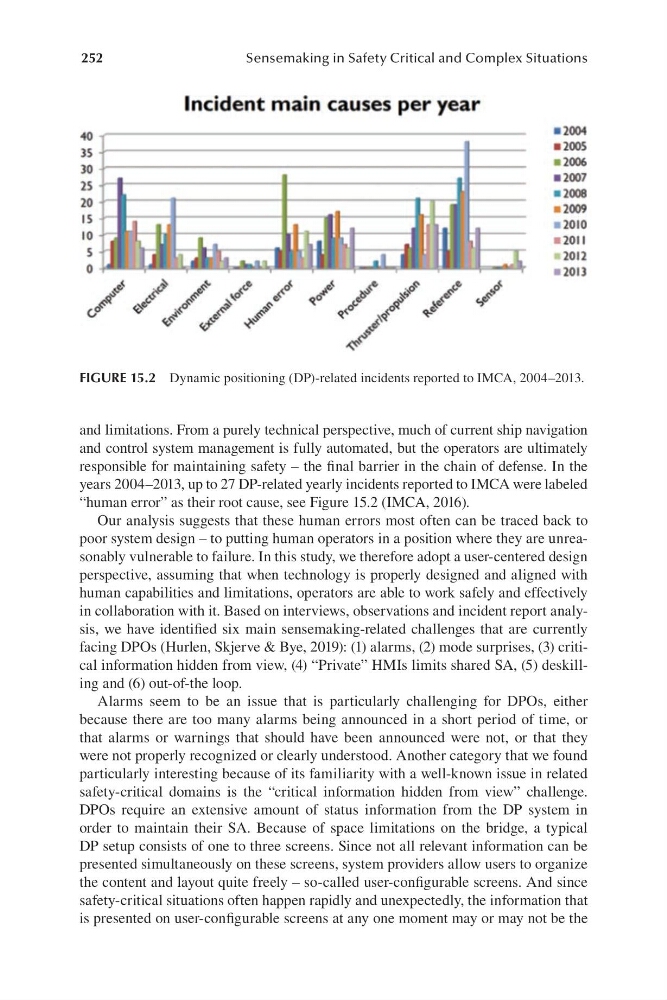
FIGURE 15.2 Dynamic positioning (D P)-related incidents reported to IMCA, 2004–2013.
and limitations. From a purely technical perspective, much of current ship navigation
and control system management is fully automated, but the operators are ultimately
responsible for maintaining safety – the final barrier in the chain of defense. In the
years 2004–2013, up to 27 DP-related yearly incidents reported to IMCA were labeled
“ human error” as their root cause, see Figure 15.2 (I MCA, 2016).
Our analysis suggests that these human errors most often can be traced back to
poor system design – to putting human operators in a position where they are unreasonably vulnerable to failure. In this study, we therefore adopt a user-centered design
perspective, assuming that when technology is properly designed and aligned with
human capabilities and limitations, operators are able to work safely and effectively
in collaboration with it. Based on interviews, observations and incident report analysis, we have identified six main sensemaking-related challenges that are currently
facing DPOs (H urlen, Skjerve & Bye, 2019): (1 ) alarms, (2 ) mode surprises, ( 3) critical information hidden from view, ( 4) “ Private” HMIs limits shared SA, ( 5) deskilling and ( 6) out-o f-the loop.
Alarms seem to be an issue that is particularly challenging for DPOs, either
because there are too many alarms being announced in a short period of time, or
that alarms or warnings that should have been announced were not, or that they
were not properly recognized or clearly understood. Another category that we found
particularly interesting because of its familiarity with a well-known issue in related
s afety-critical domains is the “c ritical information hidden from view” challenge.
DPOs require an extensive amount of status information from the DP system in
order to maintain their SA. Because of space limitations on the bridge, a typical
DP setup consists of one to three screens. Since not all relevant information can be
presented simultaneously on these screens, system providers allow users to organize
the content and layout quite f reely – so-called user-configurable screens. And since
safety-critical situations often happen rapidly and unexpectedly, the information that
is presented on us er-configurable screens at any one moment may or may not be the
Sensemaking in Safety Critical and Complex Situations
FIGURE 15.2 Dynamic positioning (D P)-related incidents reported to IMCA, 2004–2013.
and limitations. From a purely technical perspective, much of current ship navigation
and control system management is fully automated, but the operators are ultimately
responsible for maintaining safety – the final barrier in the chain of defense. In the
years 2004–2013, up to 27 DP-related yearly incidents reported to IMCA were labeled
“ human error” as their root cause, see Figure 15.2 (I MCA, 2016).
Our analysis suggests that these human errors most often can be traced back to
poor system design – to putting human operators in a position where they are unreasonably vulnerable to failure. In this study, we therefore adopt a user-centered design
perspective, assuming that when technology is properly designed and aligned with
human capabilities and limitations, operators are able to work safely and effectively
in collaboration with it. Based on interviews, observations and incident report analysis, we have identified six main sensemaking-related challenges that are currently
facing DPOs (H urlen, Skjerve & Bye, 2019): (1 ) alarms, (2 ) mode surprises, ( 3) critical information hidden from view, ( 4) “ Private” HMIs limits shared SA, ( 5) deskilling and ( 6) out-o f-the loop.
Alarms seem to be an issue that is particularly challenging for DPOs, either
because there are too many alarms being announced in a short period of time, or
that alarms or warnings that should have been announced were not, or that they
were not properly recognized or clearly understood. Another category that we found
particularly interesting because of its familiarity with a well-known issue in related
s afety-critical domains is the “c ritical information hidden from view” challenge.
DPOs require an extensive amount of status information from the DP system in
order to maintain their SA. Because of space limitations on the bridge, a typical
DP setup consists of one to three screens. Since not all relevant information can be
presented simultaneously on these screens, system providers allow users to organize
the content and layout quite f reely – so-called user-configurable screens. And since
safety-critical situations often happen rapidly and unexpectedly, the information that
is presented on us er-configurable screens at any one moment may or may not be the