

230
Sensemaking in Safety Critical and Complex Situations
and 2 were removed for disagreement in code assignment. From the remaining 6
SCDs, only 2 were of interest. Both coders had assigned an “ IO Functionality” code
to those SCDs.
The two SCDs could be summarized as a lost receive signal from the UAS,
along with improper use of checklists as the main cause for the mishap. Due to the
coders limited knowledge of the GCS layout, the Predator operator was asked to
clarify the SCDs. The operator clarified that Predator GCS consists of two identical/
interchangeable Pilot Payload Operator ( PPO) stations, named PPO-1 and P PO-2.
When the UAS is in air, one of the PPO controls the UAS while the other operates the
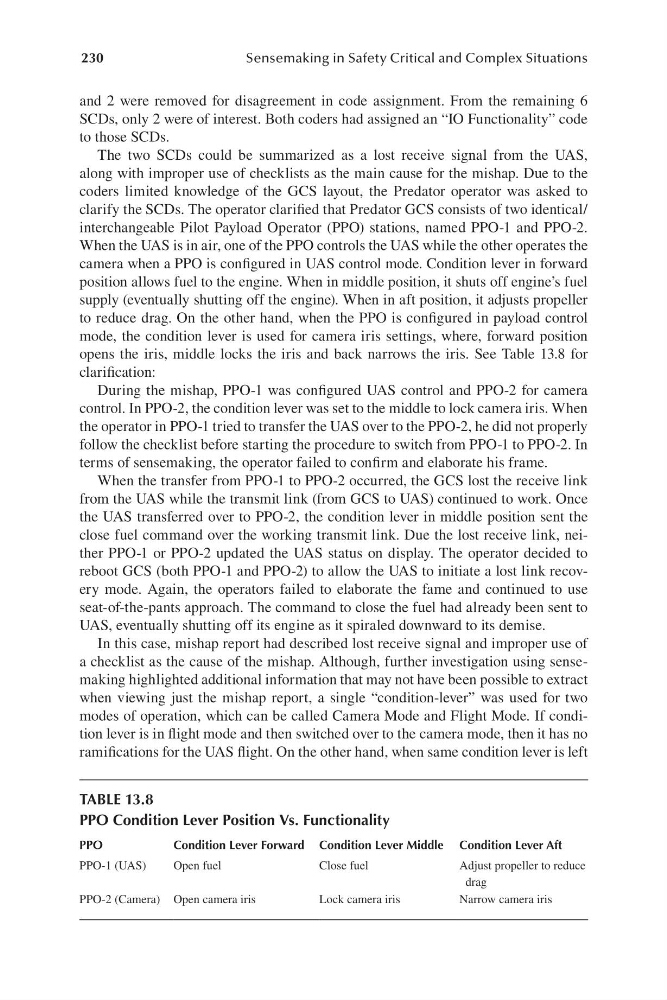
camera when a PPO is configured in UAS control mode. Condition lever in forward
position allows fuel to the engine. When in middle position, it shuts off engine’s fuel
supply ( eventually shutting off the engine). When in aft position, it adjusts propeller
to reduce drag. On the other hand, when the PPO is configured in payload control
mode, the condition lever is used for camera iris settings, where, forward position
opens the iris, middle locks the iris and back narrows the iris. See T able 13.8 for
clarification:
During the mishap, PPO-1 was configured UAS control and PPO-2 for camera
control. In PPO-2, the condition lever was set to the middle to lock camera iris. When
the operator in PPO-1 tried to transfer the UAS over to the PPO-2, he did not properly
follow the checklist before starting the procedure to switch from PPO-1 to PPO-2. In
terms of sensemaking, the operator failed to confirm and elaborate his frame.
When the transfer from PPO-1 to PPO-2 occurred, the GCS lost the receive link
from the UAS while the transmit link ( from GCS to UAS) continued to work. Once
the UAS transferred over to P PO-2, the condition lever in middle position sent the
close fuel command over the working transmit link. Due the lost receive link, neither PPO-1 or PPO-2 updated the UAS status on display. The operator decided to
reboot GCS ( both PPO-1 and PPO-2) to allow the UAS to initiate a lost link recovery mode. Again, the operators failed to elaborate the fame and continued to use
seat- of- the-pants approach. The command to close the fuel had already been sent to
UAS, eventually shutting off its engine as it spiraled downward to its demise.
In this case, mishap report had described lost receive signal and improper use of
a checklist as the cause of the mishap. Although, further investigation using sensemaking highlighted additional information that may not have been possible to extract
when viewing just the mishap report, a single “ condition-lever” was used for two
modes of operation, which can be called Camera Mode and Flight Mode. If condition lever is in flight mode and then switched over to the camera mode, then it has no
ramifications for the UAS flight. On the other hand, when same condition lever is left
TABLE 13.8
PPO Condition Lever Position Vs. Functionality
PPO
Condition Lever Forward Condition Lever Middle Condition Lever Aft
PPO-1 (UAS)
Open fuel
Close fuel
Adjust propeller to reduce
drag
PPO-2 (Camera) Open camera iris
Lock camera iris
Narrow camera iris
Sensemaking in Safety Critical and Complex Situations
and 2 were removed for disagreement in code assignment. From the remaining 6
SCDs, only 2 were of interest. Both coders had assigned an “ IO Functionality” code
to those SCDs.
The two SCDs could be summarized as a lost receive signal from the UAS,
along with improper use of checklists as the main cause for the mishap. Due to the
coders limited knowledge of the GCS layout, the Predator operator was asked to
clarify the SCDs. The operator clarified that Predator GCS consists of two identical/
interchangeable Pilot Payload Operator ( PPO) stations, named PPO-1 and P PO-2.
When the UAS is in air, one of the PPO controls the UAS while the other operates the
camera when a PPO is configured in UAS control mode. Condition lever in forward
position allows fuel to the engine. When in middle position, it shuts off engine’s fuel
supply ( eventually shutting off the engine). When in aft position, it adjusts propeller
to reduce drag. On the other hand, when the PPO is configured in payload control
mode, the condition lever is used for camera iris settings, where, forward position
opens the iris, middle locks the iris and back narrows the iris. See T able 13.8 for
clarification:
During the mishap, PPO-1 was configured UAS control and PPO-2 for camera
control. In PPO-2, the condition lever was set to the middle to lock camera iris. When
the operator in PPO-1 tried to transfer the UAS over to the PPO-2, he did not properly
follow the checklist before starting the procedure to switch from PPO-1 to PPO-2. In
terms of sensemaking, the operator failed to confirm and elaborate his frame.
When the transfer from PPO-1 to PPO-2 occurred, the GCS lost the receive link
from the UAS while the transmit link ( from GCS to UAS) continued to work. Once
the UAS transferred over to P PO-2, the condition lever in middle position sent the
close fuel command over the working transmit link. Due the lost receive link, neither PPO-1 or PPO-2 updated the UAS status on display. The operator decided to
reboot GCS ( both PPO-1 and PPO-2) to allow the UAS to initiate a lost link recovery mode. Again, the operators failed to elaborate the fame and continued to use
seat- of- the-pants approach. The command to close the fuel had already been sent to
UAS, eventually shutting off its engine as it spiraled downward to its demise.
In this case, mishap report had described lost receive signal and improper use of
a checklist as the cause of the mishap. Although, further investigation using sensemaking highlighted additional information that may not have been possible to extract
when viewing just the mishap report, a single “ condition-lever” was used for two
modes of operation, which can be called Camera Mode and Flight Mode. If condition lever is in flight mode and then switched over to the camera mode, then it has no
ramifications for the UAS flight. On the other hand, when same condition lever is left
TABLE 13.8
PPO Condition Lever Position Vs. Functionality
PPO
Condition Lever Forward Condition Lever Middle Condition Lever Aft
PPO-1 (UAS)
Open fuel
Close fuel
Adjust propeller to reduce
drag
PPO-2 (Camera) Open camera iris
Lock camera iris
Narrow camera iris