

214
Sensemaking in Safety Critical and Complex Situations
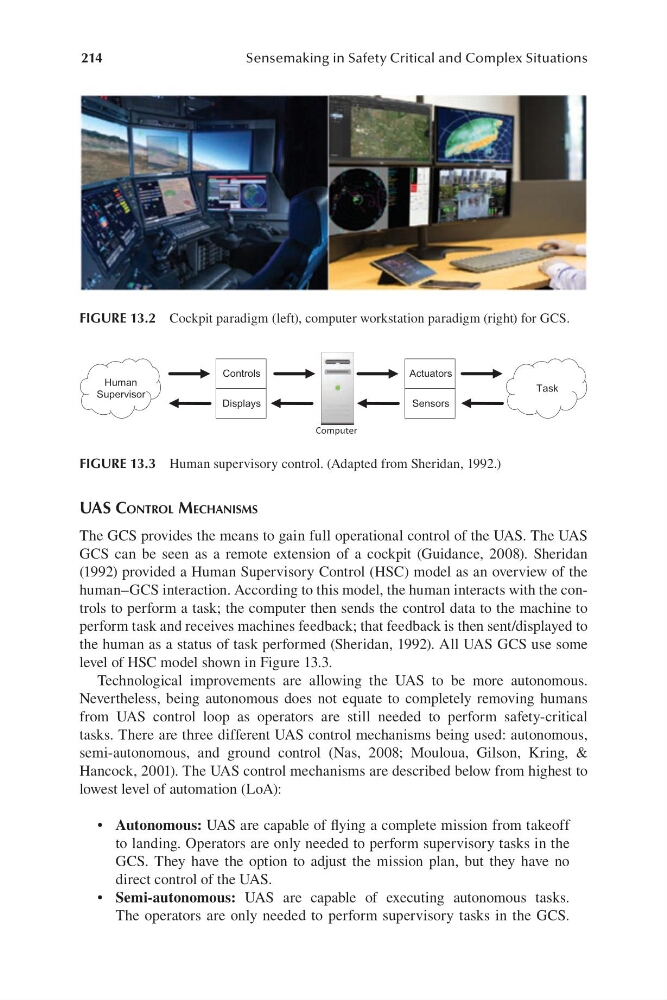
FIGURE 13.2 Cockpit paradigm ( left), computer workstation paradigm ( right) for GCS.
Controls
Displays
Actuators
Sensors
Human
Supervisor
Task
Computer
FIGURE 13.3 Human supervisory control. ( Adapted from Sheridan, 1992.)
uaS control mechaniSmS
The GCS provides the means to gain full operational control of the UAS. The UAS
GCS can be seen as a remote extension of a cockpit ( Guidance, 2008). Sheridan
( 1992) provided a Human Supervisory Control (H SC) model as an overview of the
human–GCS interaction. According to this model, the human interacts with the controls to perform a task; the computer then sends the control data to the machine to
perform task and receives machines feedback; that feedback is then sent/d isplayed to
the human as a status of task performed (S heridan, 1992). All UAS GCS use some
level of HSC model shown in Figure 13.3.
Technological improvements are allowing the UAS to be more autonomous.
Nevertheless, being autonomous does not equate to completely removing humans
from UAS control loop as operators are still needed to perform s afety-critical
tasks. There are three different UAS control mechanisms being used: autonomous,
semi-autonomous, and ground control ( Nas, 2008; Mouloua, Gilson, Kring, &
Hancock, 2001). The UAS control mechanisms are described below from highest to
lowest level of automation (L oA):
• Autonomous: UAS are capable of flying a complete mission from takeoff
to landing. Operators are only needed to perform supervisory tasks in the
GCS. They have the option to adjust the mission plan, but they have no
direct control of the UAS.
• Semi-autonomous: UAS are capable of executing autonomous tasks.
The operators are only needed to perform supervisory tasks in the GCS.
Sensemaking in Safety Critical and Complex Situations
FIGURE 13.2 Cockpit paradigm ( left), computer workstation paradigm ( right) for GCS.
Controls
Displays
Actuators
Sensors
Human
Supervisor
Task
Computer
FIGURE 13.3 Human supervisory control. ( Adapted from Sheridan, 1992.)
uaS control mechaniSmS
The GCS provides the means to gain full operational control of the UAS. The UAS
GCS can be seen as a remote extension of a cockpit ( Guidance, 2008). Sheridan
( 1992) provided a Human Supervisory Control (H SC) model as an overview of the
human–GCS interaction. According to this model, the human interacts with the controls to perform a task; the computer then sends the control data to the machine to
perform task and receives machines feedback; that feedback is then sent/d isplayed to
the human as a status of task performed (S heridan, 1992). All UAS GCS use some
level of HSC model shown in Figure 13.3.
Technological improvements are allowing the UAS to be more autonomous.
Nevertheless, being autonomous does not equate to completely removing humans
from UAS control loop as operators are still needed to perform s afety-critical
tasks. There are three different UAS control mechanisms being used: autonomous,
semi-autonomous, and ground control ( Nas, 2008; Mouloua, Gilson, Kring, &
Hancock, 2001). The UAS control mechanisms are described below from highest to
lowest level of automation (L oA):
• Autonomous: UAS are capable of flying a complete mission from takeoff
to landing. Operators are only needed to perform supervisory tasks in the
GCS. They have the option to adjust the mission plan, but they have no
direct control of the UAS.
• Semi-autonomous: UAS are capable of executing autonomous tasks.
The operators are only needed to perform supervisory tasks in the GCS.