

175
User-Centred Agile Development
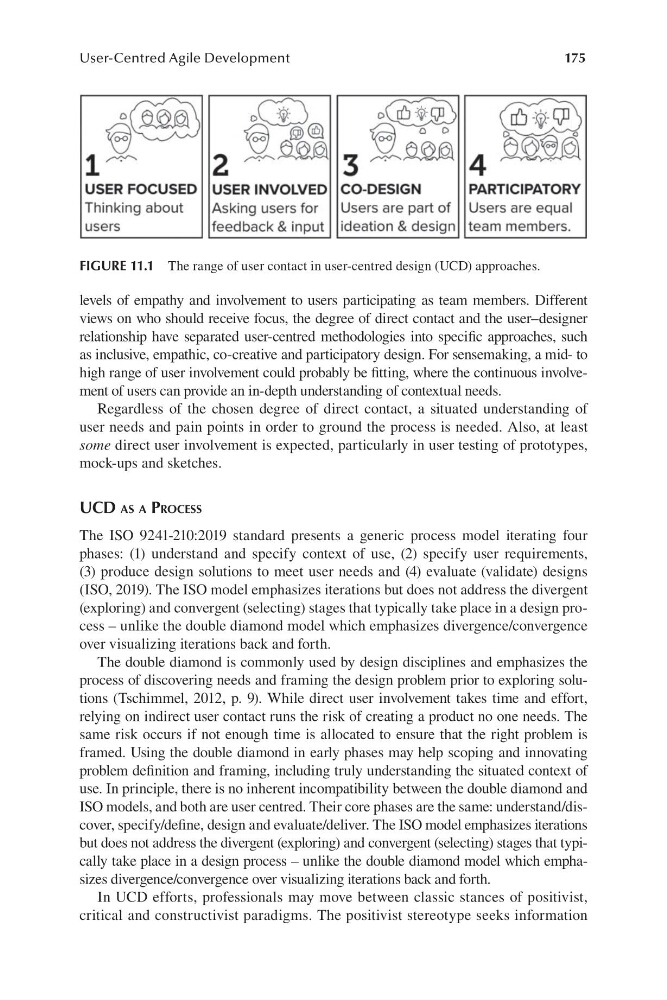
FIGURE 11.1 The range of user contact in user-centred design (U CD) approaches.
levels of empathy and involvement to users participating as team members. Different
views on who should receive focus, the degree of direct contact and the user–designer
relationship have separated user-centred methodologies into specific approaches, such
as inclusive, empathic, co-creative and participatory design. For sensemaking, a m id- to
high range of user involvement could probably be fitting, where the continuous involvement of users can provide an in-depth understanding of contextual needs.
Regardless of the chosen degree of direct contact, a situated understanding of
user needs and pain points in order to ground the process is needed. Also, at least
some direct user involvement is expected, particularly in user testing of prototypes,
mock-ups and sketches.
ucD aS a ProceSS
The ISO 9241-210:2019 standard presents a generic process model iterating four
phases: (1) understand and specify context of use, (2) specify user requirements,
(3) produce design solutions to meet user needs and (4) evaluate (validate) designs
(ISO, 2019). The ISO model emphasizes iterations but does not address the divergent
(exploring) and convergent (selecting) stages that typically take place in a design process – unlike the double diamond model which emphasizes divergence/convergence
over visualizing iterations back and forth.
The double diamond is commonly used by design disciplines and emphasizes the
process of discovering needs and framing the design problem prior to exploring solutions (Tschimmel, 2012, p. 9). While direct user involvement takes time and effort,
relying on indirect user contact runs the risk of creating a product no one needs. The
same risk occurs if not enough time is allocated to ensure that the right problem is
framed. Using the double diamond in early phases may help scoping and innovating
problem definition and framing, including truly understanding the situated context of
use. In principle, there is no inherent incompatibility between the double diamond and
ISO models, and both are user centred. Their core phases are the same: understand/discover, specify/define, design and evaluate/deliver. The ISO model emphasizes iterations
but does not address the divergent ( exploring) and convergent ( selecting) stages that typically take place in a design p rocess – unlike the double diamond model which emphasizes divergence/c onvergence over visualizing iterations back and forth.
In UCD efforts, professionals may move between classic stances of positivist,
critical and constructivist paradigms. The positivist stereotype seeks information
User-Centred Agile Development
FIGURE 11.1 The range of user contact in user-centred design (U CD) approaches.
levels of empathy and involvement to users participating as team members. Different
views on who should receive focus, the degree of direct contact and the user–designer
relationship have separated user-centred methodologies into specific approaches, such
as inclusive, empathic, co-creative and participatory design. For sensemaking, a m id- to
high range of user involvement could probably be fitting, where the continuous involvement of users can provide an in-depth understanding of contextual needs.
Regardless of the chosen degree of direct contact, a situated understanding of
user needs and pain points in order to ground the process is needed. Also, at least
some direct user involvement is expected, particularly in user testing of prototypes,
mock-ups and sketches.
ucD aS a ProceSS
The ISO 9241-210:2019 standard presents a generic process model iterating four
phases: (1) understand and specify context of use, (2) specify user requirements,
(3) produce design solutions to meet user needs and (4) evaluate (validate) designs
(ISO, 2019). The ISO model emphasizes iterations but does not address the divergent
(exploring) and convergent (selecting) stages that typically take place in a design process – unlike the double diamond model which emphasizes divergence/convergence
over visualizing iterations back and forth.
The double diamond is commonly used by design disciplines and emphasizes the
process of discovering needs and framing the design problem prior to exploring solutions (Tschimmel, 2012, p. 9). While direct user involvement takes time and effort,
relying on indirect user contact runs the risk of creating a product no one needs. The
same risk occurs if not enough time is allocated to ensure that the right problem is
framed. Using the double diamond in early phases may help scoping and innovating
problem definition and framing, including truly understanding the situated context of
use. In principle, there is no inherent incompatibility between the double diamond and
ISO models, and both are user centred. Their core phases are the same: understand/discover, specify/define, design and evaluate/deliver. The ISO model emphasizes iterations
but does not address the divergent ( exploring) and convergent ( selecting) stages that typically take place in a design p rocess – unlike the double diamond model which emphasizes divergence/c onvergence over visualizing iterations back and forth.
In UCD efforts, professionals may move between classic stances of positivist,
critical and constructivist paradigms. The positivist stereotype seeks information