

156
Sensemaking in Safety Critical and Complex Situations
INTRODUCTION
A ship’s bridge is a complex work environment that is typically outfitted with a range
of equipment supplied from numerous different vendors ( Lützhöft & Vu, 2018).
Multivendor ship bridge systems ( MBS) that merge independent equipment from different vendors can create disparities for navigation crew once all necessary equipment is installed into a single work environment ( Nordby, Mallam & Lützhöft, 2019).
Navigators must engage with different pieces of equipment located on the bridge of
a ship throughout their watch shift to enable successful planning and execution of
operations. Thus, the very nature of MBS create circumstances where navigators must
interact with equipment having multiple design languages across the many physical
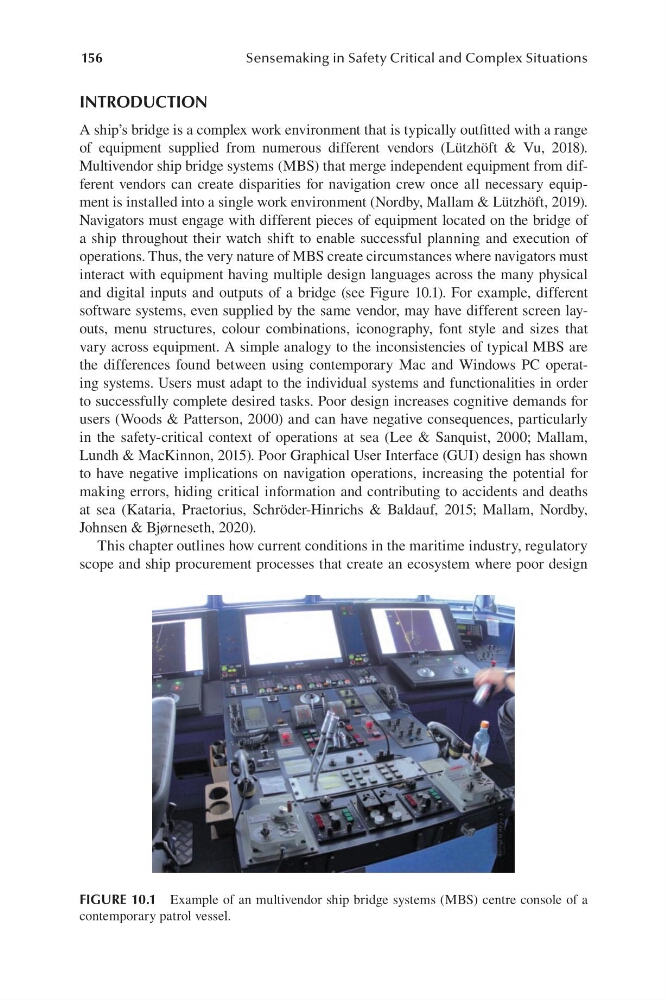
and digital inputs and outputs of a bridge ( see Figure 10.1). For example, different
software systems, even supplied by the same vendor, may have different screen layouts, menu structures, colour combinations, iconography, font style and sizes that
vary across equipment. A simple analogy to the inconsistencies of typical MBS are
the differences found between using contemporary Mac and Windows PC operating systems. Users must adapt to the individual systems and functionalities in order
to successfully complete desired tasks. Poor design increases cognitive demands for
users ( Woods & Patterson, 2000) and can have negative consequences, particularly
in the safety-critical context of operations at sea ( Lee & Sanquist, 2000; Mallam,
Lundh & MacKinnon, 2015). Poor Graphical User Interface ( GUI) design has shown
to have negative implications on navigation operations, increasing the potential for
making errors, hiding critical information and contributing to accidents and deaths
at sea ( Kataria, Praetorius, Schröder-Hinrichs & Baldauf, 2015; Mallam, Nordby,
Johnsen & Bjørneseth, 2020).
This chapter outlines how current conditions in the maritime industry, regulatory
scope and ship procurement processes that create an ecosystem where poor design
FIGURE 10.1 Example of an multivendor ship bridge systems ( MBS) centre console of a
contemporary patrol vessel.
Sensemaking in Safety Critical and Complex Situations
INTRODUCTION
A ship’s bridge is a complex work environment that is typically outfitted with a range
of equipment supplied from numerous different vendors ( Lützhöft & Vu, 2018).
Multivendor ship bridge systems ( MBS) that merge independent equipment from different vendors can create disparities for navigation crew once all necessary equipment is installed into a single work environment ( Nordby, Mallam & Lützhöft, 2019).
Navigators must engage with different pieces of equipment located on the bridge of
a ship throughout their watch shift to enable successful planning and execution of
operations. Thus, the very nature of MBS create circumstances where navigators must
interact with equipment having multiple design languages across the many physical
and digital inputs and outputs of a bridge ( see Figure 10.1). For example, different
software systems, even supplied by the same vendor, may have different screen layouts, menu structures, colour combinations, iconography, font style and sizes that
vary across equipment. A simple analogy to the inconsistencies of typical MBS are
the differences found between using contemporary Mac and Windows PC operating systems. Users must adapt to the individual systems and functionalities in order
to successfully complete desired tasks. Poor design increases cognitive demands for
users ( Woods & Patterson, 2000) and can have negative consequences, particularly
in the safety-critical context of operations at sea ( Lee & Sanquist, 2000; Mallam,
Lundh & MacKinnon, 2015). Poor Graphical User Interface ( GUI) design has shown
to have negative implications on navigation operations, increasing the potential for
making errors, hiding critical information and contributing to accidents and deaths
at sea ( Kataria, Praetorius, Schröder-Hinrichs & Baldauf, 2015; Mallam, Nordby,
Johnsen & Bjørneseth, 2020).
This chapter outlines how current conditions in the maritime industry, regulatory
scope and ship procurement processes that create an ecosystem where poor design
FIGURE 10.1 Example of an multivendor ship bridge systems ( MBS) centre console of a
contemporary patrol vessel.