

149
Unified Bridge
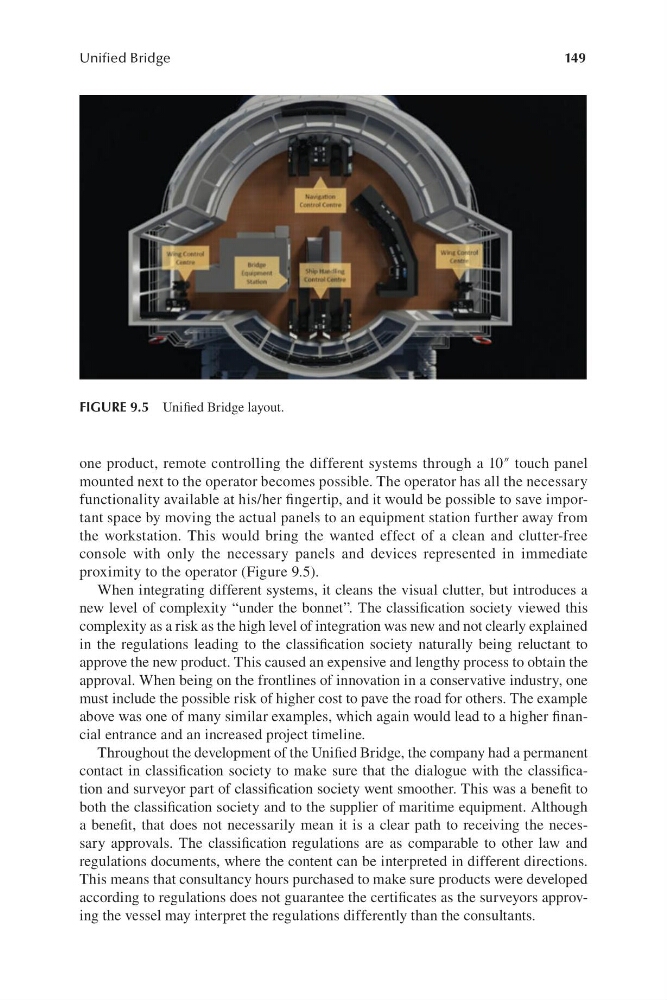
FIGURE 9.5 Unified Bridge layout.
one product, remote controlling the different systems through a 10″ touch panel
mounted next to the operator becomes possible. The operator has all the necessary
functionality available at his/ her fingertip, and it would be possible to save important space by moving the actual panels to an equipment station further away from
the workstation. This would bring the wanted effect of a clean and c lutter-free
console with only the necessary panels and devices represented in immediate
proximity to the operator ( F igure 9.5).
When integrating different systems, it cleans the visual clutter, but introduces a
new level of complexity “ under the bonnet”. The classification society viewed this
complexity as a risk as the high level of integration was new and not clearly explained
in the regulations leading to the classification society naturally being reluctant to
approve the new product. This caused an expensive and lengthy process to obtain the
approval. When being on the frontlines of innovation in a conservative industry, one
must include the possible risk of higher cost to pave the road for others. The example
above was one of many similar examples, which again would lead to a higher financial entrance and an increased project timeline.
Throughout the development of the Unified Bridge, the company had a permanent
contact in classification society to make sure that the dialogue with the classification and surveyor part of classification society went smoother. This was a benefit to
both the classification society and to the supplier of maritime equipment. Although
a benefit, that does not necessarily mean it is a clear path to receiving the necessary approvals. The classification regulations are as comparable to other law and
regulations documents, where the content can be interpreted in different directions.
This means that consultancy hours purchased to make sure products were developed
according to regulations does not guarantee the certificates as the surveyors approving the vessel may interpret the regulations differently than the consultants.
Unified Bridge
FIGURE 9.5 Unified Bridge layout.
one product, remote controlling the different systems through a 10″ touch panel
mounted next to the operator becomes possible. The operator has all the necessary
functionality available at his/ her fingertip, and it would be possible to save important space by moving the actual panels to an equipment station further away from
the workstation. This would bring the wanted effect of a clean and c lutter-free
console with only the necessary panels and devices represented in immediate
proximity to the operator ( F igure 9.5).
When integrating different systems, it cleans the visual clutter, but introduces a
new level of complexity “ under the bonnet”. The classification society viewed this
complexity as a risk as the high level of integration was new and not clearly explained
in the regulations leading to the classification society naturally being reluctant to
approve the new product. This caused an expensive and lengthy process to obtain the
approval. When being on the frontlines of innovation in a conservative industry, one
must include the possible risk of higher cost to pave the road for others. The example
above was one of many similar examples, which again would lead to a higher financial entrance and an increased project timeline.
Throughout the development of the Unified Bridge, the company had a permanent
contact in classification society to make sure that the dialogue with the classification and surveyor part of classification society went smoother. This was a benefit to
both the classification society and to the supplier of maritime equipment. Although
a benefit, that does not necessarily mean it is a clear path to receiving the necessary approvals. The classification regulations are as comparable to other law and
regulations documents, where the content can be interpreted in different directions.
This means that consultancy hours purchased to make sure products were developed
according to regulations does not guarantee the certificates as the surveyors approving the vessel may interpret the regulations differently than the consultants.