

148
Sensemaking in Safety Critical and Complex Situations
STANDARDS AND REGULATIONS
When being innovative in the maritime industry and presenting solutions that
have not been evaluated earlier to stakeholders, the solutions on board needed
acceptance in the classification regulations given by the classification society.
DNV-GL’s NAUT-OSV standard ( D NV-GL, 2012) was the main working document that the development of the innovative solutions needed to adhere to for
the vessel to be allowed to sail on its maiden voyage. The N AUT-OSV classification regulation ( DNV-GL, 2012) contains some sections that reviews topics
such as the design of workplace on board. This section specifies the requirements
for bridge design, including field of vision, wheelhouse arrangement, workstation configuration and location of equipment within workstations. The regulations
can in many cases be widely interpreted and include the minimum of necessary
requirements to take care of the human element. Methodologies or processes on
how to do this, such as utilizing design thinking or the user centred design process, are not a part of the regulations. To comply with the rules and regulations,
the solutions presented were in many cases far from the traditional solutions. One
example that was costly both financially and in time was the need to clean up
the clutter on the worksurfaces. To be able to fulfil this requirement, equipment
integration was the keyword to make this happen. The possibility to introduce
new solutions that could leave only the operation critical input devices close to
the operator meant that other equipment had to give way. Equipment that was
needed for the operation, however not critical to the manoeuvring of the vessel,
such as windscreen wipers, lantern control, phone list ( often a laminated piece
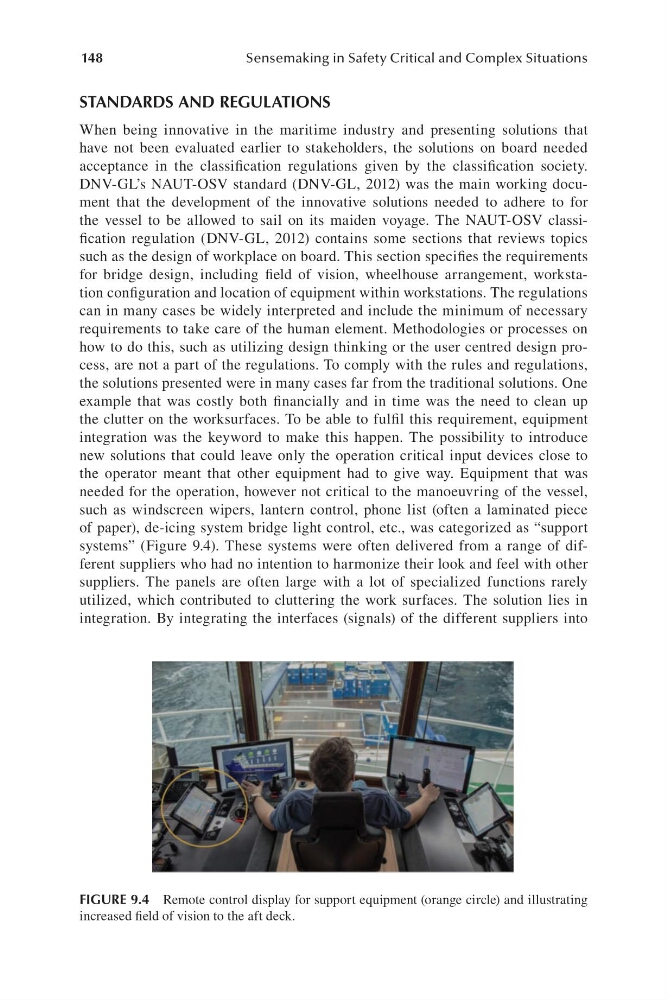
of paper), de-icing system bridge light control, etc., was categorized as “ support
systems” ( Figure 9.4). These systems were often delivered from a range of different suppliers who had no intention to harmonize their look and feel with other
suppliers. The panels are often large with a lot of specialized functions rarely
utilized, which contributed to cluttering the work surfaces. The solution lies in
integration. By integrating the interfaces ( signals) of the different suppliers into
FIGURE 9.4 Remote control display for support equipment ( orange circle) and illustrating
increased field of vision to the aft deck.
Sensemaking in Safety Critical and Complex Situations
STANDARDS AND REGULATIONS
When being innovative in the maritime industry and presenting solutions that
have not been evaluated earlier to stakeholders, the solutions on board needed
acceptance in the classification regulations given by the classification society.
DNV-GL’s NAUT-OSV standard ( D NV-GL, 2012) was the main working document that the development of the innovative solutions needed to adhere to for
the vessel to be allowed to sail on its maiden voyage. The N AUT-OSV classification regulation ( DNV-GL, 2012) contains some sections that reviews topics
such as the design of workplace on board. This section specifies the requirements
for bridge design, including field of vision, wheelhouse arrangement, workstation configuration and location of equipment within workstations. The regulations
can in many cases be widely interpreted and include the minimum of necessary
requirements to take care of the human element. Methodologies or processes on
how to do this, such as utilizing design thinking or the user centred design process, are not a part of the regulations. To comply with the rules and regulations,
the solutions presented were in many cases far from the traditional solutions. One
example that was costly both financially and in time was the need to clean up
the clutter on the worksurfaces. To be able to fulfil this requirement, equipment
integration was the keyword to make this happen. The possibility to introduce
new solutions that could leave only the operation critical input devices close to
the operator meant that other equipment had to give way. Equipment that was
needed for the operation, however not critical to the manoeuvring of the vessel,
such as windscreen wipers, lantern control, phone list ( often a laminated piece
of paper), de-icing system bridge light control, etc., was categorized as “ support
systems” ( Figure 9.4). These systems were often delivered from a range of different suppliers who had no intention to harmonize their look and feel with other
suppliers. The panels are often large with a lot of specialized functions rarely
utilized, which contributed to cluttering the work surfaces. The solution lies in
integration. By integrating the interfaces ( signals) of the different suppliers into
FIGURE 9.4 Remote control display for support equipment ( orange circle) and illustrating
increased field of vision to the aft deck.