

104
Sensemaking in Safety Critical and Complex Situations
A 3D computer model was utilized to review a new US Navy ship ( Dalpiaz,
Emmrich, Miller, & McQuillan, 2005). They found that incorrect height/ orientation
for equipment, machinery and other manually operated equipment as the most common mistakes ( 20%). Stairs, ladders, steps and walkways designs were also found to
be poorly designed ( 17%). Other deficiencies covered inaccessibility to valves, hand
wheels and hand pumps ( 15%), incorrect control panel ( i.e. controllability), console
design, control and display designs ( 8%), and problems with access and personnel
movement (6%).
imPlementation of human factorS in ShiP DeSign –
caSe StuDy: offShore SuPPly veSSel
An OSV can be described as the workhorse of the oil and gas business in Norway.
It is a combination of a bulk vessel, a general cargo vessel, a container vessel and a
tanker with some extra capabilities like firefighting and oil recovery. The operational
effectiveness, low fuel consumption, low emissions and safety are important factors
in OSV design ( Blenkey, 2004).
Field research of human factors was performed on OSV design in Norway
( Rumawas & Asbjørnslett, 2011a; Rumawas & Asbjørnslett, 2013) using qualitative
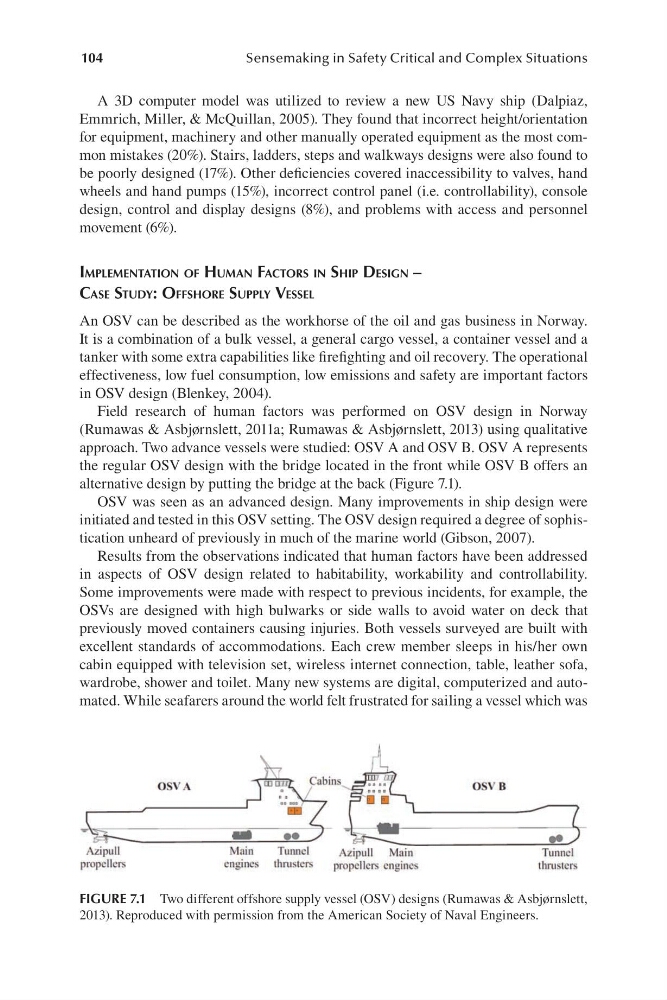
approach. Two advance vessels were studied: OSV A and OSV B. OSV A represents
the regular OSV design with the bridge located in the front while OSV B offers an
alternative design by putting the bridge at the back ( Figure 7.1).
OSV was seen as an advanced design. Many improvements in ship design were
initiated and tested in this OSV setting. The OSV design required a degree of sophistication unheard of previously in much of the marine world ( Gibson, 2007).
Results from the observations indicated that human factors have been addressed
in aspects of OSV design related to habitability, workability and controllability.
Some improvements were made with respect to previous incidents, for example, the
OSVs are designed with high bulwarks or side walls to avoid water on deck that
previously moved containers causing injuries. Both vessels surveyed are built with
excellent standards of accommodations. Each crew member sleeps in his/ her own
cabin equipped with television set, wireless internet connection, table, leather sofa,
wardrobe, shower and toilet. Many new systems are digital, computerized and automated. While seafarers around the world felt frustrated for sailing a vessel which was
FIGURE 7.1 Two different offshore supply vessel ( OSV) designs ( Rumawas & Asbjørnslett,
2013). Reproduced with permission from the American Society of Naval Engineers.
Sensemaking in Safety Critical and Complex Situations
A 3D computer model was utilized to review a new US Navy ship ( Dalpiaz,
Emmrich, Miller, & McQuillan, 2005). They found that incorrect height/ orientation
for equipment, machinery and other manually operated equipment as the most common mistakes ( 20%). Stairs, ladders, steps and walkways designs were also found to
be poorly designed ( 17%). Other deficiencies covered inaccessibility to valves, hand
wheels and hand pumps ( 15%), incorrect control panel ( i.e. controllability), console
design, control and display designs ( 8%), and problems with access and personnel
movement (6%).
imPlementation of human factorS in ShiP DeSign –
caSe StuDy: offShore SuPPly veSSel
An OSV can be described as the workhorse of the oil and gas business in Norway.
It is a combination of a bulk vessel, a general cargo vessel, a container vessel and a
tanker with some extra capabilities like firefighting and oil recovery. The operational
effectiveness, low fuel consumption, low emissions and safety are important factors
in OSV design ( Blenkey, 2004).
Field research of human factors was performed on OSV design in Norway
( Rumawas & Asbjørnslett, 2011a; Rumawas & Asbjørnslett, 2013) using qualitative
approach. Two advance vessels were studied: OSV A and OSV B. OSV A represents
the regular OSV design with the bridge located in the front while OSV B offers an
alternative design by putting the bridge at the back ( Figure 7.1).
OSV was seen as an advanced design. Many improvements in ship design were
initiated and tested in this OSV setting. The OSV design required a degree of sophistication unheard of previously in much of the marine world ( Gibson, 2007).
Results from the observations indicated that human factors have been addressed
in aspects of OSV design related to habitability, workability and controllability.
Some improvements were made with respect to previous incidents, for example, the
OSVs are designed with high bulwarks or side walls to avoid water on deck that
previously moved containers causing injuries. Both vessels surveyed are built with
excellent standards of accommodations. Each crew member sleeps in his/ her own
cabin equipped with television set, wireless internet connection, table, leather sofa,
wardrobe, shower and toilet. Many new systems are digital, computerized and automated. While seafarers around the world felt frustrated for sailing a vessel which was
FIGURE 7.1 Two different offshore supply vessel ( OSV) designs ( Rumawas & Asbjørnslett,
2013). Reproduced with permission from the American Society of Naval Engineers.