

53
Origin and Occurrence
3.2.2.3 Nature of the Source Material
The organic compounds that constitute petroleum are generated from finely disseminated organic
matter in source beds; thus the first appearance of petroleum is also in a dispersed form. Processes
of primary and especially secondary migration, which finally lead to the formation of petroleum
accumulations, must therefore encompass mechanisms that concentrate dispersed petroleum
compounds.
Hydrocarbons have contributed to the formation of crude oil to a limited extent as they occur
in living plants in concentrations up to several tenths percent on a dry weight basis (Henderson
et al., 1968; Atkinson and Zuckerman, 1981; Hunt, 1996). Paraffinic and naphthenic hydrocarbon
components undoubtedly survive after burial to become ultimately incorporated in any crude oil
formed. The polyenes, which comprise the terpene hydrocarbons and the carotenoid pigments, also
survive for a time. It has been demonstrated (Erdman, 1965) that thermal alteration of a polyterpene
(ß-carotene) and an amino acid (phenylalanine) can be natural precursors to the alkylaromatic
(i.e., alkylbenzenes and alkylnaphthalenes) constituents of petroleum.
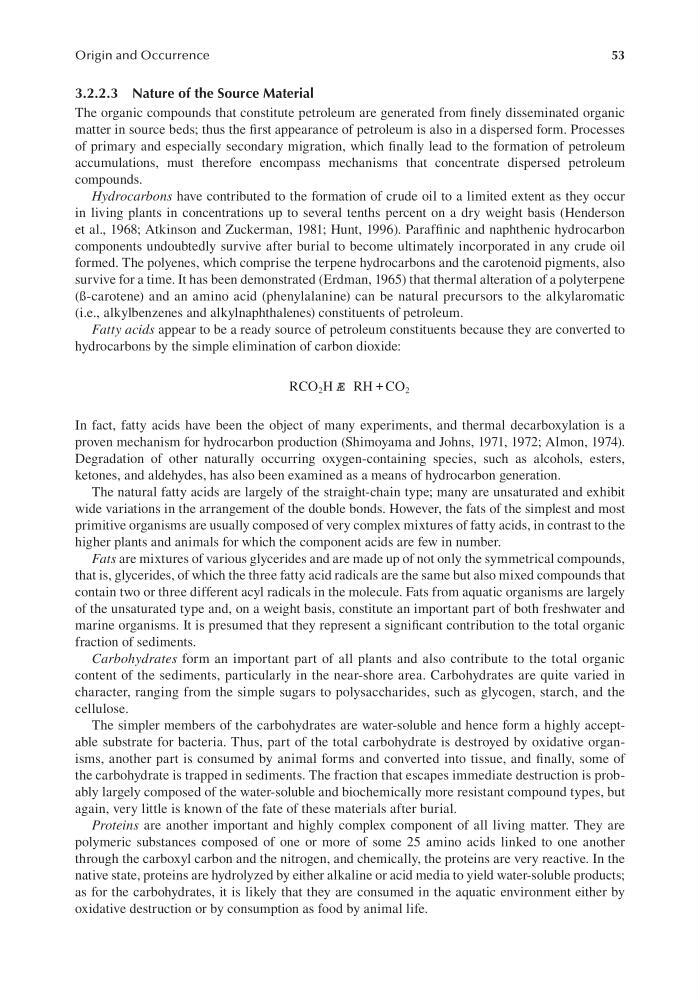
Fatty acids appear to be a ready source of petroleum constituents because they are converted to
hydrocarbons by the simple elimination of carbon dioxide:
RCO H RH CO
2
2
Æ
+
In fact, fatty acids have been the object of many experiments, and thermal decarboxylation is a
proven mechanism for hydrocarbon production (Shimoyama and Johns, 1971, 1972; Almon, 1974).
Degradation of other naturally occurring oxygen-containing species, such as alcohols, esters,
ketones, and aldehydes, has also been examined as a means of hydrocarbon generation.
The natural fatty acids are largely of the straight-chain type; many are unsaturated and exhibit
wide variations in the arrangement of the double bonds. However, the fats of the simplest and most
primitive organisms are usually composed of very complex mixtures of fatty acids, in contrast to the
higher plants and animals for which the component acids are few in number.
Fats are mixtures of various glycerides and are made up of not only the symmetrical compounds,
that is, glycerides, of which the three fatty acid radicals are the same but also mixed compounds that
contain two or three different acyl radicals in the molecule. Fats from aquatic organisms are largely
of the unsaturated type and, on a weight basis, constitute an important part of both freshwater and
marine organisms. It is presumed that they represent a significant contribution to the total organic
fraction of sediments.
Carbohydrates form an important part of all plants and also contribute to the total organic
content of the sediments, particularly in the near-shore area. Carbohydrates are quite varied in
character, ranging from the simple sugars to polysaccharides, such as glycogen, starch, and the
cellulose.
The simpler members of the carbohydrates are water-soluble and hence form a highly acceptable substrate for bacteria. Thus, part of the total carbohydrate is destroyed by oxidative organisms, another part is consumed by animal forms and converted into tissue, and finally, some of
the carbohydrate is trapped in sediments. The fraction that escapes immediate destruction is probably largely composed of the water-soluble and biochemically more resistant compound types, but
again, very little is known of the fate of these materials after burial.
Proteins are another important and highly complex component of all living matter. They are
polymeric substances composed of one or more of some 25 amino acids linked to one another
through the carboxyl carbon and the nitrogen, and chemically, the proteins are very reactive. In the
native state, proteins are hydrolyzed by either alkaline or acid media to yield water-soluble products;
as for the carbohydrates, it is likely that they are consumed in the aquatic environment either by
oxidative destruction or by consumption as food by animal life.
Origin and Occurrence
3.2.2.3 Nature of the Source Material
The organic compounds that constitute petroleum are generated from finely disseminated organic
matter in source beds; thus the first appearance of petroleum is also in a dispersed form. Processes
of primary and especially secondary migration, which finally lead to the formation of petroleum
accumulations, must therefore encompass mechanisms that concentrate dispersed petroleum
compounds.
Hydrocarbons have contributed to the formation of crude oil to a limited extent as they occur
in living plants in concentrations up to several tenths percent on a dry weight basis (Henderson
et al., 1968; Atkinson and Zuckerman, 1981; Hunt, 1996). Paraffinic and naphthenic hydrocarbon
components undoubtedly survive after burial to become ultimately incorporated in any crude oil
formed. The polyenes, which comprise the terpene hydrocarbons and the carotenoid pigments, also
survive for a time. It has been demonstrated (Erdman, 1965) that thermal alteration of a polyterpene
(ß-carotene) and an amino acid (phenylalanine) can be natural precursors to the alkylaromatic
(i.e., alkylbenzenes and alkylnaphthalenes) constituents of petroleum.
Fatty acids appear to be a ready source of petroleum constituents because they are converted to
hydrocarbons by the simple elimination of carbon dioxide:
RCO H RH CO
2
2
Æ
+
In fact, fatty acids have been the object of many experiments, and thermal decarboxylation is a
proven mechanism for hydrocarbon production (Shimoyama and Johns, 1971, 1972; Almon, 1974).
Degradation of other naturally occurring oxygen-containing species, such as alcohols, esters,
ketones, and aldehydes, has also been examined as a means of hydrocarbon generation.
The natural fatty acids are largely of the straight-chain type; many are unsaturated and exhibit
wide variations in the arrangement of the double bonds. However, the fats of the simplest and most
primitive organisms are usually composed of very complex mixtures of fatty acids, in contrast to the
higher plants and animals for which the component acids are few in number.
Fats are mixtures of various glycerides and are made up of not only the symmetrical compounds,
that is, glycerides, of which the three fatty acid radicals are the same but also mixed compounds that
contain two or three different acyl radicals in the molecule. Fats from aquatic organisms are largely
of the unsaturated type and, on a weight basis, constitute an important part of both freshwater and
marine organisms. It is presumed that they represent a significant contribution to the total organic
fraction of sediments.
Carbohydrates form an important part of all plants and also contribute to the total organic
content of the sediments, particularly in the near-shore area. Carbohydrates are quite varied in
character, ranging from the simple sugars to polysaccharides, such as glycogen, starch, and the
cellulose.
The simpler members of the carbohydrates are water-soluble and hence form a highly acceptable substrate for bacteria. Thus, part of the total carbohydrate is destroyed by oxidative organisms, another part is consumed by animal forms and converted into tissue, and finally, some of
the carbohydrate is trapped in sediments. The fraction that escapes immediate destruction is probably largely composed of the water-soluble and biochemically more resistant compound types, but
again, very little is known of the fate of these materials after burial.
Proteins are another important and highly complex component of all living matter. They are
polymeric substances composed of one or more of some 25 amino acids linked to one another
through the carboxyl carbon and the nitrogen, and chemically, the proteins are very reactive. In the
native state, proteins are hydrolyzed by either alkaline or acid media to yield water-soluble products;
as for the carbohydrates, it is likely that they are consumed in the aquatic environment either by
oxidative destruction or by consumption as food by animal life.