

52
The Chemistry and Technology of Petroleum
There are, indeed, indications that the oxygen content of the organic matter decreases during
these bacterial conversions and the chemical composition of the source material becomes more
oriented toward a petroleum type of material. However, the number of hydrocarbon constituents is
not as great as in the ultimate petroleum, and molecular weights of the components are somewhat
higher because it is presumed that the organic matter must be present in the solid or semisolid state
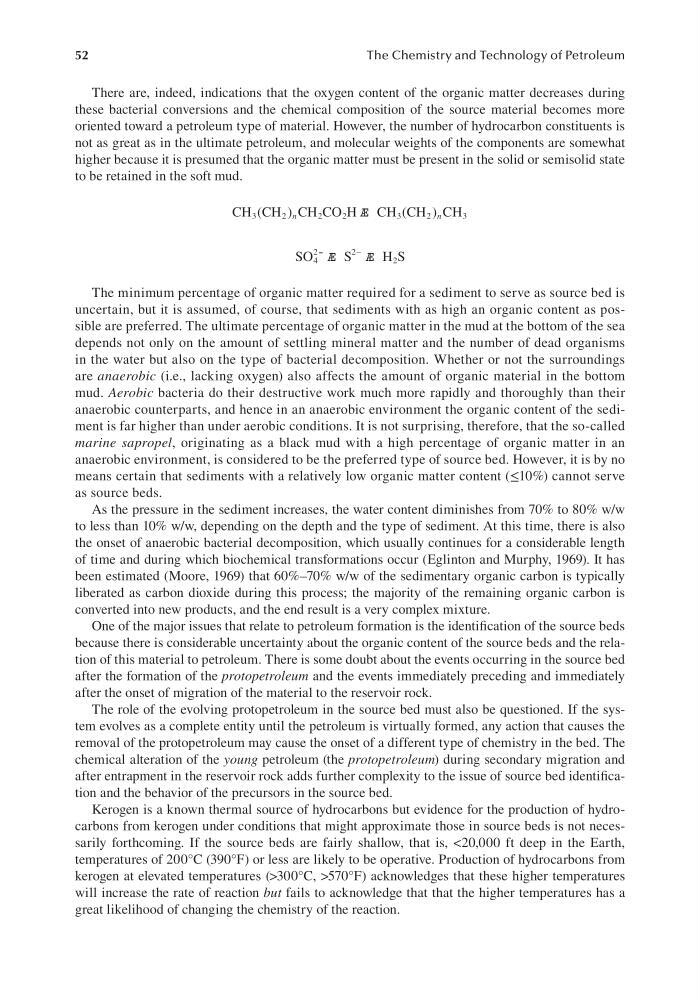
to be retained in the soft mud.
CH CH CH CO H CH CH CH
3
2
2
2
3
2
3
(
)
(
)
n
n
Æ
SO
S
H S
4
2
2
2
-
Æ
Æ
–
The minimum percentage of organic matter required for a sediment to serve as source bed is
uncertain, but it is assumed, of course, that sediments with as high an organic content as possible are preferred. The ultimate percentage of organic matter in the mud at the bottom of the sea
depends not only on the amount of settling mineral matter and the number of dead organisms
in the water but also on the type of bacterial decomposition. Whether or not the surroundings
are anaerobic (i.e., lacking oxygen) also affects the amount of organic material in the bottom
mud. Aerobic bacteria do their destructive work much more rapidly and thoroughly than their
anaerobic counterparts, and hence in an anaerobic environment the organic content of the sediment is far higher than under aerobic conditions. It is not surprising, therefore, that the so-called
marine sapropel, originating as a black mud with a high percentage of organic matter in an
anaerobic environment, is considered to be the preferred type of source bed. However, it is by no
means certain that sediments with a relatively low organic matter content (≤10%) cannot serve
as source beds.
As the pressure in the sediment increases, the water content diminishes from 70% to 80% w/w
to less than 10% w/w, depending on the depth and the type of sediment. At this time, there is also
the onset of anaerobic bacterial decomposition, which usually continues for a considerable length
of time and during which biochemical transformations occur (Eglinton and Murphy, 1969). It has
been estimated (Moore, 1969) that 60%–70% w/w of the sedimentary organic carbon is typically
liberated as carbon dioxide during this process; the majority of the remaining organic carbon is
converted into new products, and the end result is a very complex mixture.
One of the major issues that relate to petroleum formation is the identification of the source beds
because there is considerable uncertainty about the organic content of the source beds and the relation of this material to petroleum. There is some doubt about the events occurring in the source bed
after the formation of the protopetroleum and the events immediately preceding and immediately
after the onset of migration of the material to the reservoir rock.
The role of the evolving protopetroleum in the source bed must also be questioned. If the system evolves as a complete entity until the petroleum is virtually formed, any action that causes the
removal of the protopetroleum may cause the onset of a different type of chemistry in the bed. The
chemical alteration of the young petroleum (the protopetroleum) during secondary migration and
after entrapment in the reservoir rock adds further complexity to the issue of source bed identification and the behavior of the precursors in the source bed.
Kerogen is a known thermal source of hydrocarbons but evidence for the production of hydrocarbons from kerogen under conditions that might approximate those in source beds is not necessarily forthcoming. If the source beds are fairly shallow, that is, <20,000 ft deep in the Earth,
temperatures of 200°C (390°F) or less are likely to be operative. Production of hydrocarbons from
kerogen at elevated temperatures (>300°C, >570°F) acknowledges that these higher temperatures
will increase the rate of reaction but fails to acknowledge that that the higher temperatures has a
great likelihood of changing the chemistry of the reaction.
The Chemistry and Technology of Petroleum
There are, indeed, indications that the oxygen content of the organic matter decreases during
these bacterial conversions and the chemical composition of the source material becomes more
oriented toward a petroleum type of material. However, the number of hydrocarbon constituents is
not as great as in the ultimate petroleum, and molecular weights of the components are somewhat
higher because it is presumed that the organic matter must be present in the solid or semisolid state
to be retained in the soft mud.
CH CH CH CO H CH CH CH
3
2
2
2
3
2
3
(
)
(
)
n
n
Æ
SO
S
H S
4
2
2
2
-
Æ
Æ
–
The minimum percentage of organic matter required for a sediment to serve as source bed is
uncertain, but it is assumed, of course, that sediments with as high an organic content as possible are preferred. The ultimate percentage of organic matter in the mud at the bottom of the sea
depends not only on the amount of settling mineral matter and the number of dead organisms
in the water but also on the type of bacterial decomposition. Whether or not the surroundings
are anaerobic (i.e., lacking oxygen) also affects the amount of organic material in the bottom
mud. Aerobic bacteria do their destructive work much more rapidly and thoroughly than their
anaerobic counterparts, and hence in an anaerobic environment the organic content of the sediment is far higher than under aerobic conditions. It is not surprising, therefore, that the so-called
marine sapropel, originating as a black mud with a high percentage of organic matter in an
anaerobic environment, is considered to be the preferred type of source bed. However, it is by no
means certain that sediments with a relatively low organic matter content (≤10%) cannot serve
as source beds.
As the pressure in the sediment increases, the water content diminishes from 70% to 80% w/w
to less than 10% w/w, depending on the depth and the type of sediment. At this time, there is also
the onset of anaerobic bacterial decomposition, which usually continues for a considerable length
of time and during which biochemical transformations occur (Eglinton and Murphy, 1969). It has
been estimated (Moore, 1969) that 60%–70% w/w of the sedimentary organic carbon is typically
liberated as carbon dioxide during this process; the majority of the remaining organic carbon is
converted into new products, and the end result is a very complex mixture.
One of the major issues that relate to petroleum formation is the identification of the source beds
because there is considerable uncertainty about the organic content of the source beds and the relation of this material to petroleum. There is some doubt about the events occurring in the source bed
after the formation of the protopetroleum and the events immediately preceding and immediately
after the onset of migration of the material to the reservoir rock.
The role of the evolving protopetroleum in the source bed must also be questioned. If the system evolves as a complete entity until the petroleum is virtually formed, any action that causes the
removal of the protopetroleum may cause the onset of a different type of chemistry in the bed. The
chemical alteration of the young petroleum (the protopetroleum) during secondary migration and
after entrapment in the reservoir rock adds further complexity to the issue of source bed identification and the behavior of the precursors in the source bed.
Kerogen is a known thermal source of hydrocarbons but evidence for the production of hydrocarbons from kerogen under conditions that might approximate those in source beds is not necessarily forthcoming. If the source beds are fairly shallow, that is, <20,000 ft deep in the Earth,
temperatures of 200°C (390°F) or less are likely to be operative. Production of hydrocarbons from
kerogen at elevated temperatures (>300°C, >570°F) acknowledges that these higher temperatures
will increase the rate of reaction but fails to acknowledge that that the higher temperatures has a
great likelihood of changing the chemistry of the reaction.