

663
Product Improvement and Treating
gas produced by the process, which is cycled through the catalyst cases, must be scrubbed free of
its hydrogen sulfide content.
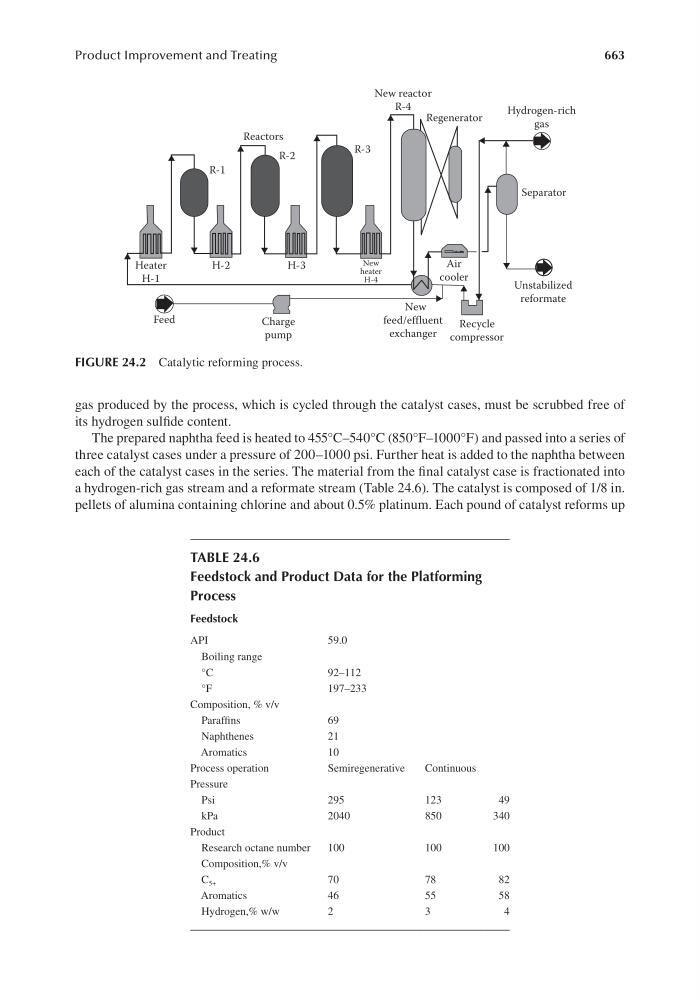
The prepared naphtha feed is heated to 455°C–540°C (850°F–1000°F) and passed into a series of
three catalyst cases under a pressure of 200–1000 psi. Further heat is added to the naphtha between
each of the catalyst cases in the series. The material from the final catalyst case is fractionated into
a hydrogen-rich gas stream and a reformate stream (Table 24.6). The catalyst is composed of 1/8 in.
pellets of alumina containing chlorine and about 0.5% platinum. Each pound of catalyst reforms up
New reactor
R-4
Regenerator
Hydrogen-rich
gas
Separator
Unstabilized
reformate
New
feed/effluent
exchanger
New
heater
H-4
Air
cooler
R-1
H-3
H-2
R-2
R-3
Heater
H-1
Charge
pump
Feed
Reactors
Recycle
compressor
FIGURE 24.2 Catalytic reforming process.
TABLE 24.6
Feedstock and Product Data for the Platforming
Process
Feedstock
API
59.0
Boiling range
°C
92–112
°F
197–233
Composition, % v/v
Paraffins
69
Naphthenes
21
Aromatics
10
Process operation
Semiregenerative
Continuous
Pressure
Psi
295
123
49
kPa
2040
850
340
Product
Research octane number
100
100
100
Composition,% v/v
C 5+
70
78
82
Aromatics
46
55
58
Hydrogen,% w/w
2
3
4