

662
The Chemistry and Technology of Petroleum
24.2.2.1.1 Hydroforming
The Hydroforming process made use of molybdena–alumina (MoO 2 –Al 2 O 3 ) catalyst pellets arranged
in fixed beds; hence the process is known as fixed-bed hydroforming. The hydroformer had four reaction vessels or catalyst cases, two of which were regenerated; the other two were on the process cycle.
Naphtha feed is preheated at 400°C–540°C (900°F–1000°F) and passed in series through the two
catalyst cases under a pressure of 150–300 psi. Gas containing 70% hydrogen produced by the process was passed through the catalyst cases with the naphtha. The material leaving the final catalyst
case entered a four-tower system where fractional distillation separated hydrogen-rich gas, a product
(reformate) suitable for motor gasoline and an aromatic polymer boiling above 205°C (400°F).
After 4–16 h on process cycle, the catalyst was regenerated. This was done by burning carbon
deposits from the catalyst at a temperature of 565°C (1050°F) by blowing air diluted with flue gas
through the catalyst. The air also reoxidized the reduced catalyst (9% molybdenum oxide on activated alumina pellets) and removed sulfur from the catalyst.
24.2.2.1.2 Iso-Plus Houdriforming
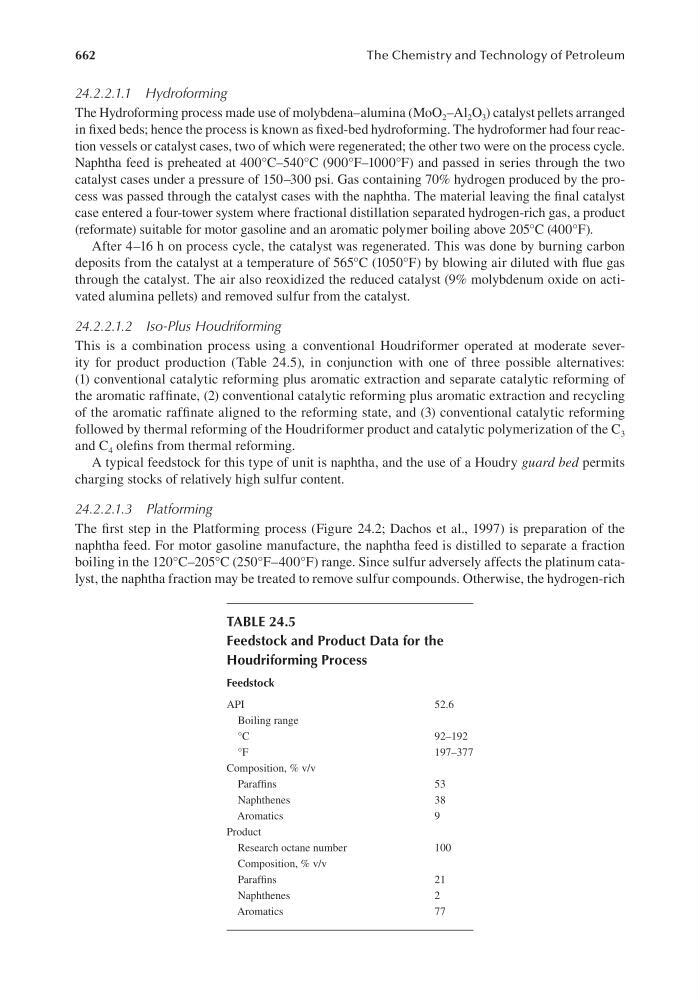
This is a combination process using a conventional Houdriformer operated at moderate severity for product production (Table 24.5), in conjunction with one of three possible alternatives:
(1) conventional catalytic reforming plus aromatic extraction and separate catalytic reforming of
the aromatic raffinate, (2) conventional catalytic reforming plus aromatic extraction and recycling
of the aromatic raffinate aligned to the reforming state, and (3) conventional catalytic reforming
followed by thermal reforming of the Houdriformer product and catalytic polymerization of the C 3
and C 4 olefins from thermal reforming.
A typical feedstock for this type of unit is naphtha, and the use of a Houdry guard bed permits
charging stocks of relatively high sulfur content.
24.2.2.1.3 Platforming
The first step in the Platforming process (Figure 24.2; Dachos et al., 1997) is preparation of the
naphtha feed. For motor gasoline manufacture, the naphtha feed is distilled to separate a fraction
boiling in the 120°C–205°C (250°F–400°F) range. Since sulfur adversely affects the platinum catalyst, the naphtha fraction may be treated to remove sulfur compounds. Otherwise, the hydrogen-rich
TABLE 24.5
Feedstock and Product Data for the
Houdriforming Process
Feedstock
API
52.6
Boiling range
°C
92–192
°F
197–377
Composition, % v/v
Paraffins
53
Naphthenes
38
Aromatics
9
Product
Research octane number
100
Composition, % v/v
Paraffins
21
Naphthenes
2
Aromatics
77