

660
The Chemistry and Technology of Petroleum
between the subsequent reforming reactors. As a result of the very high temperatures, the catalyst
becomes deactivated by the formation of coke (i.e., essentially pure carbon) on the catalyst which
reduces the surface area available to contact with the hydrocarbons.
Catalytic reforming is usually carried out by feeding a naphtha (after pretreating with hydrogen
if necessary) and hydrogen mixture to a furnace where the mixture is heated to the desired temperatures 450°C–520°C (840°F–965°F), and then passed through fixed-bed catalytic reactors at
hydrogen pressures of 100–1000 psi. Normally two (or more than one) reactors are used in series,
and reheaters are located between adjoining reactors to compensate for the endothermic reactions
taking place. Sometimes as many as four or five are kept on-stream in series while one or more is
being regenerated. The on-stream cycle of any one reactor may vary from several hours to many
days, depending on the feedstock and reaction conditions.
The product issuing from the last catalytic reactor is cooled and sent to a high-pressure
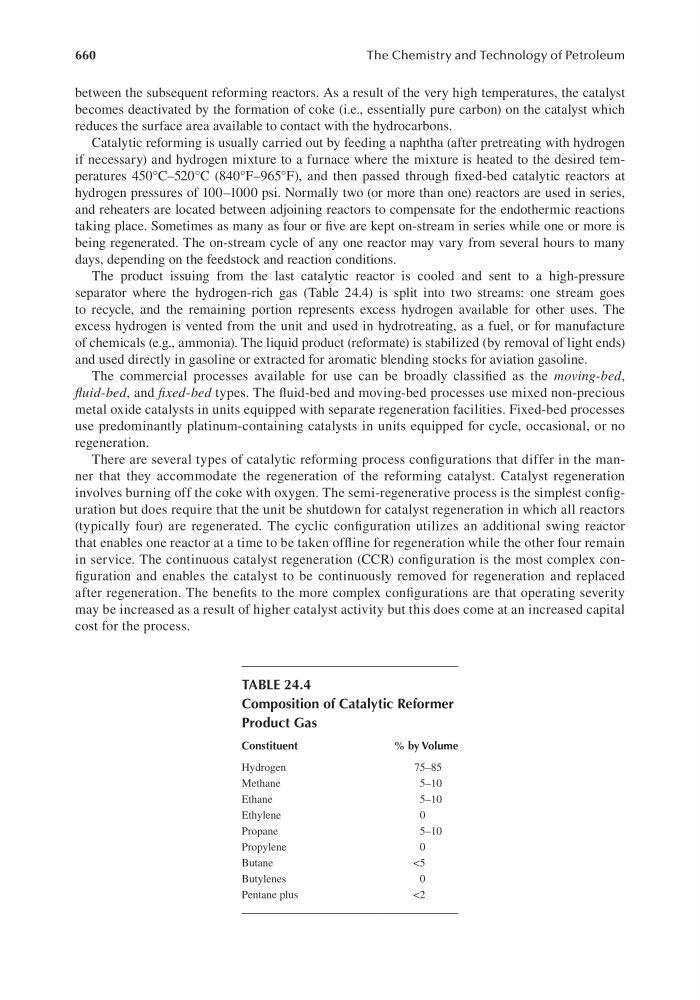
separator where the hydrogen-rich gas (Table 24.4) is split into two streams: one stream goes
to recycle, and the remaining portion represents excess hydrogen available for other uses. The
excess hydrogen is vented from the unit and used in hydrotreating, as a fuel, or for manufacture
of chemicals (e.g., ammonia). The liquid product (reformate) is stabilized (by removal of light ends)
and used directly in gasoline or extracted for aromatic blending stocks for aviation gasoline.
The commercial processes available for use can be broadly classified as the moving-bed,
fluid-bed, and fixed-bed types. The fluid-bed and moving-bed processes use mixed non-precious
metal oxide catalysts in units equipped with separate regeneration facilities. Fixed-bed processes
use predominantly platinum-containing catalysts in units equipped for cycle, occasional, or no
regeneration.
There are several types of catalytic reforming process configurations that differ in the manner that they accommodate the regeneration of the reforming catalyst. Catalyst regeneration
involves burning off the coke with oxygen. The semi-regenerative process is the simplest configuration but does require that the unit be shutdown for catalyst regeneration in which all reactors
(typically four) are regenerated. The cyclic configuration utilizes an additional swing reactor
that enables one reactor at a time to be taken offline for regeneration while the other four remain
in service. The continuous catalyst regeneration (CCR) configuration is the most complex configuration and enables the catalyst to be continuously removed for regeneration and replaced
after regeneration. The benefits to the more complex configurations are that operating severity
may be increased as a result of higher catalyst activity but this does come at an increased capital
cost for the process.
TABLE 24.4
Composition of Catalytic Reformer
Product Gas
Constituent
% by Volume
Hydrogen
75–85
Methane
5–10
Ethane
5–10
Ethylene
0
Propane
5–10
Propylene
0
Butane
<5
Butylenes
0
Pentane plus
<2