

659
Product Improvement and Treating
These processes are essentially the same but differ in the manner in which the gases and naphtha
are passed through the heating furnace. In gas reversion, the naphtha and gases flow through separate lines in the furnace and are heated independently of one another. Before leaving the furnace,
both lines join to form a common soaking section where the reforming, polymerization, and other
reactions take place. In naphtha reforming, the C 3 and C 4 gases are premixed with the naphtha and
pass together through the furnace. Except for the gaseous components in the feedstock, both processes operate in much the same manner as thermal reforming and produce similar products.
24.2.2 CAtAlytIC reFormIng
Like thermal reforming, catalytic reforming converts low-octane gasoline into high-octane gasoline
(reformate) (Kelly et al., 1997). Although thermal reforming can produce reformate with an RON
in the range 65–80 depending on the yield, catalytic reforming produces reformate with octane
numbers of the order of 90–95. Catalytic reforming is conducted in the presence of hydrogen over
hydrogenation-dehydrogenation catalysts, which may be supported on alumina or silica-alumina.
Depending on the catalyst, a definite sequence of reactions takes place, involving structural
changes in the charge stock. The catalytic reforming process was commercially nonexistent in the
United States before 1940. The process is really a process of the 1950s and showed phenomenal
growth in 1953–1959 time period (Bland and Davidson, 1967; Riediger, 1971). As a result, thermal
reforming is now somewhat obsolete (Schwarzenbek, 1971).
Catalytic reformer feeds are saturated (i.e., not olefinic) materials; in the majority of cases the
feed may be a straight-run naphtha, but other by-product low-octane naphtha (e.g., coker naphtha)
can be processed after treatment to remove olefins and other contaminants. Hydrocarbon naphtha
that contains substantial quantities of naphthenes is also a suitable feed. The process uses a precious
metal catalyst (platinum supported by an alumina base) in conjunction with very high temperatures
to reform the paraffin and naphthene constituents into high-octane components. Sulfur is a poison to
the reforming catalyst, which requires that virtually all the sulfur must be removed from the heavy
naphtha through hydrotreating prior to reforming. Several different types of chemical reactions
occur in the reforming reactors: paraffins are isomerized to branched chains and to a lesser extent to
naphthenes, and naphthenes are converted to aromatics. Overall, the reforming reactions are endothermic. The resulting product stream (reformate) from catalytic reforming has a RON from 96 to
102 depending on the reactor severity and feedstock quality. The dehydrogenation reactions which
convert the saturated naphthenes into unsaturated aromatics produce hydrogen, which is available
for distribution to other refinery hydroprocesses.
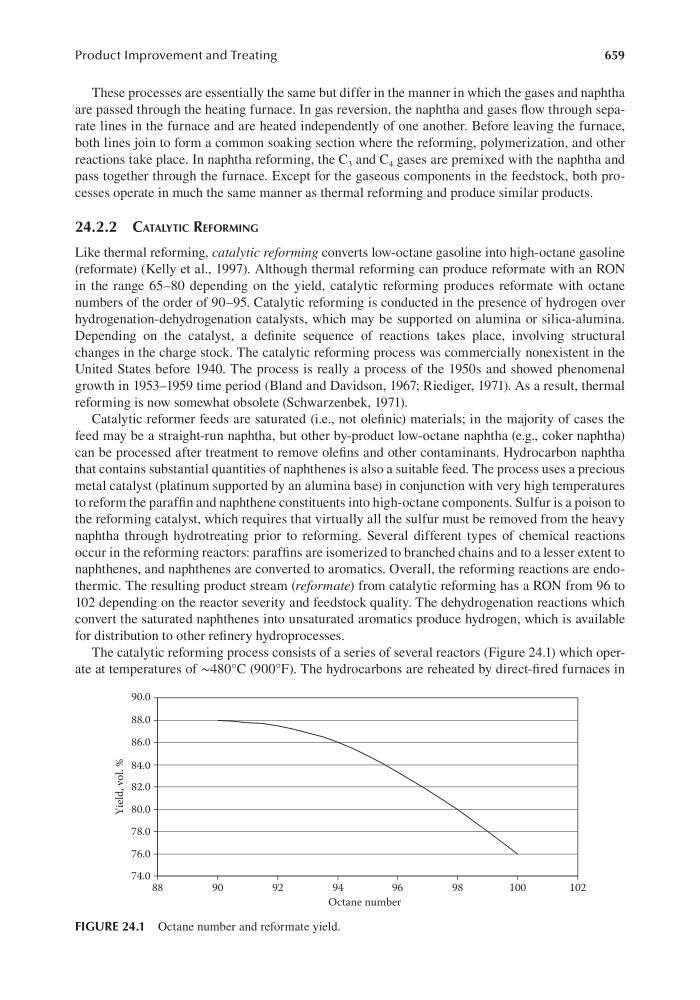
The catalytic reforming process consists of a series of several reactors (Figure 24.1) which operate at temperatures of ∼480°C (900°F). The hydrocarbons are reheated by direct-fired furnaces in
74.0
76.0
78.0
80.0
82.0
84.0
86.0
88.0
90.0
88
90
92
94
96
98
100
1 02
Yield, vol. %
Octane number
FIGURE 24.1 Octane number and reformate yield.