

635
Hydrogen Production
owing to the unacceptable odor, color, and gum-forming tendencies of this material. The quality of
pygas, which is high in di-olefin content, can be satisfactorily improved by hydrotreating, whereby conversion of di-olefins into mono-olefins provides an acceptable product for motor gas blending.
23.2.2 HydroCrACkIng
Hydrocracking is a two-stage process combining catalytic cracking and hydrogenation, wherein
heavier feedstocks are cracked in the presence of hydrogen to produce more desirable products.
Hydrocracking also produces relatively large amounts of iso-butane for alkylation feedstock and the
process also performs isomerization for pour-point control and smoke-point control, both of which
are important in high-quality jet fuel.
Hydrocracking employs high pressure, high temperature, and a catalyst. Hydrocracking is used
for feedstocks that are difficult to process by either catalytic cracking or reforming, since these
feedstocks are characterized usually by high polycyclic aromatic content and/or high concentrations
of the two principal catalyst poisons, sulfur, and nitrogen compounds. The hydrocracking process
largely depends on the nature of the feedstock and the relative rates of the two competing reactions,
hydrogenation and cracking. Heavy aromatic feedstock is converted into lighter products under a
wide range of very high pressures (1000–2000 psi) and fairly high temperatures (400°C–815°C;
750°F–1500°F), in the presence of hydrogen and special catalysts. When the feedstock has a high
paraffinic content, the primary function of hydrogen is to prevent the formation of polycyclic aromatic compounds. Another important role of hydrogen in the hydrocracking process is to reduce tar
formation and prevent buildup of coke on the catalyst. Hydrogenation also serves to convert sulfur
and nitrogen compounds present in the feedstock to hydrogen sulfide and ammonia.
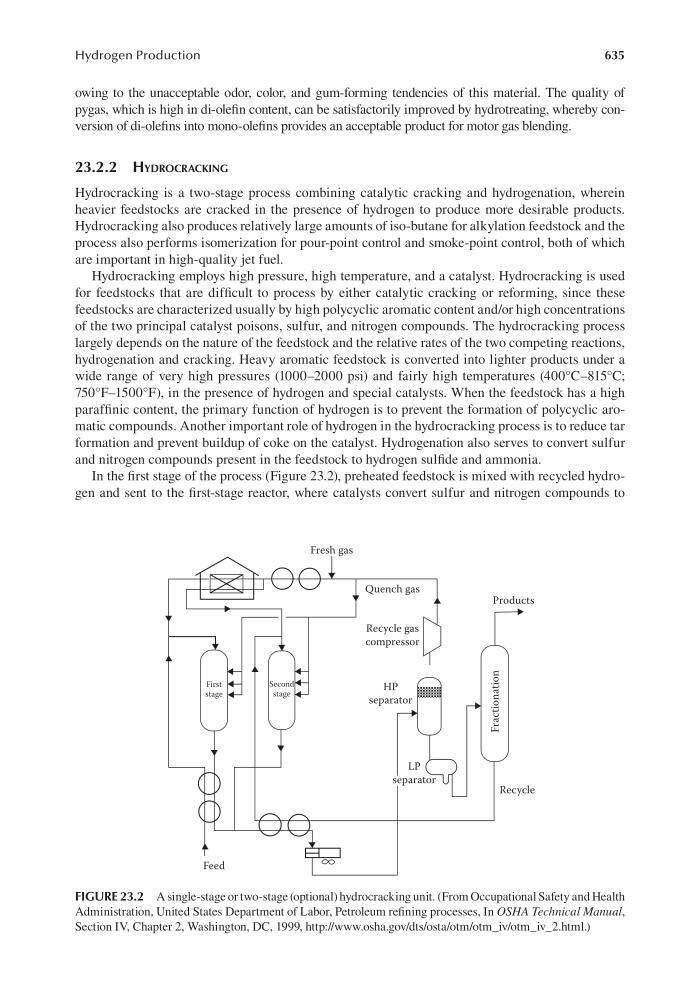
In the first stage of the process (Figure 23.2), preheated feedstock is mixed with recycled hydrogen and sent to the first-stage reactor, where catalysts convert sulfur and nitrogen compounds to
Fresh gas
First
stage
Second
stage
Products
Recycle
Fractionation
Quench gas
Recycle gas
compressor
HP
separator
LP
separator
Feed
FIGURE 23.2 A single-stage or two-stage (optional) hydrocracking unit. (From Occupational Safety and Health
Administration, United States Department of Labor, Petroleum refining processes, In OSHA Technical Manual,
Section IV, Chapter 2, Washington, DC, 1999, http://www.osha.gov/dts/osta/otm/otm_iv/otm_iv_2.html.)