

634
The Chemistry and Technology of Petroleum
23.2 PROCESSES REQUIRING HYDROGEN
23.2.1 HydrotreAtIng
Catalytic hydrotreating is a hydrogenation process used to remove about 90% of contaminants such
as nitrogen, sulfur, oxygen, and metals from liquid petroleum fractions (Chapter 21). These contaminants, if not removed from the petroleum fractions as they travel through the refinery processing
units, can have detrimental effects on the equipment, the catalysts, and the quality of the finished
product. Typically, hydrotreating is done prior to processes such as catalytic reforming so that the
catalyst is not contaminated by untreated feedstock. Hydrotreating is also used prior to catalytic
cracking to reduce sulfur and improve product yields, and to upgrade middle-distillate petroleum
fractions into finished kerosene, diesel fuel, and heating fuel oils. In addition, hydrotreating converts olefins and aromatics to saturated compounds.
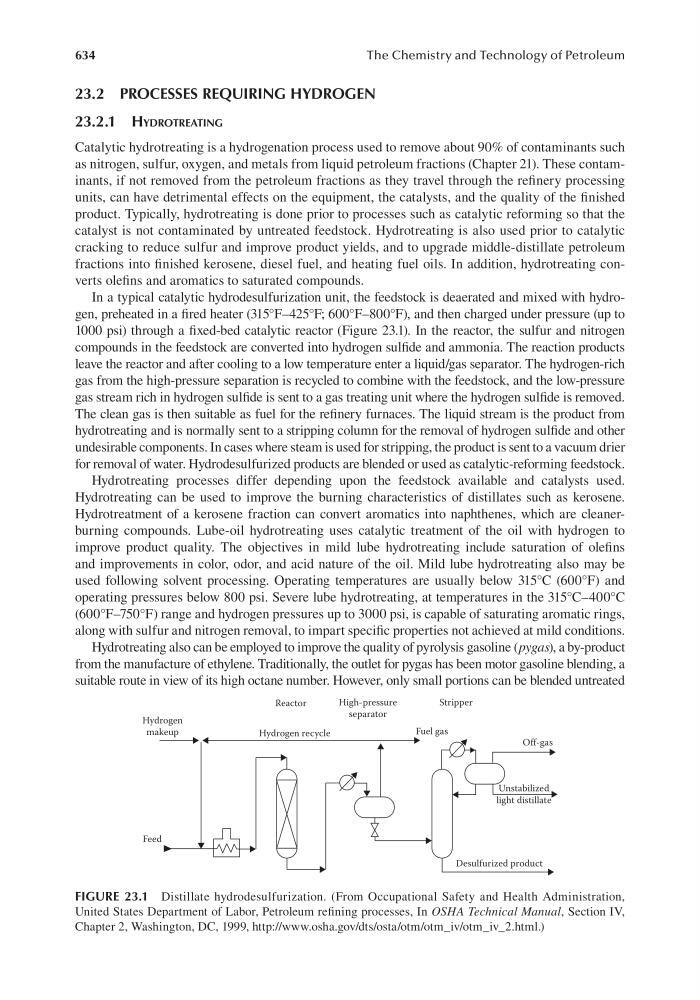
In a typical catalytic hydrodesulfurization unit, the feedstock is deaerated and mixed with hydrogen, preheated in a fired heater (315°F–425°F; 600°F–800°F), and then charged under pressure (up to
1000 psi) through a fixed-bed catalytic reactor (Figure 23.1). In the reactor, the sulfur and nitrogen
compounds in the feedstock are converted into hydrogen sulfide and ammonia. The reaction products
leave the reactor and after cooling to a low temperature enter a liquid/gas separator. The hydrogen-rich
gas from the high-pressure separation is recycled to combine with the feedstock, and the low-pressure
gas stream rich in hydrogen sulfide is sent to a gas treating unit where the hydrogen sulfide is removed.
The clean gas is then suitable as fuel for the refinery furnaces. The liquid stream is the product from
hydrotreating and is normally sent to a stripping column for the removal of hydrogen sulfide and other
undesirable components. In cases where steam is used for stripping, the product is sent to a vacuum drier
for removal of water. Hydrodesulfurized products are blended or used as catalytic-reforming feedstock.
Hydrotreating processes differ depending upon the feedstock available and catalysts used.
Hydrotreating can be used to improve the burning characteristics of distillates such as kerosene.
Hydrotreatment of a kerosene fraction can convert aromatics into naphthenes, which are cleanerburning compounds. Lube-oil hydrotreating uses catalytic treatment of the oil with hydrogen to
improve product quality. The objectives in mild lube hydrotreating include saturation of olefins
and improvements in color, odor, and acid nature of the oil. Mild lube hydrotreating also may be
used following solvent processing. Operating temperatures are usually below 315°C (600°F) and
operating pressures below 800 psi. Severe lube hydrotreating, at temperatures in the 315°C–400°C
(600°F–750°F) range and hydrogen pressures up to 3000 psi, is capable of saturating aromatic rings,
along with sulfur and nitrogen removal, to impart specific properties not achieved at mild conditions.
Hydrotreating also can be employed to improve the quality of pyrolysis gasoline (pygas), a by-product
from the manufacture of ethylene. Traditionally, the outlet for pygas has been motor gasoline blending, a
suitable route in view of its high octane number. However, only small portions can be blended untreated
Hydrogen recycle
Hydrogen
makeup
Feed
Reactor
Fuel gas
Stripper
Unstabilized
light distillate
Off-gas
Desulfurized product
High-pressure
separator
FIGURE 23.1 Distillate hydrodesulfurization. (From Occupational Safety and Health Administration,
United States Department of Labor, Petroleum refining processes, In OSHA Technical Manual, Section IV,
Chapter 2, Washington, DC, 1999, http://www.osha.gov/dts/osta/otm/otm_iv/otm_iv_2.html.)