

603
Hydrocracking
In case of the ABC–hydrodesulfurization catalyst combination, the ABC catalyst is placed
upstream of the hydrodesulfurization catalyst and can be operated at a higher temperature than the
hydrodesulfurization catalyst under conventional residuum hydrodesulfurization conditions. In the
VisABC process, a soaking drum is provided after heater, when necessary. Hydrovisbroken oil is
first stabilized by the ABC catalyst through hydrogenation of coke precursors and then desulfurized
by the HDS catalyst.
22.3.2 CAnmet ProCess
The CANMET process was designed and developed as a hydrocracking process for heavy oil, atmospheric resid, vacuum resid, and tar sand bitumen (Pruden, 1978; Pruden et al., 1993). The process is
a high conversion, high demetallization, residuum hydrocracking process which, using an additive
to inhibit coke formation, achieves conversion of high-boiling point hydrocarbons into lighter products. Initially developed to upgrade heavy oil and tar sand bitumen as well as residua. The process
does not use a catalyst but employs a low-cost additive to inhibit coke formation and allow high
conversion of heavy feedstocks (such as heavy oil and bitumen) into lower boiling products using
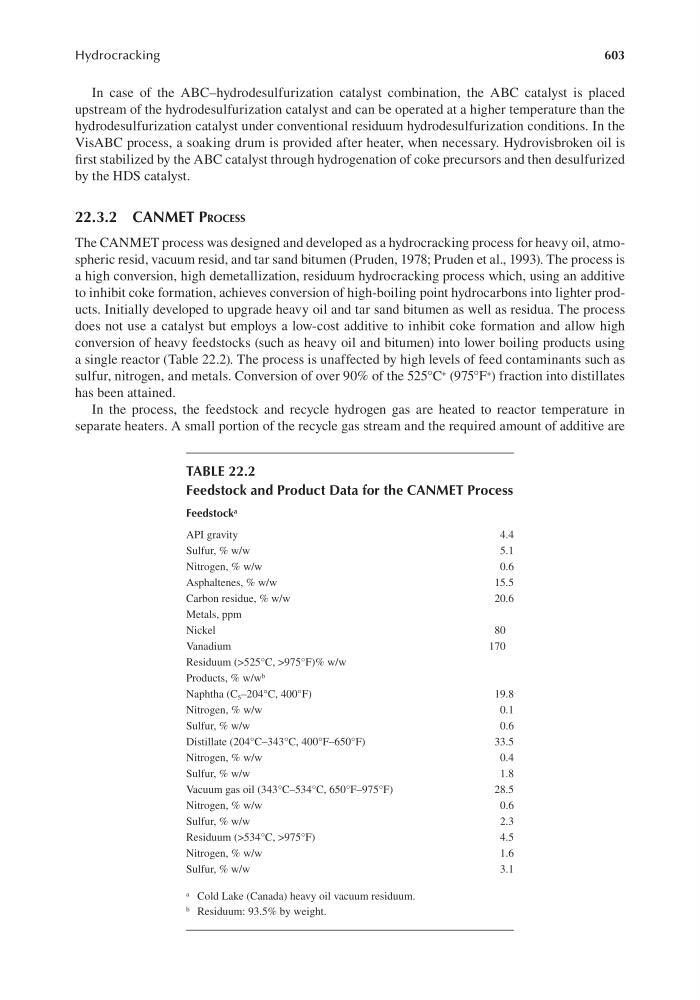
a single reactor (Table 22.2). The process is unaffected by high levels of feed contaminants such as
sulfur, nitrogen, and metals. Conversion of over 90% of the 525°C + (975°F + ) fraction into distillates
has been attained.
In the process, the feedstock and recycle hydrogen gas are heated to reactor temperature in
separate heaters. A small portion of the recycle gas stream and the required amount of additive are
TABLE 22.2
Feedstock and Product Data for the CANMET Process
Feedstock a
API gravity
4.4
Sulfur, % w/w
5.1
Nitrogen, % w/w
0.6
Asphaltenes, % w/w
15.5
Carbon residue, % w/w
20.6
Metals, ppm
Nickel
80
Vanadium
170
Residuum (>525°C, >975°F)% w/w
Products, % w/w b
Naphtha (C 5 –204°C, 400°F)
19.8
Nitrogen, % w/w
0.1
Sulfur, % w/w
0.6
Distillate (204°C–343°C, 400°F–650°F)
33.5
Nitrogen, % w/w
0.4
Sulfur, % w/w
1.8
Vacuum gas oil (343°C–534°C, 650°F–975°F)
28.5
Nitrogen, % w/w
0.6
Sulfur, % w/w
2.3
Residuum (>534°C, >975°F)
4.5
Nitrogen, % w/w
1.6
Sulfur, % w/w
3.1
a Cold Lake (Canada) heavy oil vacuum residuum.
b Residuum: 93.5% by weight.