

602
The Chemistry and Technology of Petroleum
22.3.1 AsPHAltenIC Bottom CrACkIng ProCess
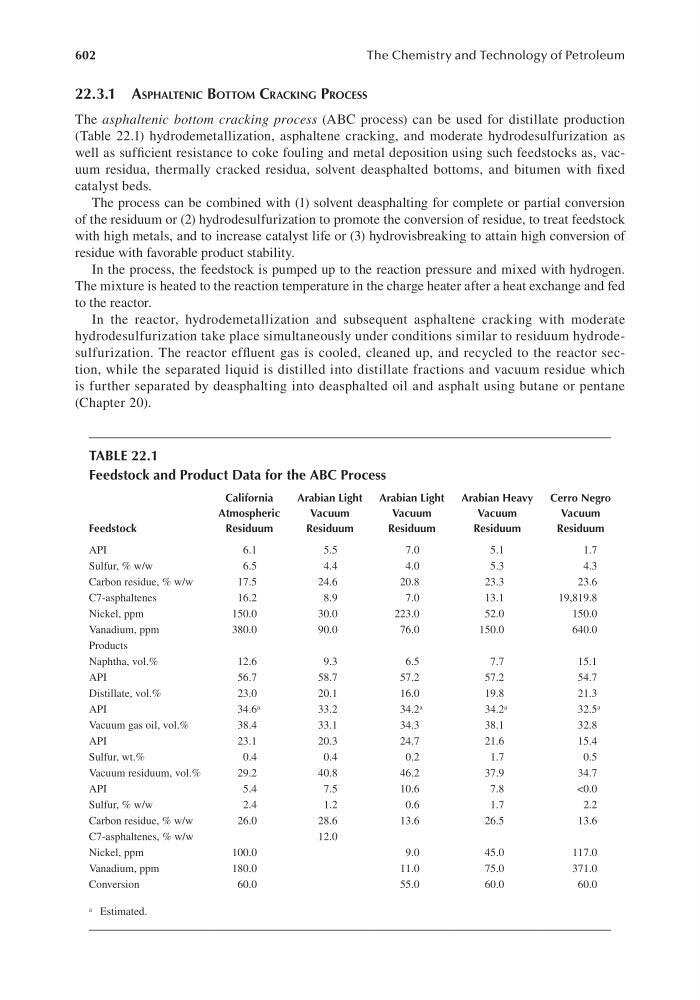
The asphaltenic bottom cracking process (ABC process) can be used for distillate production
(Table 22.1) hydrodemetallization, asphaltene cracking, and moderate hydrodesulfurization as
well as sufficient resistance to coke fouling and metal deposition using such feedstocks as, vacuum residua, thermally cracked residua, solvent deasphalted bottoms, and bitumen with fixed
catalyst beds.
The process can be combined with (1) solvent deasphalting for complete or partial conversion
of the residuum or (2) hydrodesulfurization to promote the conversion of residue, to treat feedstock
with high metals, and to increase catalyst life or (3) hydrovisbreaking to attain high conversion of
residue with favorable product stability.
In the process, the feedstock is pumped up to the reaction pressure and mixed with hydrogen.
The mixture is heated to the reaction temperature in the charge heater after a heat exchange and fed
to the reactor.
In the reactor, hydrodemetallization and subsequent asphaltene cracking with moderate
hydrodesulfurization take place simultaneously under conditions similar to residuum hydrodesulfurization. The reactor effluent gas is cooled, cleaned up, and recycled to the reactor section, while the separated liquid is distilled into distillate fractions and vacuum residue which
is further separated by deasphalting into deasphalted oil and asphalt using butane or pentane
(Chapter 20).
TABLE 22.1
Feedstock and Product Data for the ABC Process
Feedstock
California
Atmospheric
Residuum
Arabian Light
Vacuum
Residuum
Arabian Light
Vacuum
Residuum
Arabian Heavy
Vacuum
Residuum
Cerro Negro
Vacuum
Residuum
API
6.1
5.5
7.0
5.1
1.7
Sulfur, % w/w
6.5
4.4
4.0
5.3
4.3
Carbon residue, % w/w
17.5
24.6
20.8
23.3
23.6
C7-asphaltenes
16.2
8.9
7.0
13.1
19,819.8
Nickel, ppm
150.0
30.0
223.0
52.0
150.0
Vanadium, ppm
380.0
90.0
76.0
150.0
640.0
Products
Naphtha, vol.%
12.6
9.3
6.5
7.7
15.1
API
56.7
58.7
57.2
57.2
54.7
Distillate, vol.%
23.0
20.1
16.0
19.8
21.3
API
34.6 a
33.2
34.2 a
34.2 a
32.5 a
Vacuum gas oil, vol.%
38.4
33.1
34.3
38.1
32.8
API
23.1
20.3
24.7
21.6
15.4
Sulfur, wt.%
0.4
0.4
0.2
1.7
0.5
Vacuum residuum, vol.%
29.2
40.8
46.2
37.9
34.7
API
5.4
7.5
10.6
7.8
<0.0
Sulfur, % w/w
2.4
1.2
0.6
1.7
2.2
Carbon residue, % w/w
26.0
28.6
13.6
26.5
13.6
C7-asphaltenes, % w/w
12.0
Nickel, ppm
100.0
9.0
45.0
117.0
Vanadium, ppm
180.0
11.0
75.0
371.0
Conversion
60.0
55.0
60.0
60.0
a Estimated.