

592
The Chemistry and Technology of Petroleum
single most significant advance in refining technology during the twentieth century and the ability
of refiners to cope with the renewed trend toward distillate production from heavier feedstocks with
low atomic hydrogen/carbon ratios has created a renewed interest in hydrocracking (Scherzer and
Gruia, 1996; Dolbear, 1998). Without the required conversion units, heavier crude oils produce in
lower yields of naphtha and middle distillate. To maintain current gasoline and middle distillate production levels, additional conversion capacity is required because of the differential in the amount of
distillates produced from light crude oil and the distillate products produced from heavier crude oil.
The concept of hydrocracking allows the refiner to produce products having a lower molecular
weight with higher hydrogen content and a lower yield of coke. In summary, hydrocracking facilities
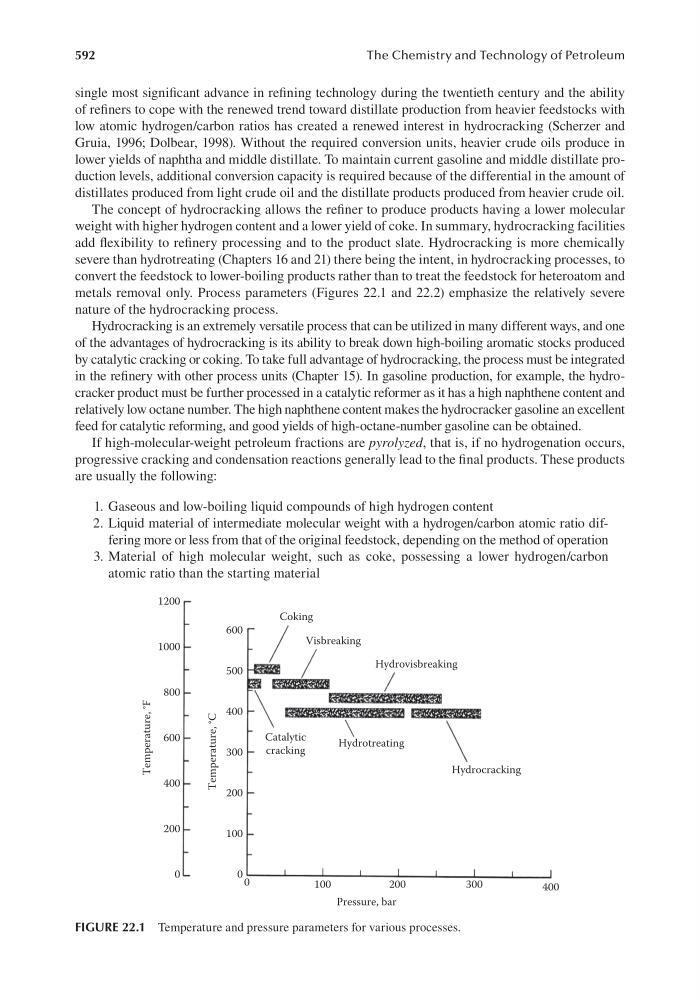
add flexibility to refinery processing and to the product slate. Hydrocracking is more chemically
severe than hydrotreating (Chapters 16 and 21) there being the intent, in hydrocracking processes, to
convert the feedstock to lower-boiling products rather than to treat the feedstock for heteroatom and
metals removal only. Process parameters (Figures 22.1 and 22.2) emphasize the relatively severe
nature of the hydrocracking process.
Hydrocracking is an extremely versatile process that can be utilized in many different ways, and one
of the advantages of hydrocracking is its ability to break down high-boiling aromatic stocks produced
by catalytic cracking or coking. To take full advantage of hydrocracking, the process must be integrated
in the refinery with other process units (Chapter 15). In gasoline production, for example, the hydrocracker product must be further processed in a catalytic reformer as it has a high naphthene content and
relatively low octane number. The high naphthene content makes the hydrocracker gasoline an excellent
feed for catalytic reforming, and good yields of high-octane-number gasoline can be obtained.
If high-molecular-weight petroleum fractions are pyrolyzed, that is, if no hydrogenation occurs,
progressive cracking and condensation reactions generally lead to the final products. These products
are usually the following:
1. Gaseous and low-boiling liquid compounds of high hydrogen content
2. Liquid material of intermediate molecular weight with a hydrogen/carbon atomic ratio differing more or less from that of the original feedstock, depending on the method of operation
3. Material of high molecular weight, such as coke, possessing a lower hydrogen/carbon
atomic ratio than the starting material
200
200
Temperature, °C
Temperature, °F
200
100
100
0
0
0
300
300
Hydrocracking
Hydrotreating
Hydrovisbreaking
Visbreaking
Coking
Catalytic
cracking
400
400
600
800
1000
1200
400
500
600
Pressure, bar
FIGURE 22.1 Temperature and pressure parameters for various processes.