

583
Hydrotreating and Desulfurization
awareness of refiners to the presence of nitrogen compounds in crude feedstocks. For the most part,
however, hydrodesulfurization catalyst technology has been used to accomplish hydrodenitrogenation although such catalysts are not ideally suited to nitrogen removal. However, in recent years,
the limitations of hydrodesulfurization catalysts when applied to hydrodenitrogenation have been
recognized, and there are reports of attempts to manufacture catalysts more specific to nitrogen
removal (Ho, 1988).
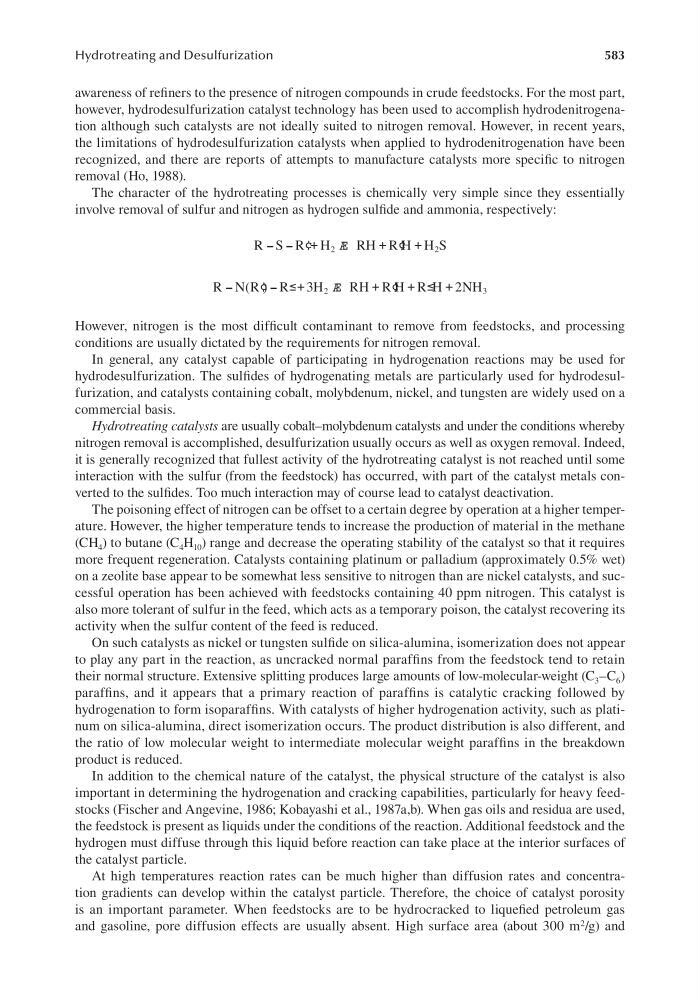
The character of the hydrotreating processes is chemically very simple since they essentially
involve removal of sulfur and nitrogen as hydrogen sulfide and ammonia, respectively:
R S R H
RH R H H S
- - ¢+
Æ
+ ¢ +
2
2
R N R R
H
RH R H R H NH
-
¢- ≤+
Æ
+ ¢ + ≤ +
( )
3
2
2
3
However, nitrogen is the most difficult contaminant to remove from feedstocks, and processing
conditions are usually dictated by the requirements for nitrogen removal.
In general, any catalyst capable of participating in hydrogenation reactions may be used for
hydrodesulfurization. The sulfides of hydrogenating metals are particularly used for hydrodesulfurization, and catalysts containing cobalt, molybdenum, nickel, and tungsten are widely used on a
commercial basis.
Hydrotreating catalysts are usually cobalt–molybdenum catalysts and under the conditions whereby
nitrogen removal is accomplished, desulfurization usually occurs as well as oxygen removal. Indeed,
it is generally recognized that fullest activity of the hydrotreating catalyst is not reached until some
interaction with the sulfur (from the feedstock) has occurred, with part of the catalyst metals converted to the sulfides. Too much interaction may of course lead to catalyst deactivation.
The poisoning effect of nitrogen can be offset to a certain degree by operation at a higher temperature. However, the higher temperature tends to increase the production of material in the methane
(CH 4 ) to butane (C 4 H 10 ) range and decrease the operating stability of the catalyst so that it requires
more frequent regeneration. Catalysts containing platinum or palladium (approximately 0.5% wet)
on a zeolite base appear to be somewhat less sensitive to nitrogen than are nickel catalysts, and successful operation has been achieved with feedstocks containing 40 ppm nitrogen. This catalyst is
also more tolerant of sulfur in the feed, which acts as a temporary poison, the catalyst recovering its
activity when the sulfur content of the feed is reduced.
On such catalysts as nickel or tungsten sulfide on silica-alumina, isomerization does not appear
to play any part in the reaction, as uncracked normal paraffins from the feedstock tend to retain
their normal structure. Extensive splitting produces large amounts of low-molecular-weight (C 3 –C 6 )
paraffins, and it appears that a primary reaction of paraffins is catalytic cracking followed by
hydrogenation to form isoparaffins. With catalysts of higher hydrogenation activity, such as platinum on silica-alumina, direct isomerization occurs. The product distribution is also different, and
the ratio of low molecular weight to intermediate molecular weight paraffins in the breakdown
product is reduced.
In addition to the chemical nature of the catalyst, the physical structure of the catalyst is also
important in determining the hydrogenation and cracking capabilities, particularly for heavy feedstocks (Fischer and Angevine, 1986; Kobayashi et al., 1987a,b). When gas oils and residua are used,
the feedstock is present as liquids under the conditions of the reaction. Additional feedstock and the
hydrogen must diffuse through this liquid before reaction can take place at the interior surfaces of
the catalyst particle.
At high temperatures reaction rates can be much higher than diffusion rates and concentration gradients can develop within the catalyst particle. Therefore, the choice of catalyst porosity
is an important parameter. When feedstocks are to be hydrocracked to liquefied petroleum gas
and gasoline, pore diffusion effects are usually absent. High surface area (about 300 m 2 /g) and