

582
The Chemistry and Technology of Petroleum
and ammonia in the catalytic reactor and these gases are scrubbed out of the reactor effluent gas
stream. The metals in the feedstock are deposited on the catalyst in the form of metal sulfides and
cracking of the feedstock to distillate produces a laydown of carbonaceous material on the catalyst;
both events poison the catalyst and activity or selectivity suffers. The deposition of carbonaceous
material is a fast reaction that soon equilibrates to a particular carbon level and is controlled by
hydrogen partial pressure within the reactors. On the other hand, metal deposition is a slow reaction
that is directly proportional to the amount of feedstock passed over the catalyst.
The need to develop catalysts that can carry out deep hydrodesulfurization and deep hydrodenitrogenation has become even more pressing in view of recent environmental regulations limiting
the amount of sulfur and nitrogen emissions. The development of a new generation of catalysts to
achieve this objective of low nitrogen and sulfur levels in the processing of different feedstocks
presents an interesting challenge for catalyst development.
Basic nitrogen-containing compounds in a feed diminish the cracking activity of hydrocracking
catalysts. However, zeolite catalysts can operate in the presence of substantial concentrations of
ammonia, in marked contrast to silica-alumina catalysts, which are strongly poisoned by ammonia.
Similarly, sulfur-containing compounds in a feedstock adversely affect the noble metal hydrogenation component of hydrocracking catalysts. These compounds are hydrocracked to hydrogen sulfide, which converts the noble metal to the sulfide form. The extent of this conversion is a function
of the hydrogen and hydrogen sulfide partial pressures.
Removal of sulfur from the feedstock results in a gradual increase in catalyst activity, returning
almost to the original activity level. As with ammonia, the concentration of the hydrogen sulfide
can be used to control precisely the activity of the catalyst. Non-noble metal-loaded zeolite catalysts
have an inherently different response to sulfur impurities because a minimum level of hydrogen
sulfide is required to maintain the nickel–molybdenum and nickel–tungsten in the sulfide state.
Hydrodenitrogenation is more difficult to accomplish than hydrodesulfurization, but the relatively smaller amounts of nitrogen-containing compounds in conventional crude oil (Chapters 8
and 9) made this of lesser concern to refiners. However, the trend to heavier feedstocks in refinery operations, which are richer in nitrogen than the conventional feedstocks, has increased the
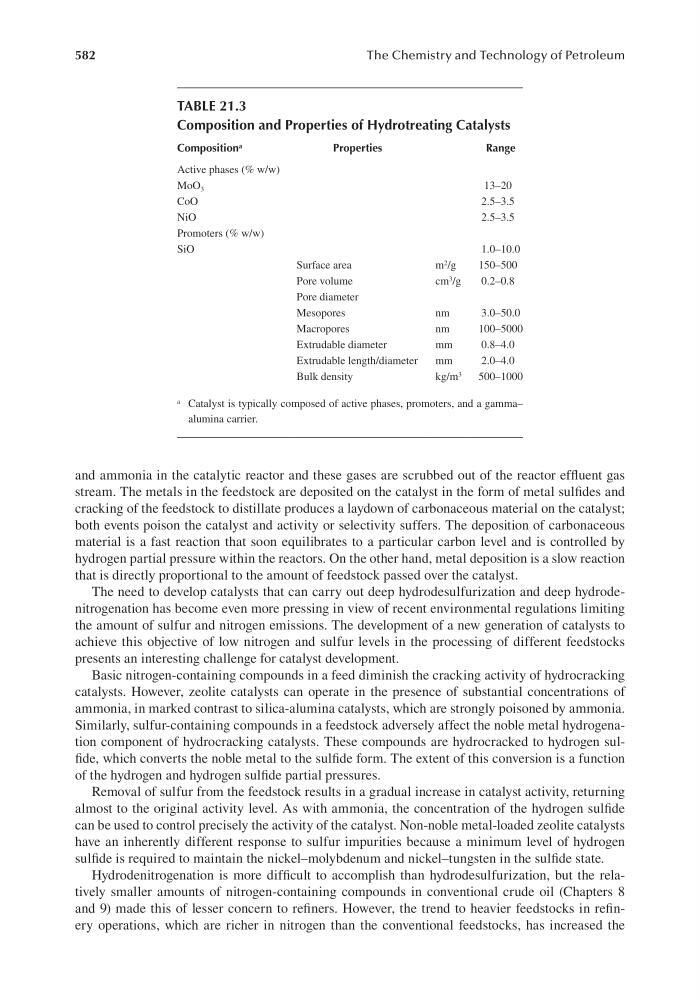
TABLE 21.3
Composition and Properties of Hydrotreating Catalysts
Composition a
Properties
Range
Active phases (% w/w)
MoO 3
13–20
CoO
2.5–3.5
NiO
2.5–3.5
Promoters (% w/w)
SiO
1.0–10.0
Surface area
m 2 /g
150–500
Pore volume
cm 3 /g
0.2–0.8
Pore diameter
Mesopores
nm
3.0–50.0
Macropores
nm
100–5000
Extrudable diameter
mm
0.8–4.0
Extrudable length/diameter
mm
2.0–4.0
Bulk density
kg/m 3
500–1000
a Catalyst is typically composed of active phases, promoters, and a gamma–
alumina carrier.