

577
Hydrotreating and Desulfurization
depending on the kind of feedstock and the degree of treatment required. Higher boiling feedstocks,
high sulfur content, and maximum sulfur removal require higher temperatures and pressures.
After passing through the reactor, the treated oil is cooled and separated from the excess hydrogen, which is recycled through the reactor. The treated oil is pumped to a stripper tower, where
hydrogen sulfide formed by the hydrogenation reaction is removed by steam, vacuum, or flue gas
and the finished product leaves the bottom of the stripper tower. The catalyst is not usually regenerated; it is replaced after about a year’s use.
Lube oil hydrofining is a catalytic technology to prepare lube base stocks for further processing
or it may be used as a base-stock finishing step. The process is usually integrated Exol N technology,
into an Exolfining configuration, to treat the waxy raffinate from extraction upstream from the lube
dewaxing unit. It saturates multiring aromatics; destroys acids; and removes sulfur, nitrogen and
color bodies to improve the color, and the color and oxidation stability of base stocks. As a finishing
step, the lube hydrofining process may be used to treat a dewaxed oil product with similar color and
oxidation stability benefits. Lube hydrofining, when used on lube distillate feedstocks can enhance
the ensuing solvent extraction performance.
Lube hydrofining technology generally produced a product with (1) improved color, (2) improved
oxidation stability, (3) improved antioxidant response, (4) better odor, (5) better surface properties,
(6) optimal sulfur reduction, (7) significant viscosity index (VI) increase at high desulfurization
levels, and (8) reduction in toxicity.
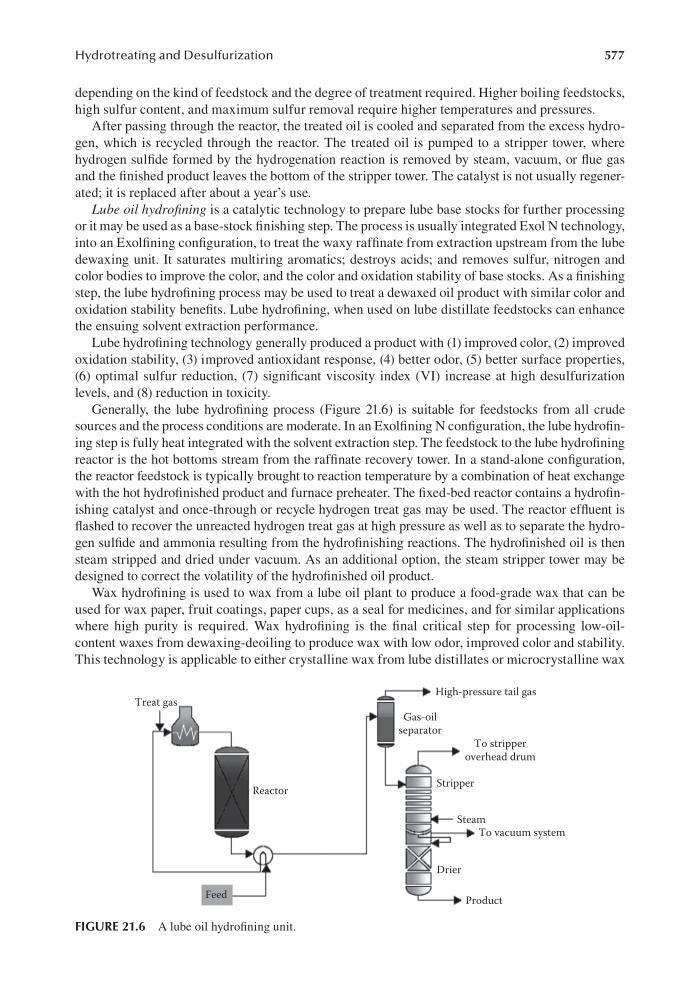
Generally, the lube hydrofining process (Figure 21.6) is suitable for feedstocks from all crude
sources and the process conditions are moderate. In an Exolfining N configuration, the lube hydrofining step is fully heat integrated with the solvent extraction step. The feedstock to the lube hydrofining
reactor is the hot bottoms stream from the raffinate recovery tower. In a stand-alone configuration,
the reactor feedstock is typically brought to reaction temperature by a combination of heat exchange
with the hot hydrofinished product and furnace preheater. The fixed-bed reactor contains a hydrofinishing catalyst and once-through or recycle hydrogen treat gas may be used. The reactor effluent is
flashed to recover the unreacted hydrogen treat gas at high pressure as well as to separate the hydrogen sulfide and ammonia resulting from the hydrofinishing reactions. The hydrofinished oil is then
steam stripped and dried under vacuum. As an additional option, the steam stripper tower may be
designed to correct the volatility of the hydrofinished oil product.
Wax hydrofining is used to wax from a lube oil plant to produce a food-grade wax that can be
used for wax paper, fruit coatings, paper cups, as a seal for medicines, and for similar applications
where high purity is required. Wax hydrofining is the final critical step for processing low-oilcontent waxes from dewaxing-deoiling to produce wax with low odor, improved color and stability.
This technology is applicable to either crystalline wax from lube distillates or microcrystalline wax
Product
Feed
Reactor
Treat gas
Steam
To vacuum system
To stripper
overhead drum
High-pressure tail gas
Gas-oil
separator
Stripper
Drier
FIGURE 21.6 A lube oil hydrofining unit.