

567
Hydrotreating and Desulfurization
primarily to produce high yields of gasoline from straight-run gas oil, and the first stage may actually be a purification step to remove sulfur-containing (as well as nitrogen-containing) organic materials. Both processes use an extinction-recycling technique to maximize the yields of the desired
product. Significant conversion of heavy feedstocks can be accomplished by hydrocracking at high
severity (Howell et al., 1985). For some applications, the products boiling up to 340°C (650°F) can
be blended to give the desired final product.
For lower boiling feedstocks, the commercial processes for treating or finishing petroleum fractions
with hydrogen all operate in essentially the same manner. The feedstock is heated and passed with
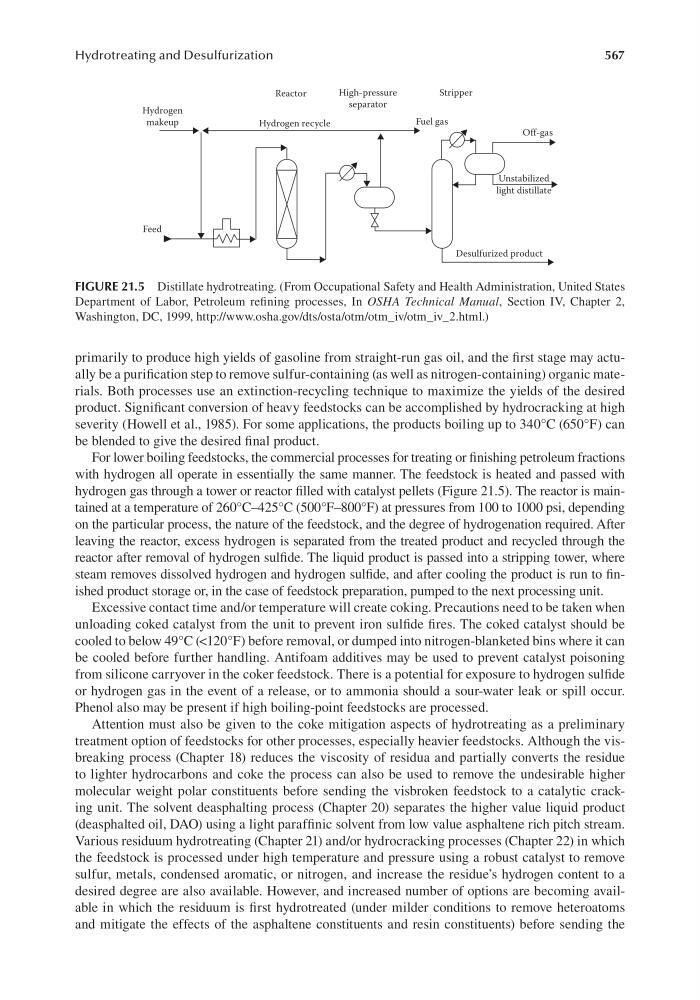
hydrogen gas through a tower or reactor filled with catalyst pellets (Figure 21.5). The reactor is maintained at a temperature of 260°C–425°C (500°F–800°F) at pressures from 100 to 1000 psi, depending
on the particular process, the nature of the feedstock, and the degree of hydrogenation required. After
leaving the reactor, excess hydrogen is separated from the treated product and recycled through the
reactor after removal of hydrogen sulfide. The liquid product is passed into a stripping tower, where
steam removes dissolved hydrogen and hydrogen sulfide, and after cooling the product is run to finished product storage or, in the case of feedstock preparation, pumped to the next processing unit.
Excessive contact time and/or temperature will create coking. Precautions need to be taken when
unloading coked catalyst from the unit to prevent iron sulfide fires. The coked catalyst should be
cooled to below 49°C (<120°F) before removal, or dumped into nitrogen-blanketed bins where it can
be cooled before further handling. Antifoam additives may be used to prevent catalyst poisoning
from silicone carryover in the coker feedstock. There is a potential for exposure to hydrogen sulfide
or hydrogen gas in the event of a release, or to ammonia should a sour-water leak or spill occur.
Phenol also may be present if high boiling-point feedstocks are processed.
Attention must also be given to the coke mitigation aspects of hydrotreating as a preliminary
treatment option of feedstocks for other processes, especially heavier feedstocks. Although the visbreaking process (Chapter 18) reduces the viscosity of residua and partially converts the residue
to lighter hydrocarbons and coke the process can also be used to remove the undesirable higher
molecular weight polar constituents before sending the visbroken feedstock to a catalytic cracking unit. The solvent deasphalting process (Chapter 20) separates the higher value liquid product
(deasphalted oil, DAO) using a light paraffinic solvent from low value asphaltene rich pitch stream.
Various residuum hydrotreating (Chapter 21) and/or hydrocracking processes (Chapter 22) in which
the feedstock is processed under high temperature and pressure using a robust catalyst to remove
sulfur, metals, condensed aromatic, or nitrogen, and increase the residue’s hydrogen content to a
desired degree are also available. However, and increased number of options are becoming available in which the residuum is first hydrotreated (under milder conditions to remove heteroatoms
and mitigate the effects of the asphaltene constituents and resin constituents) before sending the
Hydrogen recycle
Hydrogen
makeup
Feed
Reactor
Fuel gas
Stripper
Unstabilized
light distillate
Off-gas
Desulfurized product
High-pressure
separator
FIGURE 21.5 Distillate hydrotreating. (From Occupational Safety and Health Administration, United States
Department of Labor, Petroleum refining processes, In OSHA Technical Manual, Section IV, Chapter 2,
Washington, DC, 1999, http://www.osha.gov/dts/osta/otm/otm_iv/otm_iv_2.html.)