

566
The Chemistry and Technology of Petroleum
The problems encountered in hydrotreating heavy feedstocks can be directly equated to the
amount of complex, higher boiling constituents that may require pretreatment (Speight and
Moschopedis, 1979; Reynolds and Beret, 1989). Processing these feedstocks is not merely a matter
of applying know-how derived from refining conventional crude oils but requires knowledge of the
composition (Chapters 8 and 9). The materials are not only complex in terms of the carbon number
and boiling point ranges but also because a large part of this envelope falls into a range of model
compounds and very little is known about the properties. It is also established that the majority
of the higher molecular weight materials produce coke (with some liquids) but the majority of the
lower molecular weight constituents produce liquids (with some coke). It is to both of these trends
that hydrocracking is aimed.
It is the physical and chemical composition of a feedstock that plays a large part not only in determining the nature of the products that arise from refining operations but also in determining the
precise manner by which a particular feedstock should be processed (Speight, 1986). Furthermore,
it is apparent that the conversion of heavy oils and residua requires new lines of thought to develop
suitable processing scenarios (Speight, 2011a). Indeed, the use of thermal (carbon rejection) processes and of hydrothermal (hydrogen addition) processes, which were inherent in the refineries
designed to process lighter feedstocks, has been a particular cause for concern. This has brought
about the evolution of processing schemes that accommodate the heavier feedstocks (Khan and
Patmore, 1998; Speight, 2011a).
The choice of processing schemes for a given hydrotreating application depends on the nature of
the feedstock as well as the product requirements (Suchanek and Moore, 1986). For higher boiling
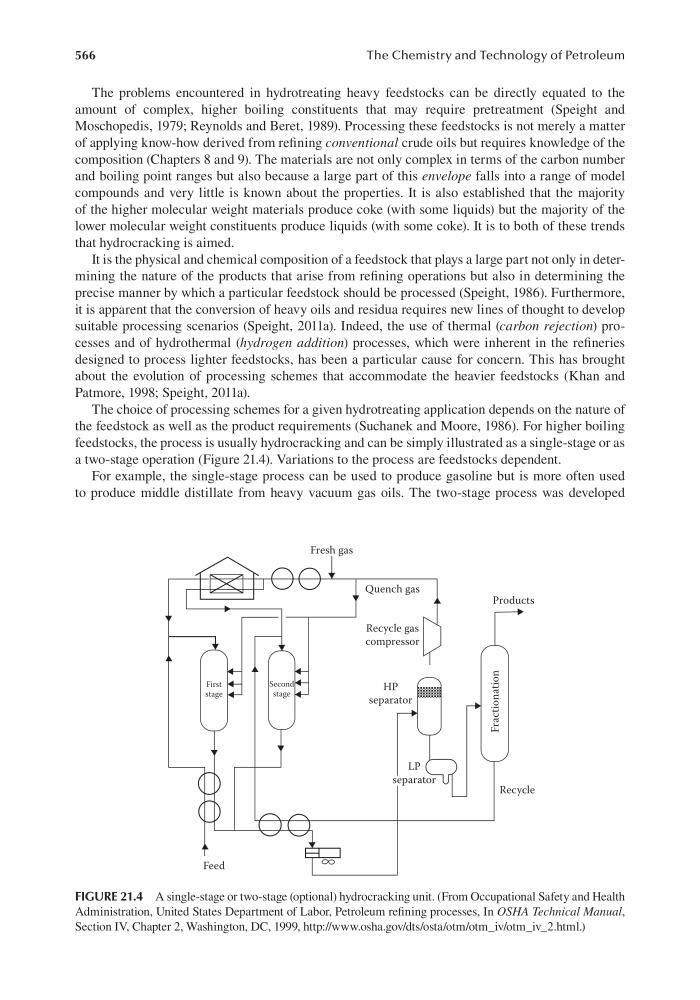
feedstocks, the process is usually hydrocracking and can be simply illustrated as a single-stage or as
a two-stage operation (Figure 21.4). Variations to the process are feedstocks dependent.
For example, the single-stage process can be used to produce gasoline but is more often used
to produce middle distillate from heavy vacuum gas oils. The two-stage process was developed
Fresh gas
First
stage
Second
stage
Products
Recycle
Fractionation
Quench gas
Recycle gas
compressor
HP
separator
LP
separator
Feed
FIGURE 21.4 A single-stage or two-stage (optional) hydrocracking unit. (From Occupational Safety and Health
Administration, United States Department of Labor, Petroleum refining processes, In OSHA Technical Manual,
Section IV, Chapter 2, Washington, DC, 1999, http://www.osha.gov/dts/osta/otm/otm_iv/otm_iv_2.html.)