

563
Hydrotreating and Desulfurization
Heteroatom removal, as practiced in various refineries, can take several forms (Speight, 2000)
such as concentration in residua during distillation (Chapter 17), concentration in coke during coking (Chapter 18), or chemical removal (acid treating, caustic treating, i.e., sweetening or finishing
processes) (Chapter 24). Nevertheless, the heteroatom removal from petroleum feedstocks is almost
universally accomplished by the catalytic reaction of hydrogen with the feedstock constituents.
However, there are certain other refinery processes, which are adaptable to residua and heavy oils
and which may be effective for reducing, but not necessarily effective for removing completely, the
heteroatom content.
Thus, catalytic hydrotreating is a hydrogenation process used to remove about 90% of contaminants such as nitrogen, sulfur, oxygen, and metals from liquid petroleum fractions. These
contaminants, if not removed from the petroleum fractions as they travel through the refinery processing units, can have detrimental effects on the equipment, the catalysts, and the quality of the
finished product. Typically, hydrotreating is done prior to processes such as catalytic reforming
so that the catalyst is not contaminated by untreated feedstock. Hydrotreating is also used prior to
catalytic cracking to reduce sulfur and improve product yields, and to upgrade middle-distillate
petroleum fractions into finished kerosene, diesel fuel, and heating fuel oils. In addition, hydrotreating converts olefins and aromatics to saturated compounds.
Hydrotreating (variously referred to as hydroprocessing to avoid any confusion with those
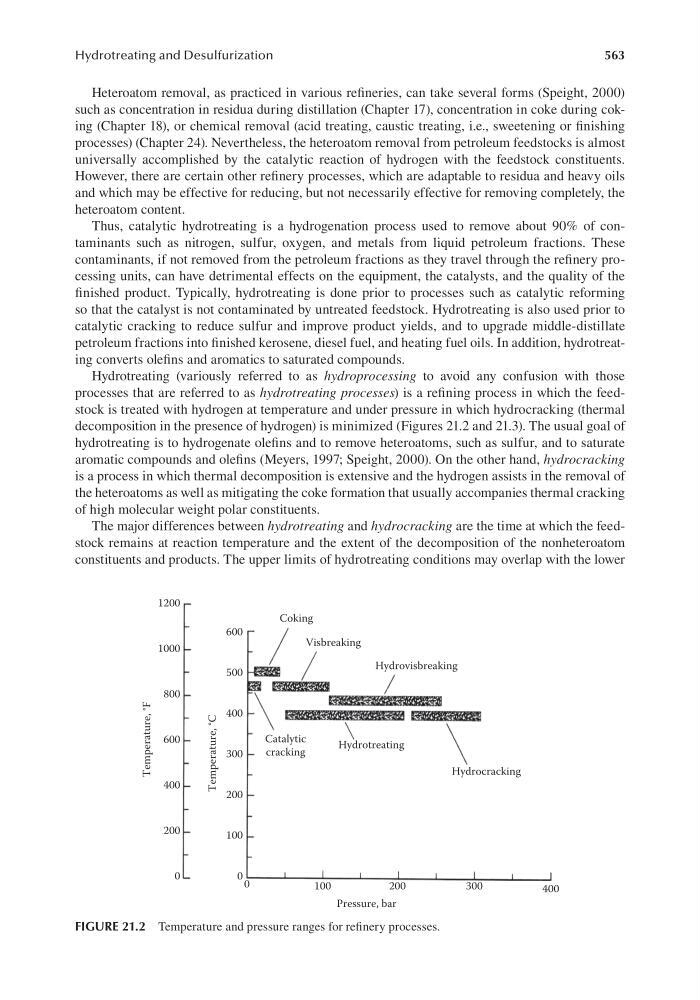
processes that are referred to as hydrotreating processes) is a refining process in which the feedstock is treated with hydrogen at temperature and under pressure in which hydrocracking (thermal
decomposition in the presence of hydrogen) is minimized (Figures 21.2 and 21.3). The usual goal of
hydrotreating is to hydrogenate olefins and to remove heteroatoms, such as sulfur, and to saturate
aromatic compounds and olefins (Meyers, 1997; Speight, 2000). On the other hand, hydrocracking
is a process in which thermal decomposition is extensive and the hydrogen assists in the removal of
the heteroatoms as well as mitigating the coke formation that usually accompanies thermal cracking
of high molecular weight polar constituents.
The major differences between hydrotreating and hydrocracking are the time at which the feedstock remains at reaction temperature and the extent of the decomposition of the nonheteroatom
constituents and products. The upper limits of hydrotreating conditions may overlap with the lower
200
200
Temperature, °C
Temperature, °F
200
100
100
0
0
0
300
300
Hydrocracking
Hydrotreating
Hydrovisbreaking
Visbreaking
Coking
Catalytic
cracking
400
400
600
800
1000
1200
400
500
600
Pressure, bar
FIGURE 21.2 Temperature and pressure ranges for refinery processes.