

555
Solvent Processes
chiefly in the use of the solvent. Commercially used solvents were naphtha, propane, sulfur dioxide,
acetone-benzene, trichloroethylene, ethylene dichloride-benzene (Barisol), methyl ethyl ketonebenzene (benzol), methyl-n-butyl ketone, and methyl-n-propyl ketone.
In the first solvent dewaxing process (developed in 1924), the waxy oil was mixed with naphtha
and filter aid (fuller’s earth or diatomaceous earth). The mixture was chilled and filtered, and the
filter aid assisted in building a wax cake on the filter cloth. This process is now obsolete, and most
of the modern dewaxing processes use a mixture of methyl ethyl ketone and benzene. Other ketones
may be substituted for dewaxing, but regardless of what ketone is used, the process is generally
known as ketone dewaxing.
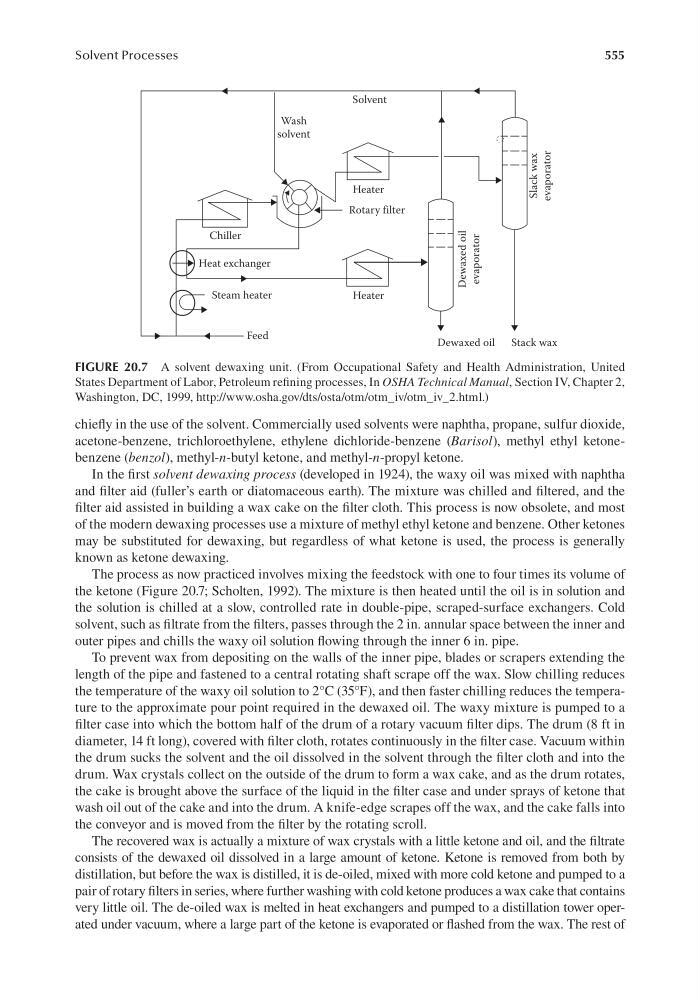
The process as now practiced involves mixing the feedstock with one to four times its volume of
the ketone (Figure 20.7; Scholten, 1992). The mixture is then heated until the oil is in solution and
the solution is chilled at a slow, controlled rate in double-pipe, scraped-surface exchangers. Cold
solvent, such as filtrate from the filters, passes through the 2 in. annular space between the inner and
outer pipes and chills the waxy oil solution flowing through the inner 6 in. pipe.
To prevent wax from depositing on the walls of the inner pipe, blades or scrapers extending the
length of the pipe and fastened to a central rotating shaft scrape off the wax. Slow chilling reduces
the temperature of the waxy oil solution to 2°C (35°F), and then faster chilling reduces the temperature to the approximate pour point required in the dewaxed oil. The waxy mixture is pumped to a
filter case into which the bottom half of the drum of a rotary vacuum filter dips. The drum (8 ft in
diameter, 14 ft long), covered with filter cloth, rotates continuously in the filter case. Vacuum within
the drum sucks the solvent and the oil dissolved in the solvent through the filter cloth and into the
drum. Wax crystals collect on the outside of the drum to form a wax cake, and as the drum rotates,
the cake is brought above the surface of the liquid in the filter case and under sprays of ketone that
wash oil out of the cake and into the drum. A knife-edge scrapes off the wax, and the cake falls into
the conveyor and is moved from the filter by the rotating scroll.
The recovered wax is actually a mixture of wax crystals with a little ketone and oil, and the filtrate
consists of the dewaxed oil dissolved in a large amount of ketone. Ketone is removed from both by
distillation, but before the wax is distilled, it is de-oiled, mixed with more cold ketone and pumped to a
pair of rotary filters in series, where further washing with cold ketone produces a wax cake that contains
very little oil. The de-oiled wax is melted in heat exchangers and pumped to a distillation tower operated under vacuum, where a large part of the ketone is evaporated or flashed from the wax. The rest of
Solvent
Heater
Heater
Chiller
Heat exchanger
Steam heater
Feed
Dewaxed oil
evaporator
Slack wax
evaporator
Rotary filter
Wash
solvent
Dewaxed oil Stack wax
FIGURE 20.7 A solvent dewaxing unit. (From Occupational Safety and Health Administration, United
States Department of Labor, Petroleum refining processes, In OSHA Technical Manual, Section IV, Chapter 2,
Washington, DC, 1999, http://www.osha.gov/dts/osta/otm/otm_iv/otm_iv_2.html.)