

523
Catalytic Cracking
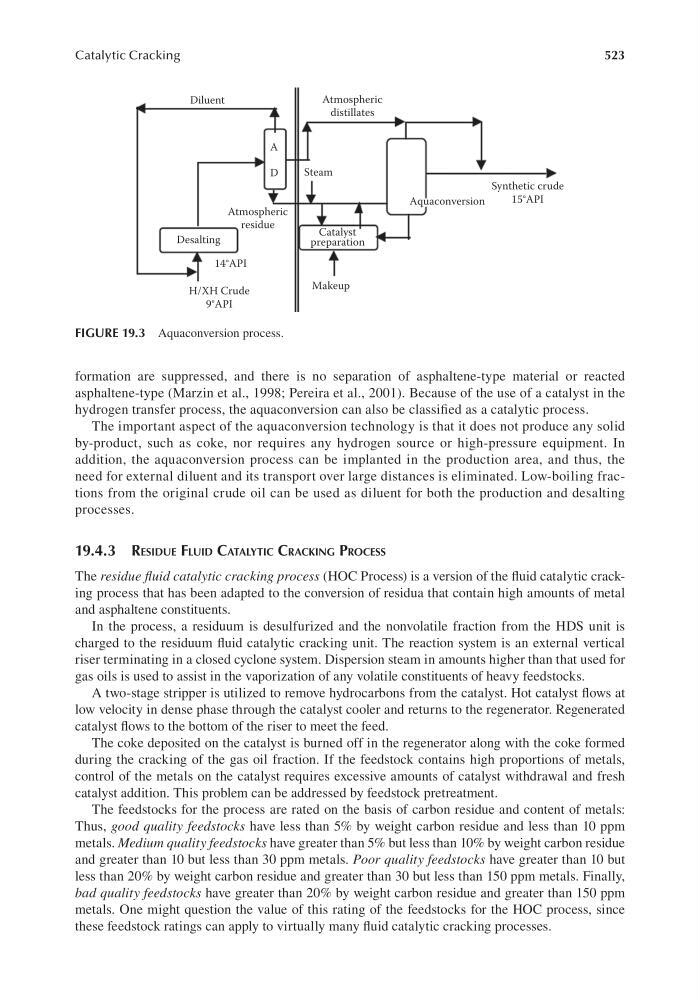
formation are suppressed, and there is no separation of asphaltene-type material or reacted
asphaltene-type (Marzin et al., 1998; Pereira et al., 2001). Because of the use of a catalyst in the
hydrogen transfer process, the aquaconversion can also be classified as a catalytic process.
The important aspect of the aquaconversion technology is that it does not produce any solid
by-product, such as coke, nor requires any hydrogen source or high-pressure equipment. In
addition, the aquaconversion process can be implanted in the production area, and thus, the
need for external diluent and its transport over large distances is eliminated. Low-boiling fractions from the original crude oil can be used as diluent for both the production and desalting
processes.
19.4.3 resIdue FluId CAtAlytIC CrACkIng ProCess
The residue fluid catalytic cracking process (HOC Process) is a version of the fluid catalytic cracking process that has been adapted to the conversion of residua that contain high amounts of metal
and asphaltene constituents.
In the process, a residuum is desulfurized and the nonvolatile fraction from the HDS unit is
charged to the residuum fluid catalytic cracking unit. The reaction system is an external vertical
riser terminating in a closed cyclone system. Dispersion steam in amounts higher than that used for
gas oils is used to assist in the vaporization of any volatile constituents of heavy feedstocks.
A two-stage stripper is utilized to remove hydrocarbons from the catalyst. Hot catalyst flows at
low velocity in dense phase through the catalyst cooler and returns to the regenerator. Regenerated
catalyst flows to the bottom of the riser to meet the feed.
The coke deposited on the catalyst is burned off in the regenerator along with the coke formed
during the cracking of the gas oil fraction. If the feedstock contains high proportions of metals,
control of the metals on the catalyst requires excessive amounts of catalyst withdrawal and fresh
catalyst addition. This problem can be addressed by feedstock pretreatment.
The feedstocks for the process are rated on the basis of carbon residue and content of metals:
Thus, good quality feedstocks have less than 5% by weight carbon residue and less than 10 ppm
metals. Medium quality feedstocks have greater than 5% but less than 10% by weight carbon residue
and greater than 10 but less than 30 ppm metals. Poor quality feedstocks have greater than 10 but
less than 20% by weight carbon residue and greater than 30 but less than 150 ppm metals. Finally,
bad quality feedstocks have greater than 20% by weight carbon residue and greater than 150 ppm
metals. One might question the value of this rating of the feedstocks for the HOC process, since
these feedstock ratings can apply to virtually many fluid catalytic cracking processes.
Desalting
Makeup
14°API
Catalyst
preparation
Atmospheric
residue
Atmospheric
distillates
Steam
A
Diluent
D
Synthetic crude
15°API
H/XH Crude
9°API
Aquaconversion
FIGURE 19.3 Aquaconversion process.