

509
Thermal Cracking
The feedstock and product requirements of the thermal distillate cracking process are flexible,
and the process has the capability to optimize conversion through adjustment of the heavy gas oil
recycle rate.
18.4.12 tervAHl-t ProCess
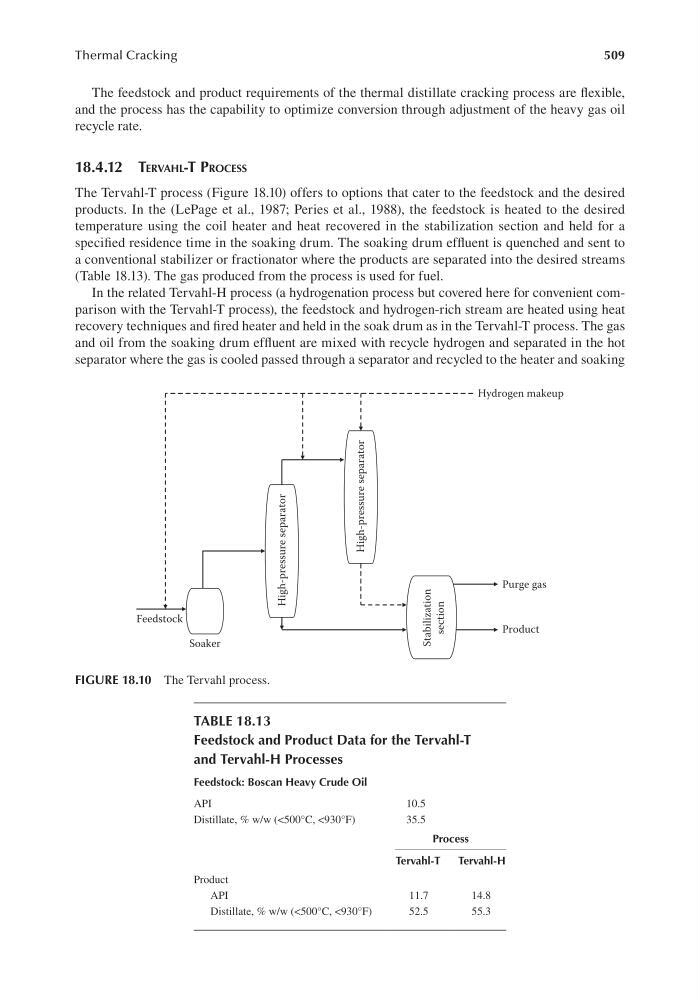
The Tervahl-T process (Figure 18.10) offers to options that cater to the feedstock and the desired
products. In the (LePage et al., 1987; Peries et al., 1988), the feedstock is heated to the desired
temperature using the coil heater and heat recovered in the stabilization section and held for a
specified residence time in the soaking drum. The soaking drum effluent is quenched and sent to
a conventional stabilizer or fractionator where the products are separated into the desired streams
(Table 18.13). The gas produced from the process is used for fuel.
In the related Tervahl-H process (a hydrogenation process but covered here for convenient comparison with the Tervahl-T process), the feedstock and hydrogen-rich stream are heated using heat
recovery techniques and fired heater and held in the soak drum as in the Tervahl-T process. The gas
and oil from the soaking drum effluent are mixed with recycle hydrogen and separated in the hot
separator where the gas is cooled passed through a separator and recycled to the heater and soaking
Feedstock
Purge gas
Stabilization
section
Product
Hydrogen makeup
High-pressure separator
High-pressure separator
Soaker
FIGURE 18.10 The Tervahl process.
TABLE 18.13
Feedstock and Product Data for the Tervahl-T
and Tervahl-H Processes
Feedstock: Boscan Heavy Crude Oil
API
10.5
Distillate, % w/w (<500°C, <930°F)
35.5
Process
Tervahl-T
Tervahl-H
Product
API
11.7
14.8
Distillate, % w/w (<500°C, <930°F)
52.5
55.3