

498
The Chemistry and Technology of Petroleum
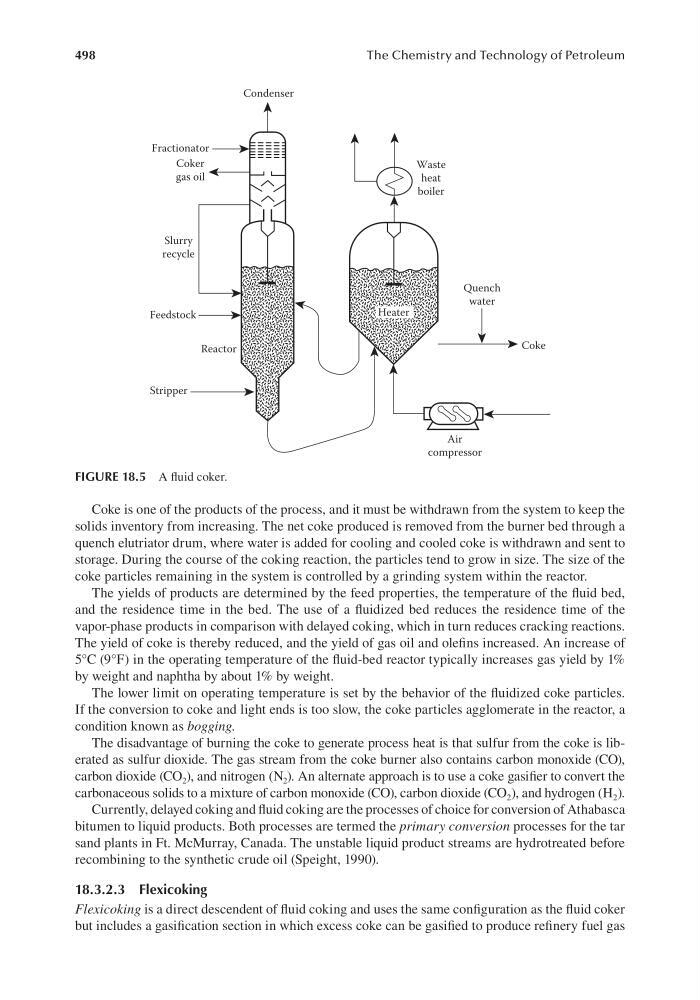
Coke is one of the products of the process, and it must be withdrawn from the system to keep the
solids inventory from increasing. The net coke produced is removed from the burner bed through a
quench elutriator drum, where water is added for cooling and cooled coke is withdrawn and sent to
storage. During the course of the coking reaction, the particles tend to grow in size. The size of the
coke particles remaining in the system is controlled by a grinding system within the reactor.
The yields of products are determined by the feed properties, the temperature of the fluid bed,
and the residence time in the bed. The use of a fluidized bed reduces the residence time of the
vapor-phase products in comparison with delayed coking, which in turn reduces cracking reactions.
The yield of coke is thereby reduced, and the yield of gas oil and olefins increased. An increase of
5°C (9°F) in the operating temperature of the fluid-bed reactor typically increases gas yield by 1%
by weight and naphtha by about 1% by weight.
The lower limit on operating temperature is set by the behavior of the fluidized coke particles.
If the conversion to coke and light ends is too slow, the coke particles agglomerate in the reactor, a
condition known as bogging.
The disadvantage of burning the coke to generate process heat is that sulfur from the coke is liberated as sulfur dioxide. The gas stream from the coke burner also contains carbon monoxide (CO),
carbon dioxide (CO 2 ), and nitrogen (N 2 ). An alternate approach is to use a coke gasifier to convert the
carbonaceous solids to a mixture of carbon monoxide (CO), carbon dioxide (CO 2 ), and hydrogen (H 2 ).
Currently, delayed coking and fluid coking are the processes of choice for conversion of Athabasca
bitumen to liquid products. Both processes are termed the primary conversion processes for the tar
sand plants in Ft. McMurray, Canada. The unstable liquid product streams are hydrotreated before
recombining to the synthetic crude oil (Speight, 1990).
18.3.2.3 Flexicoking
Flexicoking is a direct descendent of fluid coking and uses the same configuration as the fluid coker
but includes a gasification section in which excess coke can be gasified to produce refinery fuel gas
Air
compressor
Stripper
Reactor
Feedstock
Slurry
recycle
Fractionator
Coker
gas oil
Quench
water
Condenser
Waste
heat
boiler
Coke
Heater
FIGURE 18.5 A fluid coker.