

471
Distillation
17.4.2 PACkIng
Instead of using trays, various types of packing can be used to improve the separation in a distillation column. Packing offers the advantage of a lower pressure drop across the column (when
compared to plates or trays), beneficial when operating under vacuum. The packing in a distillation
column creates a surface for the liquid to spread on thereby providing a high surface area for mass
transfer between the liquid and the vapor.
If a distillation tower uses packing instead of trays, the number of necessary theoretical equilibrium stages is first determined and then the packing height equivalent to a theoretical equilibrium
stage (height equivalent to a theoretical plate—HETP) is also determined. The total packing height
required is the number of theoretical stages multiplied by the HETP.
The packing material can either be random dumped packing such as Raschigrings or structured
sheet metal. Liquids tend to wet the surface of the packing and the vapors pass across this wetted
surface, where mass transfer takes place. Unlike conventional tray distillation in which every tray
represents a separate point of vapor–liquid equilibrium, the vapor–liquid equilibrium curve in a
packed column is continuous. Differently shaped packing materials have different surface areas
and void space between the individual components of the packing material—both of these factors
affect packing performance.
Another factor in addition to the packing shape and surface area that affects the performance of
random or structured packing is liquid and vapor distribution entering the packed bed. The number
of theoretical stages required to make a given separation is calculated using a specific vapor to liquid
ratio. If the liquid and vapor are not evenly distributed across the superficial tower area as it enters the
packed bed, the liquid-to-vapor ratio will not be correct in the packed bed and the required separation
will not be achieved. The packing will appear to not be working properly. The height equivalent to
a theoretical plate (HETP) will be greater than expected. The problem is not the packing itself but
the uneven or irregular distribution of the fluids entering the packed bed. Liquid mal-distribution is
more frequently the problem than vapor. The design of the liquid distributors used to introduce the
feed and reflux to a packed bed is critical to making the packing perform at maximum efficiency.
17.4.3 trAys
Usually, trays are horizontal, flat, specially prefabricated metal sheets, which are placed at a regular
distance in a vertical cylindrical column. Trays have two main parts: (1) the part where vapor (gas)
0.0
2.0
4.0
6.0
8.0
10.0
12.0
14.0
1000
3000
5000
7000
9000
Diameter, ft
30% residuum
50% residuum
70% residuum
Capacity, bbl/day
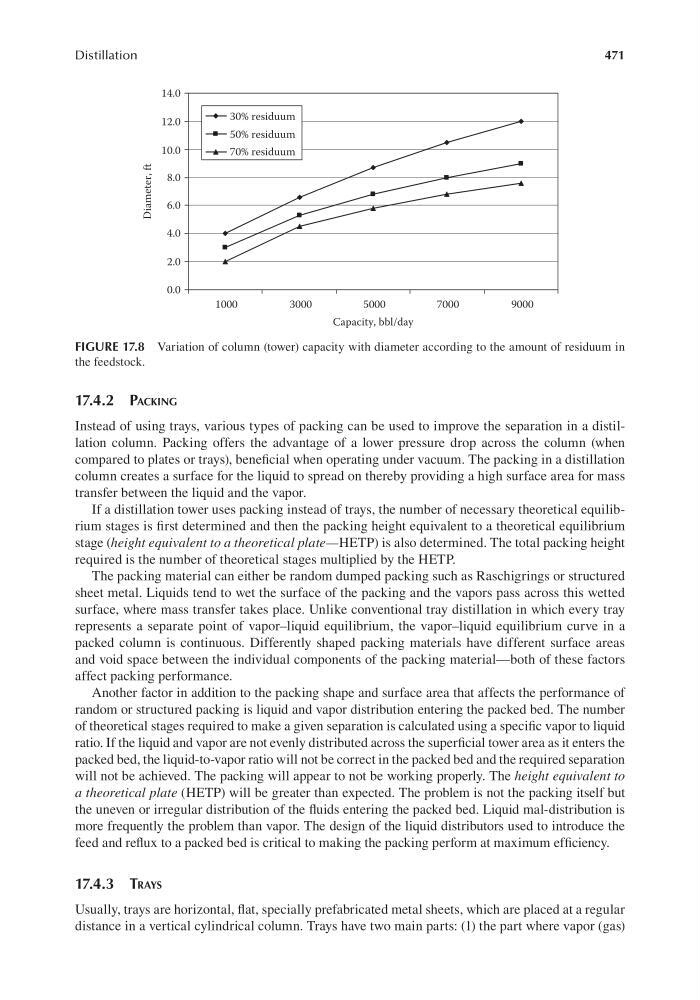
FIGURE 17.8 Variation of column (tower) capacity with diameter according to the amount of residuum in
the feedstock.