

470
The Chemistry and Technology of Petroleum
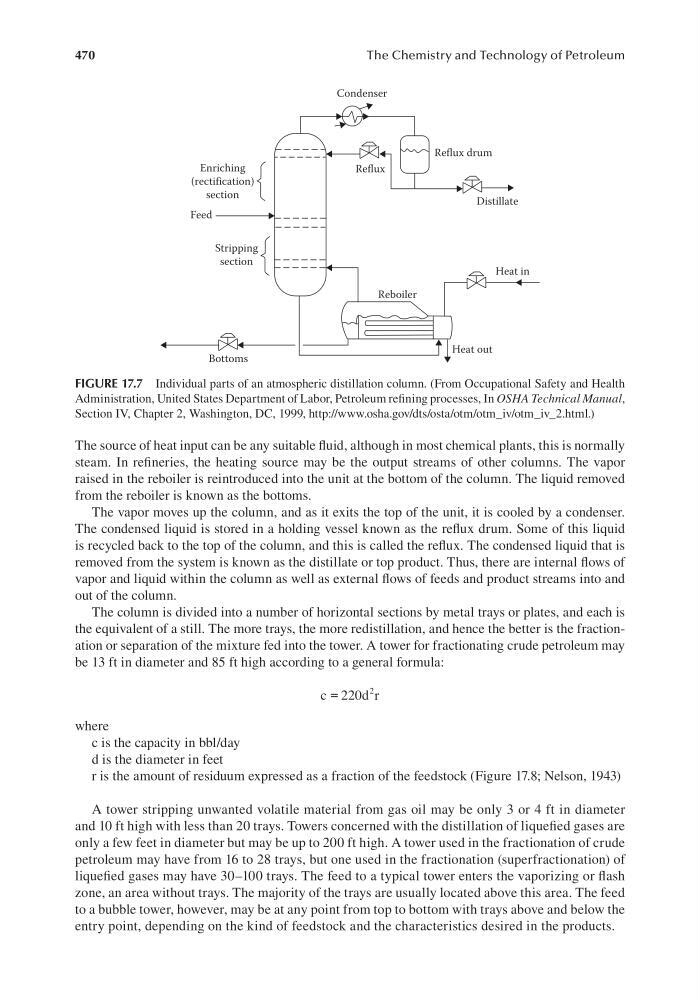
The source of heat input can be any suitable fluid, although in most chemical plants, this is normally
steam. In refineries, the heating source may be the output streams of other columns. The vapor
raised in the reboiler is reintroduced into the unit at the bottom of the column. The liquid removed
from the reboiler is known as the bottoms.
The vapor moves up the column, and as it exits the top of the unit, it is cooled by a condenser.
The condensed liquid is stored in a holding vessel known as the reflux drum. Some of this liquid
is recycled back to the top of the column, and this is called the reflux. The condensed liquid that is
removed from the system is known as the distillate or top product. Thus, there are internal flows of
vapor and liquid within the column as well as external flows of feeds and product streams into and
out of the column.
The column is divided into a number of horizontal sections by metal trays or plates, and each is
the equivalent of a still. The more trays, the more redistillation, and hence the better is the fractionation or separation of the mixture fed into the tower. A tower for fractionating crude petroleum may
be 13 ft in diameter and 85 ft high according to a general formula:
c = 220
2
d r
where
c is the capacity in bbl/day
d is the diameter in feet
r is the amount of residuum expressed as a fraction of the feedstock (Figure 17.8; Nelson, 1943)
A tower stripping unwanted volatile material from gas oil may be only 3 or 4 ft in diameter
and 10 ft high with less than 20 trays. Towers concerned with the distillation of liquefied gases are
only a few feet in diameter but may be up to 200 ft high. A tower used in the fractionation of crude
petroleum may have from 16 to 28 trays, but one used in the fractionation (superfractionation) of
liquefied gases may have 30–100 trays. The feed to a typical tower enters the vaporizing or flash
zone, an area without trays. The majority of the trays are usually located above this area. The feed
to a bubble tower, however, may be at any point from top to bottom with trays above and below the
entry point, depending on the kind of feedstock and the characteristics desired in the products.
Heat out
Stripping
section
Enriching
(rectification)
section
Feed
Heat in
Reboiler
Reflux
Distillate
Reflux drum
Condenser
Bottoms
FIGURE 17.7 Individual parts of an atmospheric distillation column. (From Occupational Safety and Health
Administration, United States Department of Labor, Petroleum refining processes, In OSHA Technical Manual,
Section IV, Chapter 2, Washington, DC, 1999, http://www.osha.gov/dts/osta/otm/otm_iv/otm_iv_2.html.)