

445
Refining Chemistry
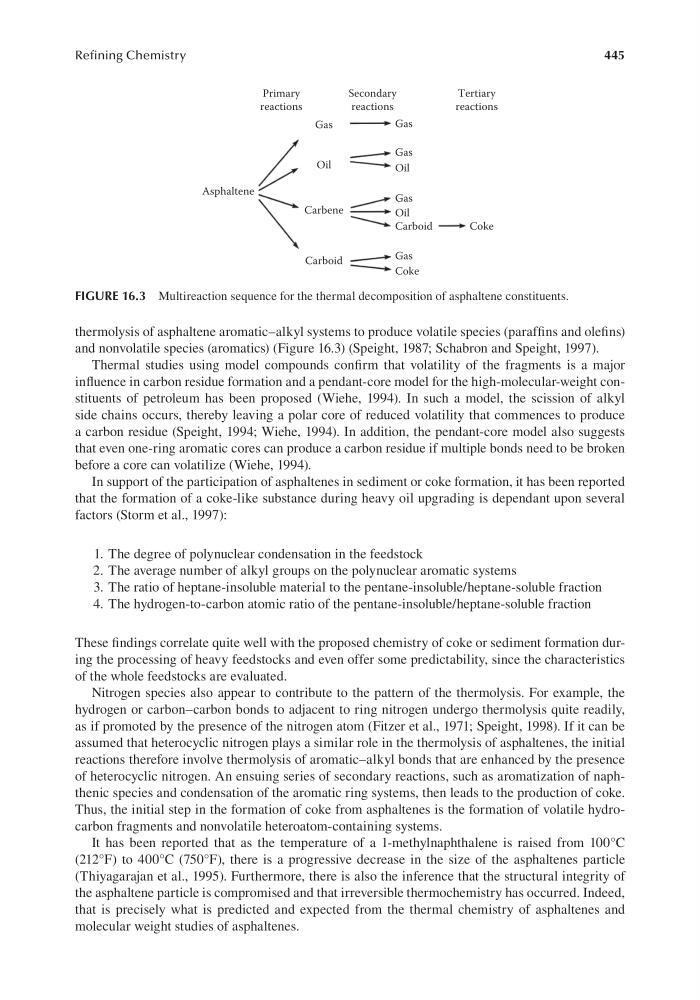
thermolysis of asphaltene aromatic–alkyl systems to produce volatile species (paraffins and olefins)
and nonvolatile species (aromatics) (Figure 16.3) (Speight, 1987; Schabron and Speight, 1997).
Thermal studies using model compounds confirm that volatility of the fragments is a major
influence in carbon residue formation and a pendant-core model for the high-molecular-weight constituents of petroleum has been proposed (Wiehe, 1994). In such a model, the scission of alkyl
side chains occurs, thereby leaving a polar core of reduced volatility that commences to produce
a carbon residue (Speight, 1994; Wiehe, 1994). In addition, the pendant-core model also suggests
that even one-ring aromatic cores can produce a carbon residue if multiple bonds need to be broken
before a core can volatilize (Wiehe, 1994).
In support of the participation of asphaltenes in sediment or coke formation, it has been reported
that the formation of a coke-like substance during heavy oil upgrading is dependant upon several
factors (Storm et al., 1997):
1. The degree of polynuclear condensation in the feedstock
2. The average number of alkyl groups on the polynuclear aromatic systems
3. The ratio of heptane-insoluble material to the pentane-insoluble/heptane-soluble fraction
4. The hydrogen-to-carbon atomic ratio of the pentane-insoluble/heptane-soluble fraction
These findings correlate quite well with the proposed chemistry of coke or sediment formation during the processing of heavy feedstocks and even offer some predictability, since the characteristics
of the whole feedstocks are evaluated.
Nitrogen species also appear to contribute to the pattern of the thermolysis. For example, the
hydrogen or carbon–carbon bonds to adjacent to ring nitrogen undergo thermolysis quite readily,
as if promoted by the presence of the nitrogen atom (Fitzer et al., 1971; Speight, 1998). If it can be
assumed that heterocyclic nitrogen plays a similar role in the thermolysis of asphaltenes, the initial
reactions therefore involve thermolysis of aromatic–alkyl bonds that are enhanced by the presence
of heterocyclic nitrogen. An ensuing series of secondary reactions, such as aromatization of naphthenic species and condensation of the aromatic ring systems, then leads to the production of coke.
Thus, the initial step in the formation of coke from asphaltenes is the formation of volatile hydrocarbon fragments and nonvolatile heteroatom-containing systems.
It has been reported that as the temperature of a 1-methylnaphthalene is raised from 100°C
(212°F) to 400°C (750°F), there is a progressive decrease in the size of the asphaltenes particle
(Thiyagarajan et al., 1995). Furthermore, there is also the inference that the structural integrity of
the asphaltene particle is compromised and that irreversible thermochemistry has occurred. Indeed,
that is precisely what is predicted and expected from the thermal chemistry of asphaltenes and
molecular weight studies of asphaltenes.
Gas
Gas
Gas
Asphaltene
Gas
Coke
Tertiary
reactions
Secondary
reactions
Primary
reactions
Gas
Carboid
Carboid
Carbene
Oil
Oil
Oil
Coke
FIGURE 16.3 Multireaction sequence for the thermal decomposition of asphaltene constituents.
Refining Chemistry
thermolysis of asphaltene aromatic–alkyl systems to produce volatile species (paraffins and olefins)
and nonvolatile species (aromatics) (Figure 16.3) (Speight, 1987; Schabron and Speight, 1997).
Thermal studies using model compounds confirm that volatility of the fragments is a major
influence in carbon residue formation and a pendant-core model for the high-molecular-weight constituents of petroleum has been proposed (Wiehe, 1994). In such a model, the scission of alkyl
side chains occurs, thereby leaving a polar core of reduced volatility that commences to produce
a carbon residue (Speight, 1994; Wiehe, 1994). In addition, the pendant-core model also suggests
that even one-ring aromatic cores can produce a carbon residue if multiple bonds need to be broken
before a core can volatilize (Wiehe, 1994).
In support of the participation of asphaltenes in sediment or coke formation, it has been reported
that the formation of a coke-like substance during heavy oil upgrading is dependant upon several
factors (Storm et al., 1997):
1. The degree of polynuclear condensation in the feedstock
2. The average number of alkyl groups on the polynuclear aromatic systems
3. The ratio of heptane-insoluble material to the pentane-insoluble/heptane-soluble fraction
4. The hydrogen-to-carbon atomic ratio of the pentane-insoluble/heptane-soluble fraction
These findings correlate quite well with the proposed chemistry of coke or sediment formation during the processing of heavy feedstocks and even offer some predictability, since the characteristics
of the whole feedstocks are evaluated.
Nitrogen species also appear to contribute to the pattern of the thermolysis. For example, the
hydrogen or carbon–carbon bonds to adjacent to ring nitrogen undergo thermolysis quite readily,
as if promoted by the presence of the nitrogen atom (Fitzer et al., 1971; Speight, 1998). If it can be
assumed that heterocyclic nitrogen plays a similar role in the thermolysis of asphaltenes, the initial
reactions therefore involve thermolysis of aromatic–alkyl bonds that are enhanced by the presence
of heterocyclic nitrogen. An ensuing series of secondary reactions, such as aromatization of naphthenic species and condensation of the aromatic ring systems, then leads to the production of coke.
Thus, the initial step in the formation of coke from asphaltenes is the formation of volatile hydrocarbon fragments and nonvolatile heteroatom-containing systems.
It has been reported that as the temperature of a 1-methylnaphthalene is raised from 100°C
(212°F) to 400°C (750°F), there is a progressive decrease in the size of the asphaltenes particle
(Thiyagarajan et al., 1995). Furthermore, there is also the inference that the structural integrity of
the asphaltene particle is compromised and that irreversible thermochemistry has occurred. Indeed,
that is precisely what is predicted and expected from the thermal chemistry of asphaltenes and
molecular weight studies of asphaltenes.
Gas
Gas
Gas
Asphaltene
Gas
Coke
Tertiary
reactions
Secondary
reactions
Primary
reactions
Gas
Carboid
Carboid
Carbene
Oil
Oil
Oil
Coke
FIGURE 16.3 Multireaction sequence for the thermal decomposition of asphaltene constituents.