

443
Refining Chemistry
The thermal decomposition of petroleum asphaltenes has received some attention (Magaril
and Aksenova, 1970; Magaril and Ramazaeva, 1969; Magaril et al., 1970, 1971; Schucker and
Keweshan, 1980; Speight, 1990, 1998). Special attention has been given to the nature of the volatile products of asphaltene decomposition mainly because of the difficulty of characterizing the
nonvolatile coke.
The organic nitrogen originally in the asphaltenes invariably undergoes thermal reaction to concentrate in the nonvolatile coke (Speight, 1970, 1989; Vercier, 1981) (Chapter 10). Thus, although
asphaltenes produce high yields of thermal coke, little is known of the actual chemistry of coke
formation. In a more general scheme, the chemistry of asphaltene coking has been suggested to
involve the thermolysis of thermally labile bonds to form reactive species that then react with each
other (condensation) to form coke. In addition, the highly aromatic and highly polar (refractory)
products separate from the surrounding oil medium as an insoluble phase and proceed to form coke.
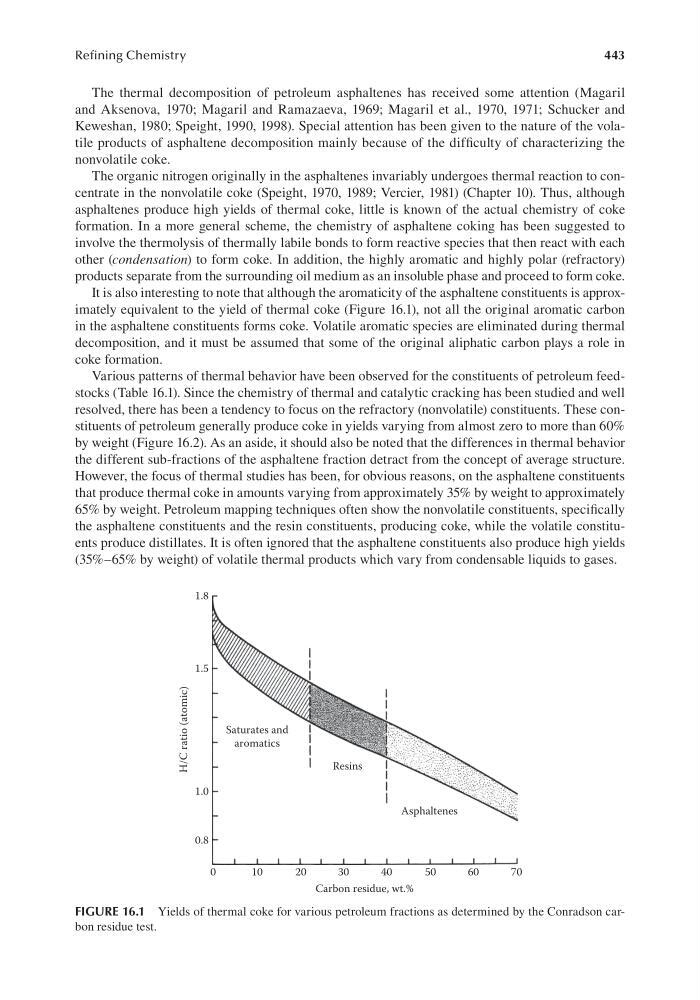
It is also interesting to note that although the aromaticity of the asphaltene constituents is approximately equivalent to the yield of thermal coke (Figure 16.1), not all the original aromatic carbon
in the asphaltene constituents forms coke. Volatile aromatic species are eliminated during thermal
decomposition, and it must be assumed that some of the original aliphatic carbon plays a role in
coke formation.
Various patterns of thermal behavior have been observed for the constituents of petroleum feedstocks (Table 16.1). Since the chemistry of thermal and catalytic cracking has been studied and well
resolved, there has been a tendency to focus on the refractory (nonvolatile) constituents. These constituents of petroleum generally produce coke in yields varying from almost zero to more than 60%
by weight (Figure 16.2). As an aside, it should also be noted that the differences in thermal behavior
the different sub-fractions of the asphaltene fraction detract from the concept of average structure.
However, the focus of thermal studies has been, for obvious reasons, on the asphaltene constituents
that produce thermal coke in amounts varying from approximately 35% by weight to approximately
65% by weight. Petroleum mapping techniques often show the nonvolatile constituents, specifically
the asphaltene constituents and the resin constituents, producing coke, while the volatile constituents produce distillates. It is often ignored that the asphaltene constituents also produce high yields
(35%–65% by weight) of volatile thermal products which vary from condensable liquids to gases.
Asphaltenes
0
1 0
0.8
1.0
1.5
1.8
20
30
40
50
60
70
Resins
Saturates and
aromatics
H/C ratio (atomic)
Carbon residue, wt.%
FIGURE 16.1 Yields of thermal coke for various petroleum fractions as determined by the Conradson carbon residue test.
Refining Chemistry
The thermal decomposition of petroleum asphaltenes has received some attention (Magaril
and Aksenova, 1970; Magaril and Ramazaeva, 1969; Magaril et al., 1970, 1971; Schucker and
Keweshan, 1980; Speight, 1990, 1998). Special attention has been given to the nature of the volatile products of asphaltene decomposition mainly because of the difficulty of characterizing the
nonvolatile coke.
The organic nitrogen originally in the asphaltenes invariably undergoes thermal reaction to concentrate in the nonvolatile coke (Speight, 1970, 1989; Vercier, 1981) (Chapter 10). Thus, although
asphaltenes produce high yields of thermal coke, little is known of the actual chemistry of coke
formation. In a more general scheme, the chemistry of asphaltene coking has been suggested to
involve the thermolysis of thermally labile bonds to form reactive species that then react with each
other (condensation) to form coke. In addition, the highly aromatic and highly polar (refractory)
products separate from the surrounding oil medium as an insoluble phase and proceed to form coke.
It is also interesting to note that although the aromaticity of the asphaltene constituents is approximately equivalent to the yield of thermal coke (Figure 16.1), not all the original aromatic carbon
in the asphaltene constituents forms coke. Volatile aromatic species are eliminated during thermal
decomposition, and it must be assumed that some of the original aliphatic carbon plays a role in
coke formation.
Various patterns of thermal behavior have been observed for the constituents of petroleum feedstocks (Table 16.1). Since the chemistry of thermal and catalytic cracking has been studied and well
resolved, there has been a tendency to focus on the refractory (nonvolatile) constituents. These constituents of petroleum generally produce coke in yields varying from almost zero to more than 60%
by weight (Figure 16.2). As an aside, it should also be noted that the differences in thermal behavior
the different sub-fractions of the asphaltene fraction detract from the concept of average structure.
However, the focus of thermal studies has been, for obvious reasons, on the asphaltene constituents
that produce thermal coke in amounts varying from approximately 35% by weight to approximately
65% by weight. Petroleum mapping techniques often show the nonvolatile constituents, specifically
the asphaltene constituents and the resin constituents, producing coke, while the volatile constituents produce distillates. It is often ignored that the asphaltene constituents also produce high yields
(35%–65% by weight) of volatile thermal products which vary from condensable liquids to gases.
Asphaltenes
0
1 0
0.8
1.0
1.5
1.8
20
30
40
50
60
70
Resins
Saturates and
aromatics
H/C ratio (atomic)
Carbon residue, wt.%
FIGURE 16.1 Yields of thermal coke for various petroleum fractions as determined by the Conradson carbon residue test.