

398
The Chemistry and Technology of Petroleum
15.4.2.2 Vacuum Distillation
Vacuum distillation as applied to the petroleum refining industry is truly a technique of the twentieth century and has since wide use in petroleum refining. Vacuum distillation evolved because
of the need to separate less volatile products, such as lubricating oils, from the petroleum without
subjecting these high-boiling products to cracking conditions. The boiling point of the heaviest cut
obtainable at atmospheric pressure is limited by the temperature (ca. 350°C; ca. 660°F) at which the
residue starts to decompose (crack). When the feedstock is required for the manufacture of lubricating oils, further fractionation without cracking is desirable and this can be achieved by distillation
under vacuum conditions.
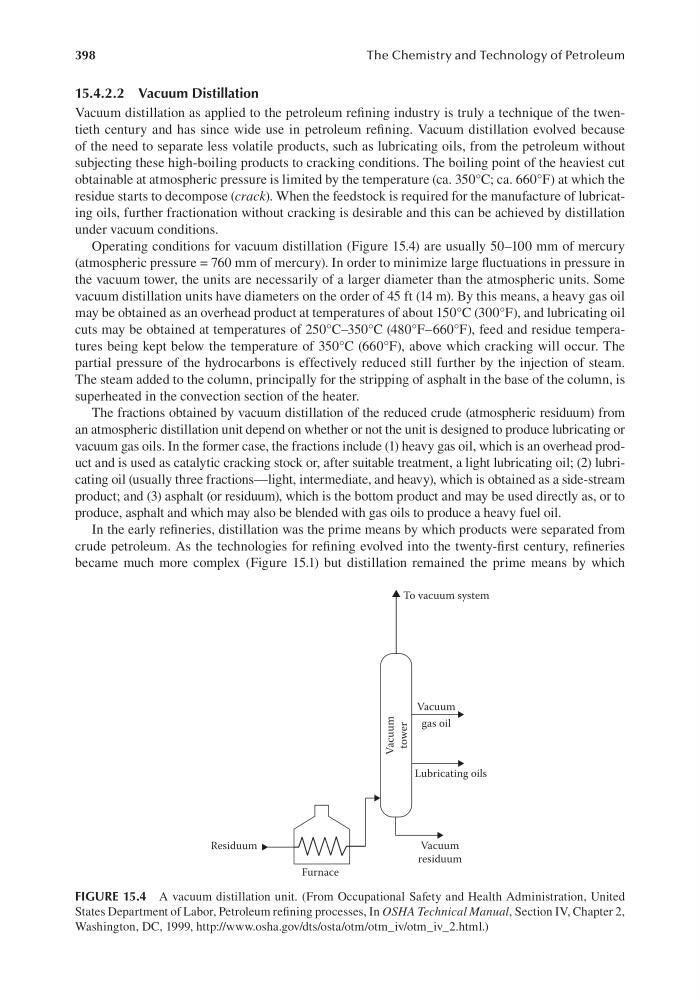
Operating conditions for vacuum distillation (Figure 15.4) are usually 50–100 mm of mercury
(atmospheric pressure = 760 mm of mercury). In order to minimize large fluctuations in pressure in
the vacuum tower, the units are necessarily of a larger diameter than the atmospheric units. Some
vacuum distillation units have diameters on the order of 45 ft (14 m). By this means, a heavy gas oil
may be obtained as an overhead product at temperatures of about 150°C (300°F), and lubricating oil
cuts may be obtained at temperatures of 250°C–350°C (480°F–660°F), feed and residue temperatures being kept below the temperature of 350°C (660°F), above which cracking will occur. The
partial pressure of the hydrocarbons is effectively reduced still further by the injection of steam.
The steam added to the column, principally for the stripping of asphalt in the base of the column, is
superheated in the convection section of the heater.
The fractions obtained by vacuum distillation of the reduced crude (atmospheric residuum) from
an atmospheric distillation unit depend on whether or not the unit is designed to produce lubricating or
vacuum gas oils. In the former case, the fractions include (1) heavy gas oil, which is an overhead product and is used as catalytic cracking stock or, after suitable treatment, a light lubricating oil; (2) lubricating oil (usually three fractions—light, intermediate, and heavy), which is obtained as a side-stream
product; and (3) asphalt (or residuum), which is the bottom product and may be used directly as, or to
produce, asphalt and which may also be blended with gas oils to produce a heavy fuel oil.
In the early refineries, distillation was the prime means by which products were separated from
crude petroleum. As the technologies for refining evolved into the twenty-first century, refineries
became much more complex (Figure 15.1) but distillation remained the prime means by which
To vacuum system
Vacuum
residuum
Lubricating oils
Residuum
Vacuum
tower
Vacuum
gas oil
Furnace
FIGURE 15.4 A vacuum distillation unit. (From Occupational Safety and Health Administration, United
States Department of Labor, Petroleum refining processes, In OSHA Technical Manual, Section IV, Chapter 2,
Washington, DC, 1999, http://www.osha.gov/dts/osta/otm/otm_iv/otm_iv_2.html.)
The Chemistry and Technology of Petroleum
15.4.2.2 Vacuum Distillation
Vacuum distillation as applied to the petroleum refining industry is truly a technique of the twentieth century and has since wide use in petroleum refining. Vacuum distillation evolved because
of the need to separate less volatile products, such as lubricating oils, from the petroleum without
subjecting these high-boiling products to cracking conditions. The boiling point of the heaviest cut
obtainable at atmospheric pressure is limited by the temperature (ca. 350°C; ca. 660°F) at which the
residue starts to decompose (crack). When the feedstock is required for the manufacture of lubricating oils, further fractionation without cracking is desirable and this can be achieved by distillation
under vacuum conditions.
Operating conditions for vacuum distillation (Figure 15.4) are usually 50–100 mm of mercury
(atmospheric pressure = 760 mm of mercury). In order to minimize large fluctuations in pressure in
the vacuum tower, the units are necessarily of a larger diameter than the atmospheric units. Some
vacuum distillation units have diameters on the order of 45 ft (14 m). By this means, a heavy gas oil
may be obtained as an overhead product at temperatures of about 150°C (300°F), and lubricating oil
cuts may be obtained at temperatures of 250°C–350°C (480°F–660°F), feed and residue temperatures being kept below the temperature of 350°C (660°F), above which cracking will occur. The
partial pressure of the hydrocarbons is effectively reduced still further by the injection of steam.
The steam added to the column, principally for the stripping of asphalt in the base of the column, is
superheated in the convection section of the heater.
The fractions obtained by vacuum distillation of the reduced crude (atmospheric residuum) from
an atmospheric distillation unit depend on whether or not the unit is designed to produce lubricating or
vacuum gas oils. In the former case, the fractions include (1) heavy gas oil, which is an overhead product and is used as catalytic cracking stock or, after suitable treatment, a light lubricating oil; (2) lubricating oil (usually three fractions—light, intermediate, and heavy), which is obtained as a side-stream
product; and (3) asphalt (or residuum), which is the bottom product and may be used directly as, or to
produce, asphalt and which may also be blended with gas oils to produce a heavy fuel oil.
In the early refineries, distillation was the prime means by which products were separated from
crude petroleum. As the technologies for refining evolved into the twenty-first century, refineries
became much more complex (Figure 15.1) but distillation remained the prime means by which
To vacuum system
Vacuum
residuum
Lubricating oils
Residuum
Vacuum
tower
Vacuum
gas oil
Furnace
FIGURE 15.4 A vacuum distillation unit. (From Occupational Safety and Health Administration, United
States Department of Labor, Petroleum refining processes, In OSHA Technical Manual, Section IV, Chapter 2,
Washington, DC, 1999, http://www.osha.gov/dts/osta/otm/otm_iv/otm_iv_2.html.)