

397
Introduction to Refining Processes
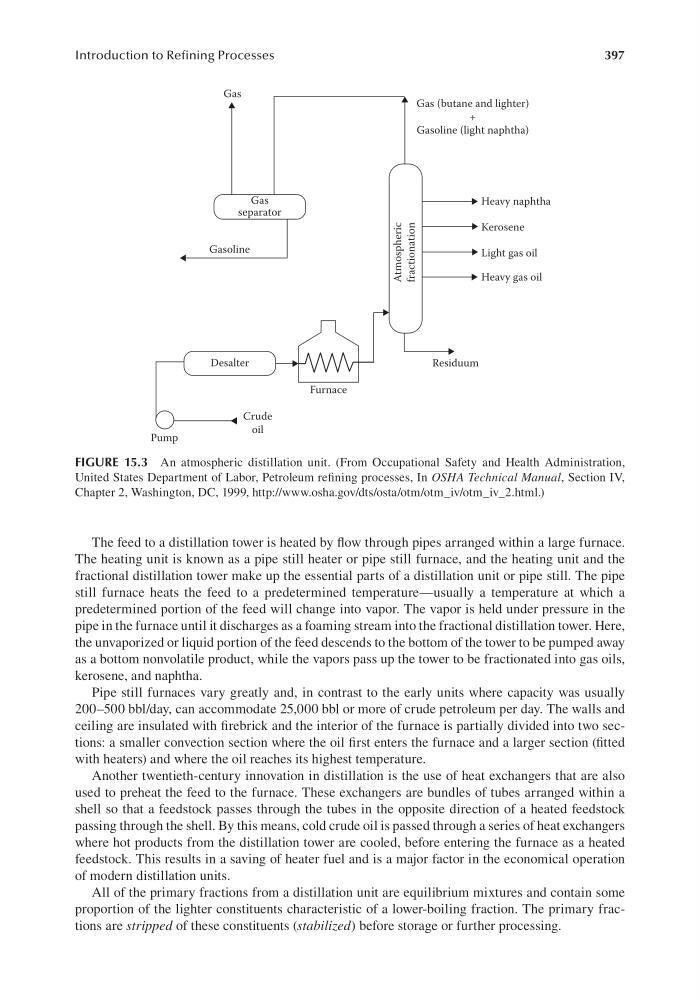
The feed to a distillation tower is heated by flow through pipes arranged within a large furnace.
The heating unit is known as a pipe still heater or pipe still furnace, and the heating unit and the
fractional distillation tower make up the essential parts of a distillation unit or pipe still. The pipe
still furnace heats the feed to a predetermined temperature—usually a temperature at which a
predetermined portion of the feed will change into vapor. The vapor is held under pressure in the
pipe in the furnace until it discharges as a foaming stream into the fractional distillation tower. Here,
the unvaporized or liquid portion of the feed descends to the bottom of the tower to be pumped away
as a bottom nonvolatile product, while the vapors pass up the tower to be fractionated into gas oils,
kerosene, and naphtha.
Pipe still furnaces vary greatly and, in contrast to the early units where capacity was usually
200–500 bbl/day, can accommodate 25,000 bbl or more of crude petroleum per day. The walls and
ceiling are insulated with firebrick and the interior of the furnace is partially divided into two sections: a smaller convection section where the oil first enters the furnace and a larger section (fitted
with heaters) and where the oil reaches its highest temperature.
Another twentieth-century innovation in distillation is the use of heat exchangers that are also
used to preheat the feed to the furnace. These exchangers are bundles of tubes arranged within a
shell so that a feedstock passes through the tubes in the opposite direction of a heated feedstock
passing through the shell. By this means, cold crude oil is passed through a series of heat exchangers
where hot products from the distillation tower are cooled, before entering the furnace as a heated
feedstock. This results in a saving of heater fuel and is a major factor in the economical operation
of modern distillation units.
All of the primary fractions from a distillation unit are equilibrium mixtures and contain some
proportion of the lighter constituents characteristic of a lower-boiling fraction. The primary fractions are stripped of these constituents (stabilized) before storage or further processing.
Gas (butane and lighter)
+
Gasoline (light naphtha)
Heavy naphtha
Gas
separator
Kerosene
Light gas oil
Heavy gas oil
Residuum
Furnace
Crude
oil
Desalter
Gas
Gasoline
Atmospheric
fractionation
Pump
FIGURE 15.3 An atmospheric distillation unit. (From Occupational Safety and Health Administration,
United States Department of Labor, Petroleum refining processes, In OSHA Technical Manual, Section IV,
Chapter 2, Washington, DC, 1999, http://www.osha.gov/dts/osta/otm/otm_iv/otm_iv_2.html.)
Introduction to Refining Processes
The feed to a distillation tower is heated by flow through pipes arranged within a large furnace.
The heating unit is known as a pipe still heater or pipe still furnace, and the heating unit and the
fractional distillation tower make up the essential parts of a distillation unit or pipe still. The pipe
still furnace heats the feed to a predetermined temperature—usually a temperature at which a
predetermined portion of the feed will change into vapor. The vapor is held under pressure in the
pipe in the furnace until it discharges as a foaming stream into the fractional distillation tower. Here,
the unvaporized or liquid portion of the feed descends to the bottom of the tower to be pumped away
as a bottom nonvolatile product, while the vapors pass up the tower to be fractionated into gas oils,
kerosene, and naphtha.
Pipe still furnaces vary greatly and, in contrast to the early units where capacity was usually
200–500 bbl/day, can accommodate 25,000 bbl or more of crude petroleum per day. The walls and
ceiling are insulated with firebrick and the interior of the furnace is partially divided into two sections: a smaller convection section where the oil first enters the furnace and a larger section (fitted
with heaters) and where the oil reaches its highest temperature.
Another twentieth-century innovation in distillation is the use of heat exchangers that are also
used to preheat the feed to the furnace. These exchangers are bundles of tubes arranged within a
shell so that a feedstock passes through the tubes in the opposite direction of a heated feedstock
passing through the shell. By this means, cold crude oil is passed through a series of heat exchangers
where hot products from the distillation tower are cooled, before entering the furnace as a heated
feedstock. This results in a saving of heater fuel and is a major factor in the economical operation
of modern distillation units.
All of the primary fractions from a distillation unit are equilibrium mixtures and contain some
proportion of the lighter constituents characteristic of a lower-boiling fraction. The primary fractions are stripped of these constituents (stabilized) before storage or further processing.
Gas (butane and lighter)
+
Gasoline (light naphtha)
Heavy naphtha
Gas
separator
Kerosene
Light gas oil
Heavy gas oil
Residuum
Furnace
Crude
oil
Desalter
Gas
Gasoline
Atmospheric
fractionation
Pump
FIGURE 15.3 An atmospheric distillation unit. (From Occupational Safety and Health Administration,
United States Department of Labor, Petroleum refining processes, In OSHA Technical Manual, Section IV,
Chapter 2, Washington, DC, 1999, http://www.osha.gov/dts/osta/otm/otm_iv/otm_iv_2.html.)