

14
The Chemistry and Technology of Petroleum
1.4 NATIVE MATERIALS
1.4.1 Petroleum
Petroleum and the equivalent term crude oil cover a wide assortment of materials consisting of
mixtures of hydrocarbons and other compounds containing variable amounts of sulfur, nitrogen,
and oxygen, which may vary widely in volatility, specific gravity, and viscosity. Metal-containing
constituents, notably those compounds that contain vanadium and nickel, usually occur in the more
viscous crude oils in amounts up to several thousand parts per million and can have serious consequences during processing of these feedstocks (Gruse and Stevens, 1960; Speight, 1984). Because
petroleum is a mixture of widely varying constituents and proportions, its physical properties also
vary widely and the color from colorless to black (Chapters 9 and 10) (Speight, 2012).
Petroleum occurs underground, at various pressures depending on the depth. Because of the
pressure, it contains considerable natural gas in solution. Petroleum underground is much more fluid
than it is on the surface and is generally mobile under reservoir conditions because the elevated temperatures (the geothermal gradient) in subterranean formations decrease the viscosity. Although
the geothermal gradient varies from place to place, it is generally on the order of 25°C–30°C/km
(15°F/1000 ft or 120°C/1000 ft, i.e., 0.015°C/ft of depth or 0.012°C/foot of depth).
Petroleum is derived from aquatic plants and animals that lived and died hundreds of millions
of years ago. Their remains mixed with mud and sand in layered deposits that, over the millennia,
were geologically transformed into sedimentary rock. Gradually the organic matter decomposed
and eventually formed petroleum (or a related precursor), which migrated from the original source
beds to more porous and permeable rocks, such as sandstone and siltstone, where it finally became
entrapped. Such entrapped accumulations of petroleum are called reservoirs. A series of reservoirs
within a common rock structure or a series of reservoirs in separate but neighboring formations is
commonly referred to as an oil field. A group of fields is often found in a single geologic environment known as a sedimentary basin or province.
The major components of petroleum (Chapters 8 and 9) are hydrocarbons, compounds of hydrogen and carbon that display great variation in their molecular structure. The simplest hydrocarbons
are a large group of chain-shaped molecules known as the paraffins. This broad series extends from
methane, which forms natural gas, through liquids that are refined into gasoline, to crystalline waxes.
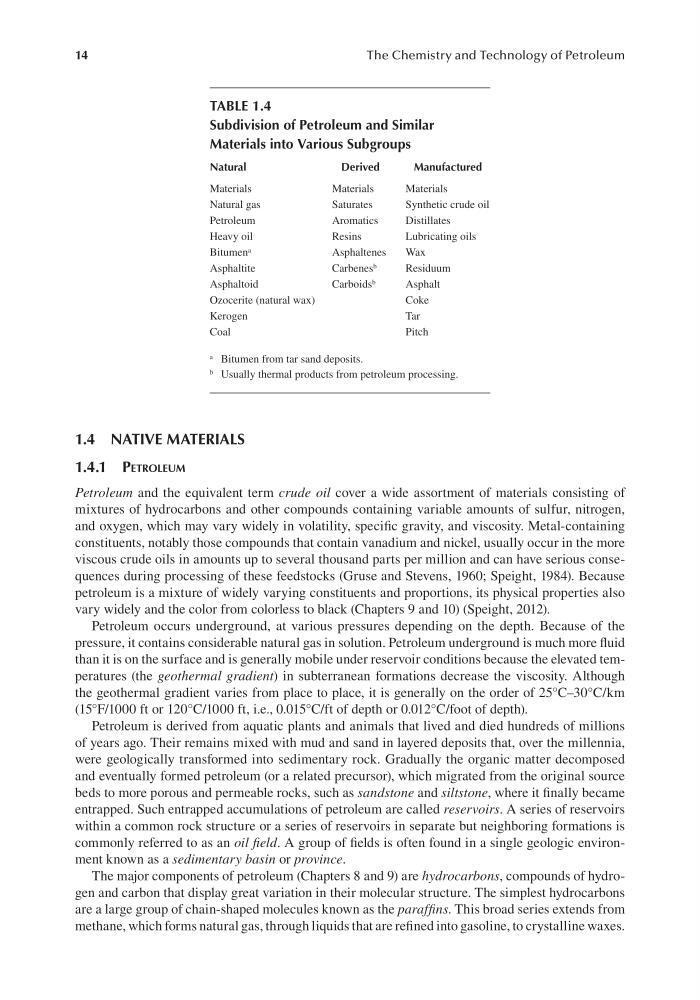
TABLE 1.4
Subdivision of Petroleum and Similar
Materials into Various Subgroups
Natural
Derived
Manufactured
Materials
Materials
Materials
Natural gas
Saturates
Synthetic crude oil
Petroleum
Aromatics
Distillates
Heavy oil
Resins
Lubricating oils
Bitumen a
Asphaltenes
Wax
Asphaltite
Carbenes b
Residuum
Asphaltoid
Carboids b
Asphalt
Ozocerite (natural wax)
Coke
Kerogen
Tar
Coal
Pitch
a Bitumen from tar sand deposits.
b Usually thermal products from petroleum processing.
The Chemistry and Technology of Petroleum
1.4 NATIVE MATERIALS
1.4.1 Petroleum
Petroleum and the equivalent term crude oil cover a wide assortment of materials consisting of
mixtures of hydrocarbons and other compounds containing variable amounts of sulfur, nitrogen,
and oxygen, which may vary widely in volatility, specific gravity, and viscosity. Metal-containing
constituents, notably those compounds that contain vanadium and nickel, usually occur in the more
viscous crude oils in amounts up to several thousand parts per million and can have serious consequences during processing of these feedstocks (Gruse and Stevens, 1960; Speight, 1984). Because
petroleum is a mixture of widely varying constituents and proportions, its physical properties also
vary widely and the color from colorless to black (Chapters 9 and 10) (Speight, 2012).
Petroleum occurs underground, at various pressures depending on the depth. Because of the
pressure, it contains considerable natural gas in solution. Petroleum underground is much more fluid
than it is on the surface and is generally mobile under reservoir conditions because the elevated temperatures (the geothermal gradient) in subterranean formations decrease the viscosity. Although
the geothermal gradient varies from place to place, it is generally on the order of 25°C–30°C/km
(15°F/1000 ft or 120°C/1000 ft, i.e., 0.015°C/ft of depth or 0.012°C/foot of depth).
Petroleum is derived from aquatic plants and animals that lived and died hundreds of millions
of years ago. Their remains mixed with mud and sand in layered deposits that, over the millennia,
were geologically transformed into sedimentary rock. Gradually the organic matter decomposed
and eventually formed petroleum (or a related precursor), which migrated from the original source
beds to more porous and permeable rocks, such as sandstone and siltstone, where it finally became
entrapped. Such entrapped accumulations of petroleum are called reservoirs. A series of reservoirs
within a common rock structure or a series of reservoirs in separate but neighboring formations is
commonly referred to as an oil field. A group of fields is often found in a single geologic environment known as a sedimentary basin or province.
The major components of petroleum (Chapters 8 and 9) are hydrocarbons, compounds of hydrogen and carbon that display great variation in their molecular structure. The simplest hydrocarbons
are a large group of chain-shaped molecules known as the paraffins. This broad series extends from
methane, which forms natural gas, through liquids that are refined into gasoline, to crystalline waxes.
TABLE 1.4
Subdivision of Petroleum and Similar
Materials into Various Subgroups
Natural
Derived
Manufactured
Materials
Materials
Materials
Natural gas
Saturates
Synthetic crude oil
Petroleum
Aromatics
Distillates
Heavy oil
Resins
Lubricating oils
Bitumen a
Asphaltenes
Wax
Asphaltite
Carbenes b
Residuum
Asphaltoid
Carboids b
Asphalt
Ozocerite (natural wax)
Coke
Kerogen
Tar
Coal
Pitch
a Bitumen from tar sand deposits.
b Usually thermal products from petroleum processing.