

13
History and Terminology
Petroleum products have a wide variety of uses that vary from gaseous and liquid fuels to nearsolid machinery lubricants. In addition, the residue of many refinery processes, asphalt—a oncemaligned by-product—is now a premium value product for highway surfaces, roofing materials, and
miscellaneous waterproofing uses.
Crude petroleum is a mixture of compounds boiling at different temperatures that can be separated into a variety of different generic fractions by distillation (Chapter 17). And the terminology
of these fractions has been bound by utility and often bears little relationship to composition.
The molecular boundaries of petroleum cover a wide range of boiling points and carbon numbers of hydrocarbon compounds and other compounds containing nitrogen, oxygen, and sulfur, as
well as metallic (porphyrinic) constituents. However, the actual boundaries of such a petroleum
map can only be arbitrarily defined in terms of boiling point and carbon number (Chapter 9).
In fact, petroleum is so diverse that materials from different sources exhibit different boundary
limits, and for this reason alone it is not surprising that petroleum has been difficult to map in a
precise manner.
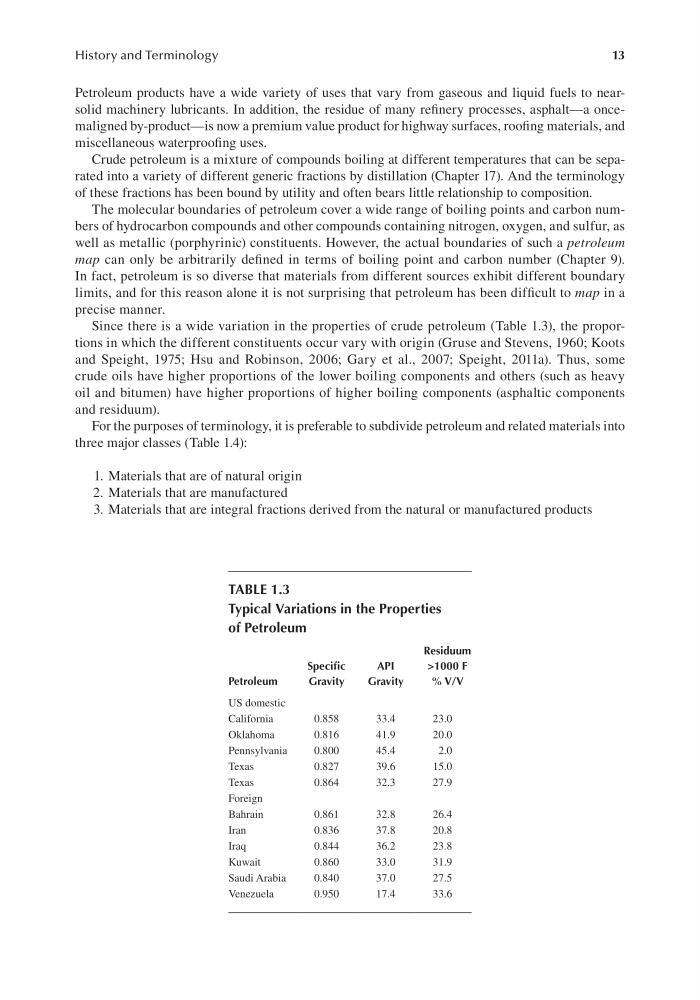
Since there is a wide variation in the properties of crude petroleum (Table 1.3), the proportions in which the different constituents occur vary with origin (Gruse and Stevens, 1960; Koots
and Speight, 1975; Hsu and Robinson, 2006; Gary et al., 2007; Speight, 2011a). Thus, some
crude oils have higher proportions of the lower boiling components and others (such as heavy
oil and bitumen) have higher proportions of higher boiling components (asphaltic components
and residuum).
For the purposes of terminology, it is preferable to subdivide petroleum and related materials into
three major classes (Table 1.4):
1. Materials that are of natural origin
2. Materials that are manufactured
3. Materials that are integral fractions derived from the natural or manufactured products
TABLE 1.3
Typical Variations in the Properties
of Petroleum
Petroleum
Specific
Gravity
API
Gravity
Residuum
>1000 F
% V/V
US domestic
California
0.858
33.4
23.0
Oklahoma
0.816
41.9
20.0
Pennsylvania
0.800
45.4
2.0
Texas
0.827
39.6
15.0
Texas
0.864
32.3
27.9
Foreign
Bahrain
0.861
32.8
26.4
Iran
0.836
37.8
20.8
Iraq
0.844
36.2
23.8
Kuwait
0.860
33.0
31.9
Saudi Arabia
0.840
37.0
27.5
Venezuela
0.950
17.4
33.6
History and Terminology
Petroleum products have a wide variety of uses that vary from gaseous and liquid fuels to nearsolid machinery lubricants. In addition, the residue of many refinery processes, asphalt—a oncemaligned by-product—is now a premium value product for highway surfaces, roofing materials, and
miscellaneous waterproofing uses.
Crude petroleum is a mixture of compounds boiling at different temperatures that can be separated into a variety of different generic fractions by distillation (Chapter 17). And the terminology
of these fractions has been bound by utility and often bears little relationship to composition.
The molecular boundaries of petroleum cover a wide range of boiling points and carbon numbers of hydrocarbon compounds and other compounds containing nitrogen, oxygen, and sulfur, as
well as metallic (porphyrinic) constituents. However, the actual boundaries of such a petroleum
map can only be arbitrarily defined in terms of boiling point and carbon number (Chapter 9).
In fact, petroleum is so diverse that materials from different sources exhibit different boundary
limits, and for this reason alone it is not surprising that petroleum has been difficult to map in a
precise manner.
Since there is a wide variation in the properties of crude petroleum (Table 1.3), the proportions in which the different constituents occur vary with origin (Gruse and Stevens, 1960; Koots
and Speight, 1975; Hsu and Robinson, 2006; Gary et al., 2007; Speight, 2011a). Thus, some
crude oils have higher proportions of the lower boiling components and others (such as heavy
oil and bitumen) have higher proportions of higher boiling components (asphaltic components
and residuum).
For the purposes of terminology, it is preferable to subdivide petroleum and related materials into
three major classes (Table 1.4):
1. Materials that are of natural origin
2. Materials that are manufactured
3. Materials that are integral fractions derived from the natural or manufactured products
TABLE 1.3
Typical Variations in the Properties
of Petroleum
Petroleum
Specific
Gravity
API
Gravity
Residuum
>1000 F
% V/V
US domestic
California
0.858
33.4
23.0
Oklahoma
0.816
41.9
20.0
Pennsylvania
0.800
45.4
2.0
Texas
0.827
39.6
15.0
Texas
0.864
32.3
27.9
Foreign
Bahrain
0.861
32.8
26.4
Iran
0.836
37.8
20.8
Iraq
0.844
36.2
23.8
Kuwait
0.860
33.0
31.9
Saudi Arabia
0.840
37.0
27.5
Venezuela
0.950
17.4
33.6