

378
The Chemistry and Technology of Petroleum
in processing petroleum residua (Chapter 20)—the asphaltene constituents are soluble in liquids such
as benzene, toluene, pyridine, carbon disulfide, and carbon tetrachloride.
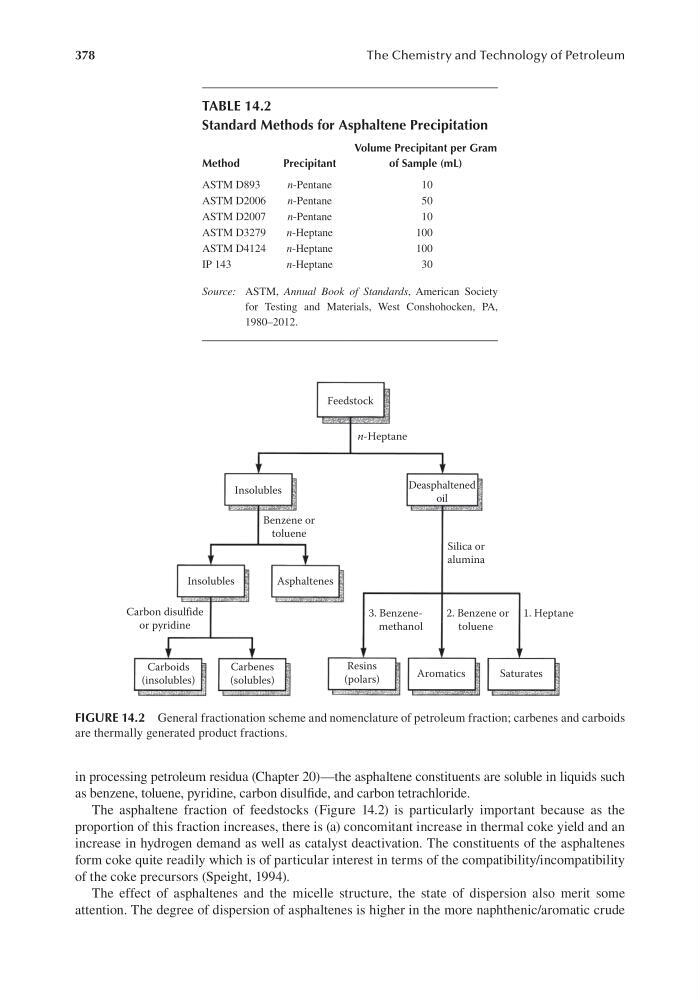
The asphaltene fraction of feedstocks (Figure 14.2) is particularly important because as the
proportion of this fraction increases, there is (a) concomitant increase in thermal coke yield and an
increase in hydrogen demand as well as catalyst deactivation. The constituents of the asphaltenes
form coke quite readily which is of particular interest in terms of the compatibility/incompatibility
of the coke precursors (Speight, 1994).
The effect of asphaltenes and the micelle structure, the state of dispersion also merit some
attention. The degree of dispersion of asphaltenes is higher in the more naphthenic/aromatic crude
TABLE 14.2
Standard Methods for Asphaltene Precipitation
Method
Precipitant
Volume Precipitant per Gram
of Sample (mL)
ASTM D893
n-Pentane
10
ASTM D2006
n-Pentane
50
ASTM D2007
n-Pentane
10
ASTM D3279
n-Heptane
100
ASTM D4124
n-Heptane
100
IP 143
n-Heptane
30
Source: ASTM, Annual Book of Standards, American Society
for Testing and Materials, West Conshohocken, PA,
1980–2012.
n-Heptane
Feedstock
Insolubles
Insolubles
Asphaltenes
Carbon disulfide
or pyridine
Deasphaltened
oil
Benzene or
toluene
Silica or
alumina
3. Benzenemethanol
2. Benzene or 1. Heptane
Saturates
Aromatics
Resins
(polars)
Carbenes
(solubles)
Carboids
(insolubles)
toluene
FIGURE 14.2 General fractionation scheme and nomenclature of petroleum fraction; carbenes and carboids
are thermally generated product fractions.
The Chemistry and Technology of Petroleum
in processing petroleum residua (Chapter 20)—the asphaltene constituents are soluble in liquids such
as benzene, toluene, pyridine, carbon disulfide, and carbon tetrachloride.
The asphaltene fraction of feedstocks (Figure 14.2) is particularly important because as the
proportion of this fraction increases, there is (a) concomitant increase in thermal coke yield and an
increase in hydrogen demand as well as catalyst deactivation. The constituents of the asphaltenes
form coke quite readily which is of particular interest in terms of the compatibility/incompatibility
of the coke precursors (Speight, 1994).
The effect of asphaltenes and the micelle structure, the state of dispersion also merit some
attention. The degree of dispersion of asphaltenes is higher in the more naphthenic/aromatic crude
TABLE 14.2
Standard Methods for Asphaltene Precipitation
Method
Precipitant
Volume Precipitant per Gram
of Sample (mL)
ASTM D893
n-Pentane
10
ASTM D2006
n-Pentane
50
ASTM D2007
n-Pentane
10
ASTM D3279
n-Heptane
100
ASTM D4124
n-Heptane
100
IP 143
n-Heptane
30
Source: ASTM, Annual Book of Standards, American Society
for Testing and Materials, West Conshohocken, PA,
1980–2012.
n-Heptane
Feedstock
Insolubles
Insolubles
Asphaltenes
Carbon disulfide
or pyridine
Deasphaltened
oil
Benzene or
toluene
Silica or
alumina
3. Benzenemethanol
2. Benzene or 1. Heptane
Saturates
Aromatics
Resins
(polars)
Carbenes
(solubles)
Carboids
(insolubles)
toluene
FIGURE 14.2 General fractionation scheme and nomenclature of petroleum fraction; carbenes and carboids
are thermally generated product fractions.