

377
Instability and Incompatibility
fuel, and lubricating oil are made up of hydrocarbon constituents containing high proportions of
hydrogen. Thus, it is not surprising that test to determine the volatility of petroleum and petroleum
products was among the first to be defined.
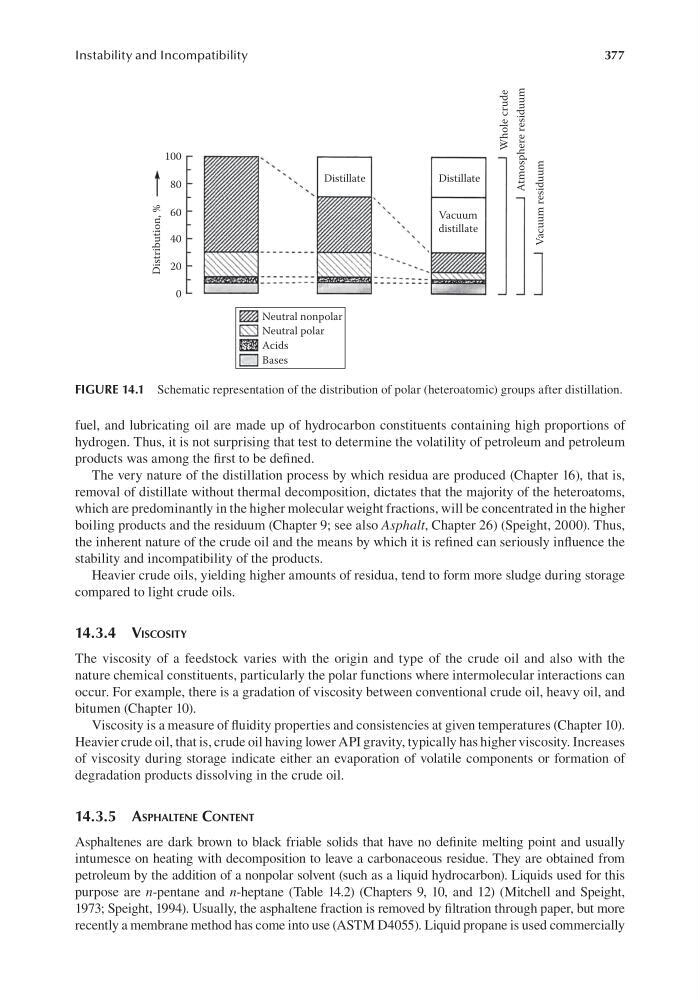
The very nature of the distillation process by which residua are produced (Chapter 16), that is,
removal of distillate without thermal decomposition, dictates that the majority of the hetero atoms,
which are predominantly in the higher molecular weight fractions, will be concentrated in the higher
boiling products and the residuum (Chapter 9; see also Asphalt, Chapter 26) (Speight, 2000). Thus,
the inherent nature of the crude oil and the means by which it is refined can seriously influence the
stability and incompatibility of the products.
Heavier crude oils, yielding higher amounts of residua, tend to form more sludge during storage
compared to light crude oils.
14.3.4 vIsCosIty
The viscosity of a feedstock varies with the origin and type of the crude oil and also with the
nature chemical constituents, particularly the polar functions where intermolecular interactions can
occur. For example, there is a gradation of viscosity between conventional crude oil, heavy oil, and
bitumen (Chapter 10).
Viscosity is a measure of fluidity properties and consistencies at given temperatures (Chapter 10).
Heavier crude oil, that is, crude oil having lower API gravity, typically has higher viscosity. Increases
of viscosity during storage indicate either an evaporation of volatile components or formation of
degradation products dissolving in the crude oil.
14.3.5 AsPHAltene Content
Asphaltenes are dark brown to black friable solids that have no definite melting point and usually
intumesce on heating with decomposition to leave a carbonaceous residue. They are obtained from
petroleum by the addition of a nonpolar solvent (such as a liquid hydrocarbon). Liquids used for this
purpose are n-pentane and n-heptane (Table 14.2) (Chapters 9, 10, and 12) (Mitchell and Speight,
1973; Speight, 1994). Usually, the asphaltene fraction is removed by filtration through paper, but more
recently a membrane method has come into use (ASTM D4055). Liquid propane is used commercially
Distillate
D istillate
Whole crude
Atmosphere
residuum
Vacuum residuum
Vacuum
distillate
Neutral nonpolar
Neutral polar
Acids
Bases
0
Distribution, %
20
40
60
80
100
FIGURE 14.1 Schematic representation of the distribution of polar (heteroatomic) groups after distillation.
Instability and Incompatibility
fuel, and lubricating oil are made up of hydrocarbon constituents containing high proportions of
hydrogen. Thus, it is not surprising that test to determine the volatility of petroleum and petroleum
products was among the first to be defined.
The very nature of the distillation process by which residua are produced (Chapter 16), that is,
removal of distillate without thermal decomposition, dictates that the majority of the hetero atoms,
which are predominantly in the higher molecular weight fractions, will be concentrated in the higher
boiling products and the residuum (Chapter 9; see also Asphalt, Chapter 26) (Speight, 2000). Thus,
the inherent nature of the crude oil and the means by which it is refined can seriously influence the
stability and incompatibility of the products.
Heavier crude oils, yielding higher amounts of residua, tend to form more sludge during storage
compared to light crude oils.
14.3.4 vIsCosIty
The viscosity of a feedstock varies with the origin and type of the crude oil and also with the
nature chemical constituents, particularly the polar functions where intermolecular interactions can
occur. For example, there is a gradation of viscosity between conventional crude oil, heavy oil, and
bitumen (Chapter 10).
Viscosity is a measure of fluidity properties and consistencies at given temperatures (Chapter 10).
Heavier crude oil, that is, crude oil having lower API gravity, typically has higher viscosity. Increases
of viscosity during storage indicate either an evaporation of volatile components or formation of
degradation products dissolving in the crude oil.
14.3.5 AsPHAltene Content
Asphaltenes are dark brown to black friable solids that have no definite melting point and usually
intumesce on heating with decomposition to leave a carbonaceous residue. They are obtained from
petroleum by the addition of a nonpolar solvent (such as a liquid hydrocarbon). Liquids used for this
purpose are n-pentane and n-heptane (Table 14.2) (Chapters 9, 10, and 12) (Mitchell and Speight,
1973; Speight, 1994). Usually, the asphaltene fraction is removed by filtration through paper, but more
recently a membrane method has come into use (ASTM D4055). Liquid propane is used commercially
Distillate
D istillate
Whole crude
Atmosphere
residuum
Vacuum residuum
Vacuum
distillate
Neutral nonpolar
Neutral polar
Acids
Bases
0
Distribution, %
20
40
60
80
100
FIGURE 14.1 Schematic representation of the distribution of polar (heteroatomic) groups after distillation.