

335
Asphaltene Constituents
The structural nature of the asphaltenes has been open to question for some time. Early postulates
invoked the concept of simple aromatic structures, while other postulates consider the possibility of
polymers of aromatic and naphthenic ring systems (see, e.g., Hillman and Barnett, 1937). A considerable amount of structural work has been carried out since that time on asphaltenes from various
crude oils. In fact, attempts to derive information about the carbon skeleton of the asphaltenes have
mainly been centered on the use of infrared and nuclear magnetic resonance spectroscopic techniques (Chapter 11).
The data obtained by these methods seemingly supported the occurrence of condensed polynuclear aromatic ring systems bearing alkyl side chains. The condensed aromatic ring systems appear
to vary from smaller systems composed of about 6 rings to the more ponderous, 15-ring to 20-ring
systems. The high molecular weight of asphaltenes is accounted for by suggesting that the unit is
repeated one or more times and is linked through saturated chains or rings.
However, it is somewhat difficult to visualize the existence of structures of this type as part of the
asphaltene molecule, irrespective of their means of derivation. Indeed, all the methods employed for
structural analysis involve, at some stage or another, assumptions that, although based upon molecular types identified in the more volatile fractions of petroleum, must be of questionable validity, even
though they may appear to serve the purpose and produce acceptable data.
Of all the methods applied to determining the types of polynuclear aromatic systems in petroleum asphaltenes (Speight and Long, 1981; Tissot, 1984), one with considerable potential, but given
the least attention, is ultraviolet spectroscopy (Bjorseth, 1983). Typically, the ultraviolet spectrum of
a petroleum asphaltene shows two major regions with very little fine structure, and interpretation of
such a spectrum can only be made in general terms. What is often not realized is that the technique
can add valuable information about the degree of condensation of polynuclear aromatic ring systems through the auspices of high-performance liquid chromatography (Lee et al., 1981; Bjorseth,
1983; Speight, 1986b).
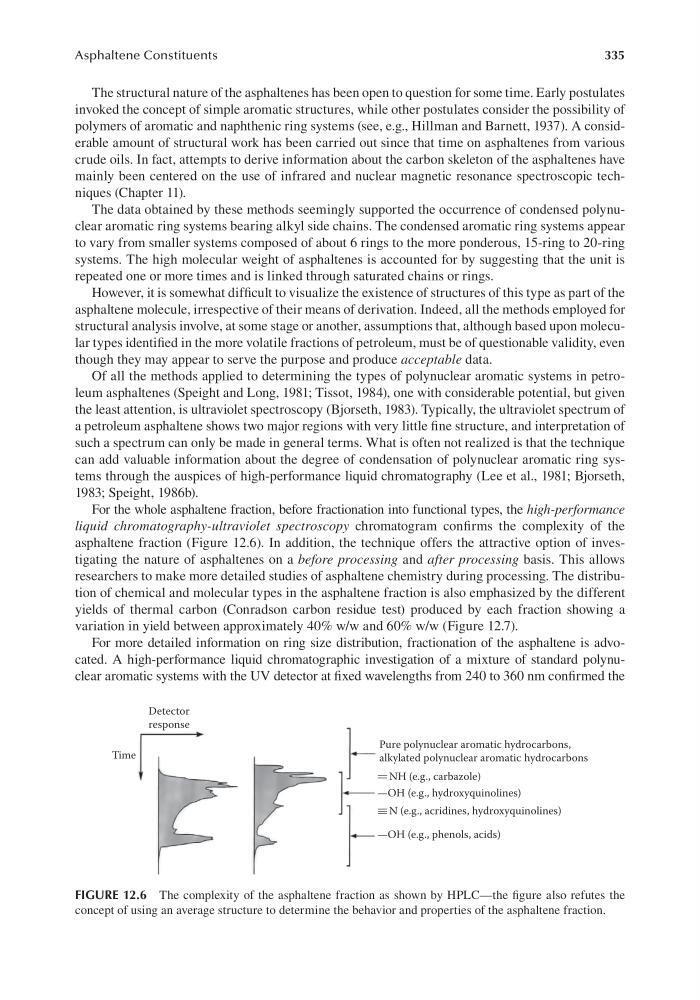
For the whole asphaltene fraction, before fractionation into functional types, the high- performance
liquid chromatography-ultraviolet spectroscopy chromatogram confirms the complexity of the
asphaltene fraction (Figure 12.6). In addition, the technique offers the attractive option of investigating the nature of asphaltenes on a before processing and after processing basis. This allows
researchers to make more detailed studies of asphaltene chemistry during processing. The distribution of chemical and molecular types in the asphaltene fraction is also emphasized by the different
yields of thermal carbon (Conradson carbon residue test) produced by each fraction showing a
variation in yield between approximately 40% w/w and 60% w/w (Figure 12.7).
For more detailed information on ring size distribution, fractionation of the asphaltene is advocated. A high-performance liquid chromatographic investigation of a mixture of standard polynuclear aromatic systems with the UV detector at fixed wavelengths from 240 to 360 nm confirmed the
Detector
response
Pure polynuclear aromatic hydrocarbons,
alkylated polynuclear aromatic hydrocarbons
—OH (e.g., hydroxyquinolines)
—OH (e.g., phenols, acids)
N (e.g., acridines, hydroxyquinolines)
NH (e.g., carbazole)
— —
— — —
Time
FIGURE 12.6 The complexity of the asphaltene fraction as shown by HPLC—the figure also refutes the
concept of using an average structure to determine the behavior and properties of the asphaltene fraction.
Asphaltene Constituents
The structural nature of the asphaltenes has been open to question for some time. Early postulates
invoked the concept of simple aromatic structures, while other postulates consider the possibility of
polymers of aromatic and naphthenic ring systems (see, e.g., Hillman and Barnett, 1937). A considerable amount of structural work has been carried out since that time on asphaltenes from various
crude oils. In fact, attempts to derive information about the carbon skeleton of the asphaltenes have
mainly been centered on the use of infrared and nuclear magnetic resonance spectroscopic techniques (Chapter 11).
The data obtained by these methods seemingly supported the occurrence of condensed polynuclear aromatic ring systems bearing alkyl side chains. The condensed aromatic ring systems appear
to vary from smaller systems composed of about 6 rings to the more ponderous, 15-ring to 20-ring
systems. The high molecular weight of asphaltenes is accounted for by suggesting that the unit is
repeated one or more times and is linked through saturated chains or rings.
However, it is somewhat difficult to visualize the existence of structures of this type as part of the
asphaltene molecule, irrespective of their means of derivation. Indeed, all the methods employed for
structural analysis involve, at some stage or another, assumptions that, although based upon molecular types identified in the more volatile fractions of petroleum, must be of questionable validity, even
though they may appear to serve the purpose and produce acceptable data.
Of all the methods applied to determining the types of polynuclear aromatic systems in petroleum asphaltenes (Speight and Long, 1981; Tissot, 1984), one with considerable potential, but given
the least attention, is ultraviolet spectroscopy (Bjorseth, 1983). Typically, the ultraviolet spectrum of
a petroleum asphaltene shows two major regions with very little fine structure, and interpretation of
such a spectrum can only be made in general terms. What is often not realized is that the technique
can add valuable information about the degree of condensation of polynuclear aromatic ring systems through the auspices of high-performance liquid chromatography (Lee et al., 1981; Bjorseth,
1983; Speight, 1986b).
For the whole asphaltene fraction, before fractionation into functional types, the high- performance
liquid chromatography-ultraviolet spectroscopy chromatogram confirms the complexity of the
asphaltene fraction (Figure 12.6). In addition, the technique offers the attractive option of investigating the nature of asphaltenes on a before processing and after processing basis. This allows
researchers to make more detailed studies of asphaltene chemistry during processing. The distribution of chemical and molecular types in the asphaltene fraction is also emphasized by the different
yields of thermal carbon (Conradson carbon residue test) produced by each fraction showing a
variation in yield between approximately 40% w/w and 60% w/w (Figure 12.7).
For more detailed information on ring size distribution, fractionation of the asphaltene is advocated. A high-performance liquid chromatographic investigation of a mixture of standard polynuclear aromatic systems with the UV detector at fixed wavelengths from 240 to 360 nm confirmed the
Detector
response
Pure polynuclear aromatic hydrocarbons,
alkylated polynuclear aromatic hydrocarbons
—OH (e.g., hydroxyquinolines)
—OH (e.g., phenols, acids)
N (e.g., acridines, hydroxyquinolines)
NH (e.g., carbazole)
— —
— — —
Time
FIGURE 12.6 The complexity of the asphaltene fraction as shown by HPLC—the figure also refutes the
concept of using an average structure to determine the behavior and properties of the asphaltene fraction.