

333
Asphaltene Constituents
Assuming that the activity of the asphaltenes a a is 1 (solid asphaltenes in equilibrium with dissolved
asphaltenes) and the volume fraction of an excess of solvent is essentially 1, the equation can be
rearranged into a form that can be used to gain insight into the solubility of asphaltenes:
ln x
M
RT
a
a
a
s
a
2
= -
-
D [(
) ]
d d
Assuming a density for asphaltenes of 1.28 g/cc and a molecular weight of 1000 g/mole, the solubility of asphaltenes as a function of the differences between solubility parameters of the asphaltenes
and precipitating solvent can be calculated. Thus, the solubility of asphaltenes can be shown to
decrease as the difference between solubility parameters increases, with the limit of solubility
attained at a difference of about 3. Thus, if the asphaltenes are part of a polarity and molecular
weight continuum in a crude oil, their precipitation is not as straightforward as it would be for a
single species with a particular solubility parameter.
Additional information can be gleaned by calculating the solubility parameter difference at several
molecular weights ranging from 50 to 10,000 g/mole at which the solubility of asphaltenic or other material is a mole fraction of 0.001 (0.1% or 1,000 ppm). As a result, a phase diagram that is a function of
molecular weight and solubility parameter difference can be defined. Both polarity and molecular weight
of asphaltenes in a solvent define the solubility boundaries and explains conceptually how asphaltenes
are precipitated from the mixture in crude oils that can be considered a type of continuum of molecular
weights and polarities. Furthermore, as the molecular weight of a particular solute decreases, there is an
increased tolerance of polarity difference between solute and solvent under miscible conditions.
Incompatibility phenomena can be explained by the use of the solubility parameter for asphaltenes
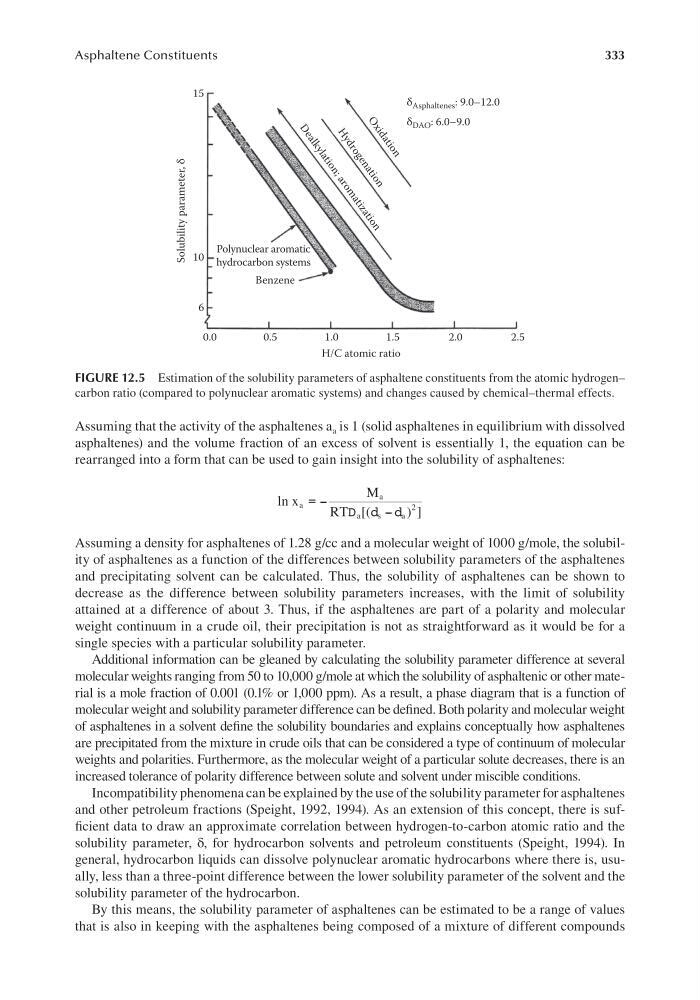
and other petroleum fractions (Speight, 1992, 1994). As an extension of this concept, there is sufficient data to draw an approximate correlation between hydrogen-to-carbon atomic ratio and the
solubility parameter, δ, for hydrocarbon solvents and petroleum constituents (Speight, 1994). In
general, hydrocarbon liquids can dissolve polynuclear aromatic hydrocarbons where there is, usually, less than a three-point difference between the lower solubility parameter of the solvent and the
solubility parameter of the hydrocarbon.
By this means, the solubility parameter of asphaltenes can be estimated to be a range of values
that is also in keeping with the asphaltenes being composed of a mixture of different compounds
0.5
Benzene
Polynuclear aromatic
hydrocarbon systems
D e a l k y l a t i o n ; a r o m a t i z a t i o n
H y d r o g e n a t i o n
O x i d a t i o n
0.0
6
10
15
1.0
Solubility parameter, δ
1.5
2.0
2.5
δ Asphaltenes : 9.0–12.0
δ DAO : 6.0–9.0
H/C atomic ratio
FIGURE 12.5 Estimation of the solubility parameters of asphaltene constituents from the atomic hydrogen–
carbon ratio (compared to polynuclear aromatic systems) and changes caused by chemical–thermal effects.
Asphaltene Constituents
Assuming that the activity of the asphaltenes a a is 1 (solid asphaltenes in equilibrium with dissolved
asphaltenes) and the volume fraction of an excess of solvent is essentially 1, the equation can be
rearranged into a form that can be used to gain insight into the solubility of asphaltenes:
ln x
M
RT
a
a
a
s
a
2
= -
-
D [(
) ]
d d
Assuming a density for asphaltenes of 1.28 g/cc and a molecular weight of 1000 g/mole, the solubility of asphaltenes as a function of the differences between solubility parameters of the asphaltenes
and precipitating solvent can be calculated. Thus, the solubility of asphaltenes can be shown to
decrease as the difference between solubility parameters increases, with the limit of solubility
attained at a difference of about 3. Thus, if the asphaltenes are part of a polarity and molecular
weight continuum in a crude oil, their precipitation is not as straightforward as it would be for a
single species with a particular solubility parameter.
Additional information can be gleaned by calculating the solubility parameter difference at several
molecular weights ranging from 50 to 10,000 g/mole at which the solubility of asphaltenic or other material is a mole fraction of 0.001 (0.1% or 1,000 ppm). As a result, a phase diagram that is a function of
molecular weight and solubility parameter difference can be defined. Both polarity and molecular weight
of asphaltenes in a solvent define the solubility boundaries and explains conceptually how asphaltenes
are precipitated from the mixture in crude oils that can be considered a type of continuum of molecular
weights and polarities. Furthermore, as the molecular weight of a particular solute decreases, there is an
increased tolerance of polarity difference between solute and solvent under miscible conditions.
Incompatibility phenomena can be explained by the use of the solubility parameter for asphaltenes
and other petroleum fractions (Speight, 1992, 1994). As an extension of this concept, there is sufficient data to draw an approximate correlation between hydrogen-to-carbon atomic ratio and the
solubility parameter, δ, for hydrocarbon solvents and petroleum constituents (Speight, 1994). In
general, hydrocarbon liquids can dissolve polynuclear aromatic hydrocarbons where there is, usually, less than a three-point difference between the lower solubility parameter of the solvent and the
solubility parameter of the hydrocarbon.
By this means, the solubility parameter of asphaltenes can be estimated to be a range of values
that is also in keeping with the asphaltenes being composed of a mixture of different compounds
0.5
Benzene
Polynuclear aromatic
hydrocarbon systems
D e a l k y l a t i o n ; a r o m a t i z a t i o n
H y d r o g e n a t i o n
O x i d a t i o n
0.0
6
10
15
1.0
Solubility parameter, δ
1.5
2.0
2.5
δ Asphaltenes : 9.0–12.0
δ DAO : 6.0–9.0
H/C atomic ratio
FIGURE 12.5 Estimation of the solubility parameters of asphaltene constituents from the atomic hydrogen–
carbon ratio (compared to polynuclear aromatic systems) and changes caused by chemical–thermal effects.