

332
The Chemistry and Technology of Petroleum
The most prevalent thermodynamic approach to describing asphaltene solubility has been the
application of the solubility parameter or the concept of cohesive energy density. The application
of solubility parameter data to correlate asphaltene precipitation, and, hence, crude oil–solvent
interaction, has been used on prior occasions (Labout, 1950; Mitchell and Speight, 1973; Wiehe,
1995). The solubility parameters of asphaltene constituents can be estimated from the properties
of the solvent used for separation (Yen, 1984; Long and Speight, 1989) or be measured by the
titration method (Andersen and Speight, 1992) or even from the atomic hydrogen–carbon ratio
(Figure 12.5).
The solubility parameter difference that results in a phase separation of two materials, such as
asphaltene constituents in a solvent, can be estimated using the Scatchard–Hildebrand equation:
ln a ln x
M
RT
a
a
a
a
s
a
2
=
+
-
{
[ (
) ]}
r
d d
F s
2
where
a a is the activity of the solute a
x a is the mole fraction solubility of a
M a is the molecular weight of a
ρ a is the density of a
Φ s is the volume fraction of solvent
(δ s − δ a ) is the difference between the solubility parameters of the solute a and the solvent s
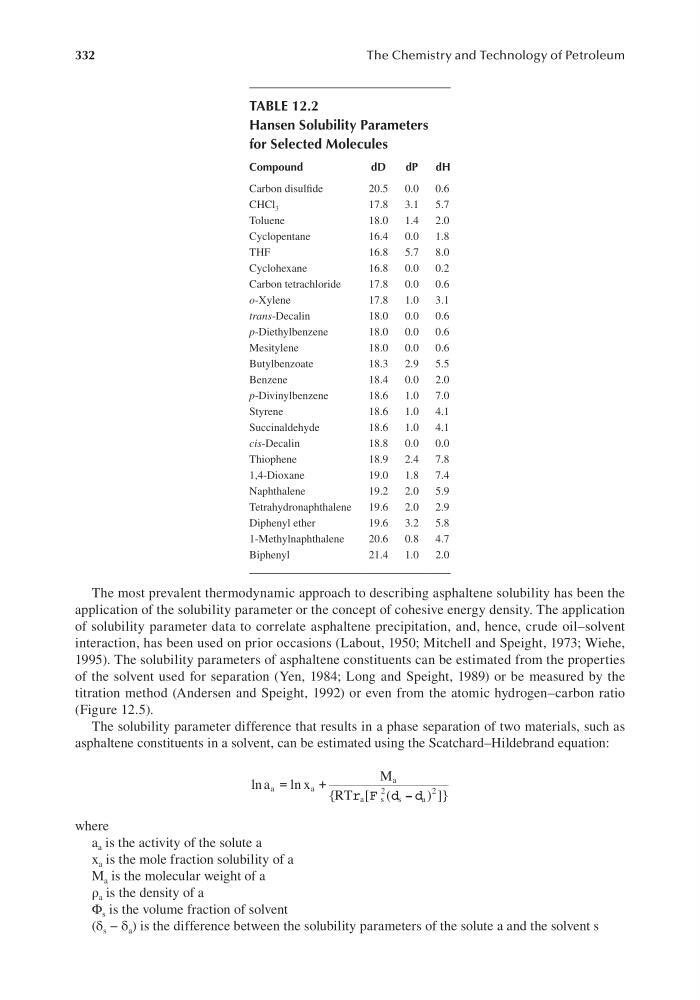
TABLE 12.2
Hansen Solubility Parameters
for Selected Molecules
Compound
dD
dP
dH
Carbon disulfide
20.5 0.0 0.6
CHCl 3
17.8 3.1 5.7
Toluene
18.0 1.4 2.0
Cyclopentane
16.4 0.0 1.8
THF
16.8 5.7 8.0
Cyclohexane
16.8 0.0 0.2
Carbon tetrachloride
17.8 0.0 0.6
o-Xylene
17.8 1.0 3.1
trans-Decalin
18.0 0.0 0.6
p-Diethylbenzene
18.0 0.0 0.6
Mesitylene
18.0 0.0 0.6
Butylbenzoate
18.3 2.9 5.5
Benzene
18.4 0.0 2.0
p-Divinylbenzene
18.6 1.0 7.0
Styrene
18.6 1.0 4.1
Succinaldehyde
18.6 1.0 4.1
cis-Decalin
18.8 0.0 0.0
Thiophene
18.9 2.4 7.8
1,4-Dioxane
19.0 1.8 7.4
Naphthalene
19.2 2.0 5.9
Tetrahydronaphthalene
19.6 2.0 2.9
Diphenyl ether
19.6 3.2 5.8
1-Methylnaphthalene
20.6 0.8 4.7
Biphenyl
21.4 1.0 2.0
The Chemistry and Technology of Petroleum
The most prevalent thermodynamic approach to describing asphaltene solubility has been the
application of the solubility parameter or the concept of cohesive energy density. The application
of solubility parameter data to correlate asphaltene precipitation, and, hence, crude oil–solvent
interaction, has been used on prior occasions (Labout, 1950; Mitchell and Speight, 1973; Wiehe,
1995). The solubility parameters of asphaltene constituents can be estimated from the properties
of the solvent used for separation (Yen, 1984; Long and Speight, 1989) or be measured by the
titration method (Andersen and Speight, 1992) or even from the atomic hydrogen–carbon ratio
(Figure 12.5).
The solubility parameter difference that results in a phase separation of two materials, such as
asphaltene constituents in a solvent, can be estimated using the Scatchard–Hildebrand equation:
ln a ln x
M
RT
a
a
a
a
s
a
2
=
+
-
{
[ (
) ]}
r
d d
F s
2
where
a a is the activity of the solute a
x a is the mole fraction solubility of a
M a is the molecular weight of a
ρ a is the density of a
Φ s is the volume fraction of solvent
(δ s − δ a ) is the difference between the solubility parameters of the solute a and the solvent s
TABLE 12.2
Hansen Solubility Parameters
for Selected Molecules
Compound
dD
dP
dH
Carbon disulfide
20.5 0.0 0.6
CHCl 3
17.8 3.1 5.7
Toluene
18.0 1.4 2.0
Cyclopentane
16.4 0.0 1.8
THF
16.8 5.7 8.0
Cyclohexane
16.8 0.0 0.2
Carbon tetrachloride
17.8 0.0 0.6
o-Xylene
17.8 1.0 3.1
trans-Decalin
18.0 0.0 0.6
p-Diethylbenzene
18.0 0.0 0.6
Mesitylene
18.0 0.0 0.6
Butylbenzoate
18.3 2.9 5.5
Benzene
18.4 0.0 2.0
p-Divinylbenzene
18.6 1.0 7.0
Styrene
18.6 1.0 4.1
Succinaldehyde
18.6 1.0 4.1
cis-Decalin
18.8 0.0 0.0
Thiophene
18.9 2.4 7.8
1,4-Dioxane
19.0 1.8 7.4
Naphthalene
19.2 2.0 5.9
Tetrahydronaphthalene
19.6 2.0 2.9
Diphenyl ether
19.6 3.2 5.8
1-Methylnaphthalene
20.6 0.8 4.7
Biphenyl
21.4 1.0 2.0