

294
The Chemistry and Technology of Petroleum
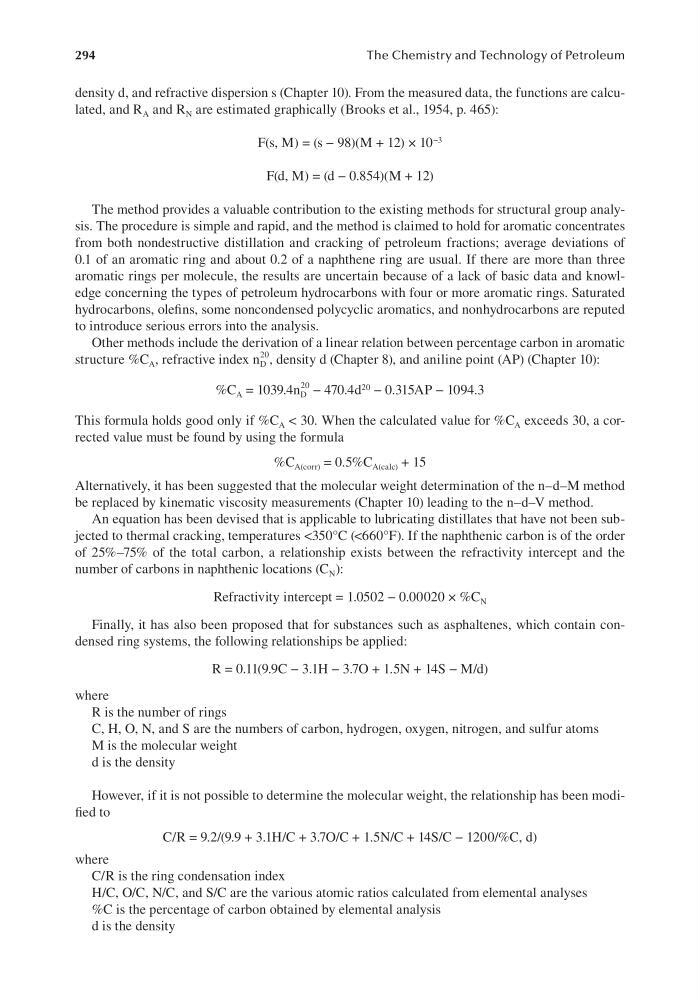
density d, and refractive dispersion s (Chapter 10). From the measured data, the functions are calculated, and R A and R N are estimated graphically (Brooks et al., 1954, p. 465):
F(s, M) = (s − 98)(M + 12) × 10 −3
F(d, M) = (d − 0.854)(M + 12)
The method provides a valuable contribution to the existing methods for structural group analysis. The procedure is simple and rapid, and the method is claimed to hold for aromatic concentrates
from both nondestructive distillation and cracking of petroleum fractions; average deviations of
0.1 of an aromatic ring and about 0.2 of a naphthene ring are usual. If there are more than three
aromatic rings per molecule, the results are uncertain because of a lack of basic data and knowledge concerning the types of petroleum hydrocarbons with four or more aromatic rings. Saturated
hydrocarbons, olefins, some noncondensed polycyclic aromatics, and nonhydrocarbons are reputed
to introduce serious errors into the analysis.
Other methods include the derivation of a linear relation between percentage carbon in aromatic
structure %C A , refractive index n D
20 , density d (Chapter 8), and aniline point (AP) (Chapter 10):
%C A = 1039.4n D
20 − 470.4d 20 − 0.315AP − 1094.3
This formula holds good only if %C A < 30. When the calculated value for %C A exceeds 30, a corrected value must be found by using the formula
%C A(corr) = 0.5%C A(calc) + 15
Alternatively, it has been suggested that the molecular weight determination of the n–d–M method
be replaced by kinematic viscosity measurements (Chapter 10) leading to the n–d–V method.
An equation has been devised that is applicable to lubricating distillates that have not been subjected to thermal cracking, temperatures <350°C (<660°F). If the naphthenic carbon is of the order
of 25%–75% of the total carbon, a relationship exists between the refractivity intercept and the
number of carbons in naphthenic locations (C N ):
Refractivity intercept = 1.0502 − 0.00020 × %C N
Finally, it has also been proposed that for substances such as asphaltenes, which contain condensed ring systems, the following relationships be applied:
R = 0.11(9.9C − 3.1H − 3.7O + 1.5N + 14S − M/d)
where
R is the number of rings
C, H, O, N, and S are the numbers of carbon, hydrogen, oxygen, nitrogen, and sulfur atoms
M is the molecular weight
d is the density
However, if it is not possible to determine the molecular weight, the relationship has been modified to
C/R = 9.2/(9.9 + 3.1H/C + 3.7O/C + 1.5N/C + 14S/C − 1200/%C, d)
where
C/R is the ring condensation index
H/C, O/C, N/C, and S/C are the various atomic ratios calculated from elemental analyses
%C is the percentage of carbon obtained by elemental analysis
d is the density
The Chemistry and Technology of Petroleum
density d, and refractive dispersion s (Chapter 10). From the measured data, the functions are calculated, and R A and R N are estimated graphically (Brooks et al., 1954, p. 465):
F(s, M) = (s − 98)(M + 12) × 10 −3
F(d, M) = (d − 0.854)(M + 12)
The method provides a valuable contribution to the existing methods for structural group analysis. The procedure is simple and rapid, and the method is claimed to hold for aromatic concentrates
from both nondestructive distillation and cracking of petroleum fractions; average deviations of
0.1 of an aromatic ring and about 0.2 of a naphthene ring are usual. If there are more than three
aromatic rings per molecule, the results are uncertain because of a lack of basic data and knowledge concerning the types of petroleum hydrocarbons with four or more aromatic rings. Saturated
hydrocarbons, olefins, some noncondensed polycyclic aromatics, and nonhydrocarbons are reputed
to introduce serious errors into the analysis.
Other methods include the derivation of a linear relation between percentage carbon in aromatic
structure %C A , refractive index n D
20 , density d (Chapter 8), and aniline point (AP) (Chapter 10):
%C A = 1039.4n D
20 − 470.4d 20 − 0.315AP − 1094.3
This formula holds good only if %C A < 30. When the calculated value for %C A exceeds 30, a corrected value must be found by using the formula
%C A(corr) = 0.5%C A(calc) + 15
Alternatively, it has been suggested that the molecular weight determination of the n–d–M method
be replaced by kinematic viscosity measurements (Chapter 10) leading to the n–d–V method.
An equation has been devised that is applicable to lubricating distillates that have not been subjected to thermal cracking, temperatures <350°C (<660°F). If the naphthenic carbon is of the order
of 25%–75% of the total carbon, a relationship exists between the refractivity intercept and the
number of carbons in naphthenic locations (C N ):
Refractivity intercept = 1.0502 − 0.00020 × %C N
Finally, it has also been proposed that for substances such as asphaltenes, which contain condensed ring systems, the following relationships be applied:
R = 0.11(9.9C − 3.1H − 3.7O + 1.5N + 14S − M/d)
where
R is the number of rings
C, H, O, N, and S are the numbers of carbon, hydrogen, oxygen, nitrogen, and sulfur atoms
M is the molecular weight
d is the density
However, if it is not possible to determine the molecular weight, the relationship has been modified to
C/R = 9.2/(9.9 + 3.1H/C + 3.7O/C + 1.5N/C + 14S/C − 1200/%C, d)
where
C/R is the ring condensation index
H/C, O/C, N/C, and S/C are the various atomic ratios calculated from elemental analyses
%C is the percentage of carbon obtained by elemental analysis
d is the density