

293
Structural Group Analysis
For the analysis of aromatic mixtures containing no naphthene rings, a procedure is followed that is
quite analogous to the ring-chain analysis for naphthenes. The line between the limiting paraffin point
and a point of the aromatic ring line in the density–density temperature coefficient diagram is divided
by the sample point. It is assumed that the parts are proportional to aromatic ring and paraffinic chain
content. The relationship between weight aromatic ring, density coefficient, and density is only given
graphically; graphs are used for condensed ring aromatics, for noncondensed ring aromatics, and for
mixtures having an equal distribution of these two types.
The applicability of the method for analyzing aromatic fractions is limited to fractions having
no naphthene rings along with the aromatic rings and since it is generally accepted that aromatic
molecules in the higher boiling straight-run petroleum fractions nearly all contain naphthene
rings, the method derived for alkylaromatics is probably not applicable to gas oil and lubricating
oil factions.
11.2.1.7 Molecular Weight–Refractive Index Method
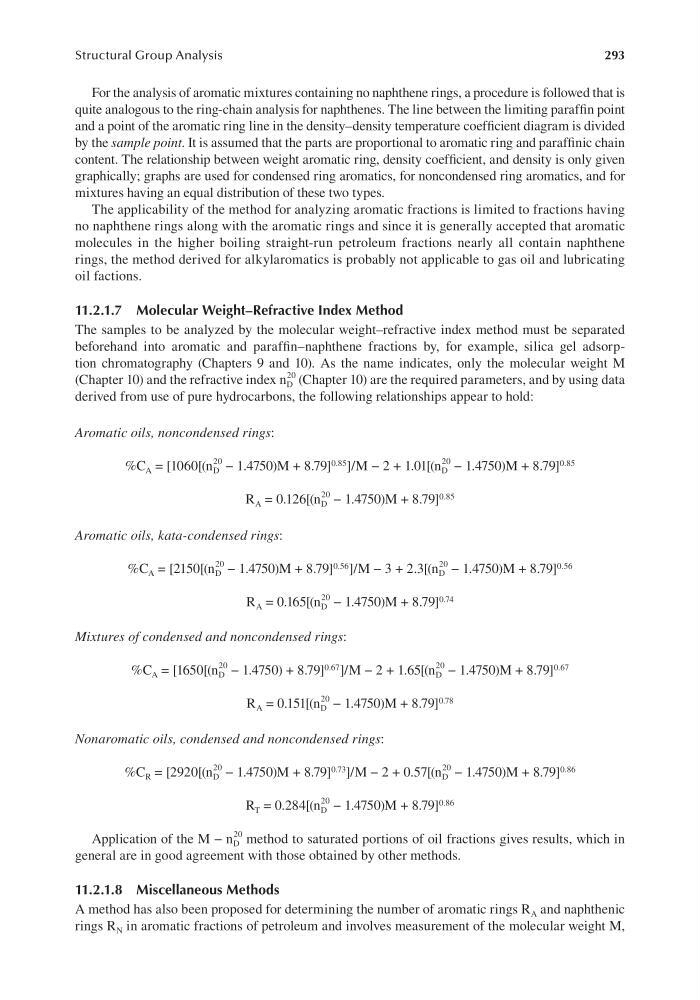
The samples to be analyzed by the molecular weight–refractive index method must be separated
beforehand into aromatic and paraffin–naphthene fractions by, for example, silica gel adsorption chromatography (Chapters 9 and 10). As the name indicates, only the molecular weight M
(Chapter 10) and the refractive index n D
20 (Chapter 10) are the required parameters, and by using data
derived from use of pure hydrocarbons, the following relationships appear to hold:
Aromatic oils, noncondensed rings:
%C A = [1060[(n D
20 − 1.4750)M + 8.79] 0.85 ]/M − 2 + 1.01[(n D
20 − 1.4750)M + 8.79] 0.85
R A = 0.126[(n D
20 − 1.4750)M + 8.79] 0.85
Aromatic oils, kata-condensed rings:
%C A = [2150[(n D
20 − 1.4750)M + 8.79] 0.56 ]/M − 3 + 2.3[(n D
20 − 1.4750)M + 8.79] 0.56
R A = 0.165[(n D
20 − 1.4750)M + 8.79] 0.74
Mixtures of condensed and noncondensed rings:
%C A = [1650[(n D
20 − 1.4750) + 8.79] 0.67 ]/M − 2 + 1.65[(n D
20 − 1.4750)M + 8.79] 0.67
R A = 0.151[(n D
20 − 1.4750)M + 8.79] 0.78
Nonaromatic oils, condensed and noncondensed rings:
%C R = [2920[(n D
20 − 1.4750)M + 8.79] 0.73 ]/M − 2 + 0.57[(n D
20 − 1.4750)M + 8.79] 0.86
R T = 0.284[(n D
20 − 1.4750)M + 8.79] 0.86
Application of the M − n D
20 method to saturated portions of oil fractions gives results, which in
general are in good agreement with those obtained by other methods.
11.2.1.8 Miscellaneous Methods
A method has also been proposed for determining the number of aromatic rings R A and naphthenic
rings R N in aromatic fractions of petroleum and involves measurement of the molecular weight M,
Structural Group Analysis
For the analysis of aromatic mixtures containing no naphthene rings, a procedure is followed that is
quite analogous to the ring-chain analysis for naphthenes. The line between the limiting paraffin point
and a point of the aromatic ring line in the density–density temperature coefficient diagram is divided
by the sample point. It is assumed that the parts are proportional to aromatic ring and paraffinic chain
content. The relationship between weight aromatic ring, density coefficient, and density is only given
graphically; graphs are used for condensed ring aromatics, for noncondensed ring aromatics, and for
mixtures having an equal distribution of these two types.
The applicability of the method for analyzing aromatic fractions is limited to fractions having
no naphthene rings along with the aromatic rings and since it is generally accepted that aromatic
molecules in the higher boiling straight-run petroleum fractions nearly all contain naphthene
rings, the method derived for alkylaromatics is probably not applicable to gas oil and lubricating
oil factions.
11.2.1.7 Molecular Weight–Refractive Index Method
The samples to be analyzed by the molecular weight–refractive index method must be separated
beforehand into aromatic and paraffin–naphthene fractions by, for example, silica gel adsorption chromatography (Chapters 9 and 10). As the name indicates, only the molecular weight M
(Chapter 10) and the refractive index n D
20 (Chapter 10) are the required parameters, and by using data
derived from use of pure hydrocarbons, the following relationships appear to hold:
Aromatic oils, noncondensed rings:
%C A = [1060[(n D
20 − 1.4750)M + 8.79] 0.85 ]/M − 2 + 1.01[(n D
20 − 1.4750)M + 8.79] 0.85
R A = 0.126[(n D
20 − 1.4750)M + 8.79] 0.85
Aromatic oils, kata-condensed rings:
%C A = [2150[(n D
20 − 1.4750)M + 8.79] 0.56 ]/M − 3 + 2.3[(n D
20 − 1.4750)M + 8.79] 0.56
R A = 0.165[(n D
20 − 1.4750)M + 8.79] 0.74
Mixtures of condensed and noncondensed rings:
%C A = [1650[(n D
20 − 1.4750) + 8.79] 0.67 ]/M − 2 + 1.65[(n D
20 − 1.4750)M + 8.79] 0.67
R A = 0.151[(n D
20 − 1.4750)M + 8.79] 0.78
Nonaromatic oils, condensed and noncondensed rings:
%C R = [2920[(n D
20 − 1.4750)M + 8.79] 0.73 ]/M − 2 + 0.57[(n D
20 − 1.4750)M + 8.79] 0.86
R T = 0.284[(n D
20 − 1.4750)M + 8.79] 0.86
Application of the M − n D
20 method to saturated portions of oil fractions gives results, which in
general are in good agreement with those obtained by other methods.
11.2.1.8 Miscellaneous Methods
A method has also been proposed for determining the number of aromatic rings R A and naphthenic
rings R N in aromatic fractions of petroleum and involves measurement of the molecular weight M,