

264
The Chemistry and Technology of Petroleum
For thermodynamic calculation of equilibria useful in hydrocarbon research, combustion data of
extreme accuracy are required because the heats of formation of water and carbon dioxide are large
in comparison with those in the hydrocarbons. Great accuracy is also required of the specific heat
data for the calculation of free energy or entropy. Much care must be exercised in selecting values
from the literature for these purposes, since many of those available were determined before the
development of modern calorimetric techniques.
10.4.11 CrItICAl ProPertIes
The temperature, pressure, and volume at the critical state are of considerable interest in petroleum
physics, particularly in connection with modern high-pressure, high-temperature refinery operations and in correlating pressure–temperature–volume relationships for other states. Critical data
are known for most of the lower molecular weight pure hydrocarbons, and standard methods are
generally used for such determinations.
The critical point of a pure compound is the equilibrium state in which its gaseous and liquid phases are indistinguishable and coexistent; they have the same intensive properties. However,
localized variations in these phase properties may be evident experimentally. The definition of the
critical point of a mixture is the same. However, mixtures generally have a maximum temperature
or pressure at other than the true critical point; maximum here denotes the greatest value at which
two phases can coexist in equilibrium.
10.5 ELECTRICAL PROPERTIES
Understanding of how petroleum behaves and why different crude oils differ in properties is also
possible with an atomistic understanding allowed by quantum mechanics. The combination of
physics, chemistry, and the focus on the relationship between the properties of a material and its electrical properties provides a knowledge base for a variety of chemical and engineering applications.
10.5.1 ConduCtIvIty
From the fragmentary evidence available, the electrical conductivity of petroleum fractions is small but
measurable (Penzes and Speight, 1974; Fotland et al., 1993; Fotland and Anfindsen, 1996). For example,
the normal hydrocarbons (from hexane up) have an electrical conductivity smaller than 10 −16 Ω/cm;
benzene itself has an electrical conductivity of 4.4 × 10 −17 Ω/cm, and cyclohexane has an electrical
conductivity of 7 × 10 −18 Ω/cm. It is generally recognized that hydrocarbons do not usually have an
electrical conductivity larger than 10 −18 Ω/cm. Thus it is not surprising that the electrical conductivity of
hydrocarbon oils is also exceedingly small (ASTM D3114), of the order of 10 −19 to 10 −12 Ω/cm.
Available data indicate that the observed conductivity is frequently more dependent on the
method of measurement and the presence of trace impurities than on the chemical type of the oil.
Conduction through oils is not ohmic; that is, the current is not proportional to field strength: in
some regions it is observed to increase exponentially with the latter. Time effects are also observed,
the current being at first relatively large and decreasing to a smaller steady value. This is partly
because of electrode polarization and partly because of ions removed from the solution. Most oils
increase in conductivity with rising temperatures.
10.5.2 dIeleCtrIC ConstAnt
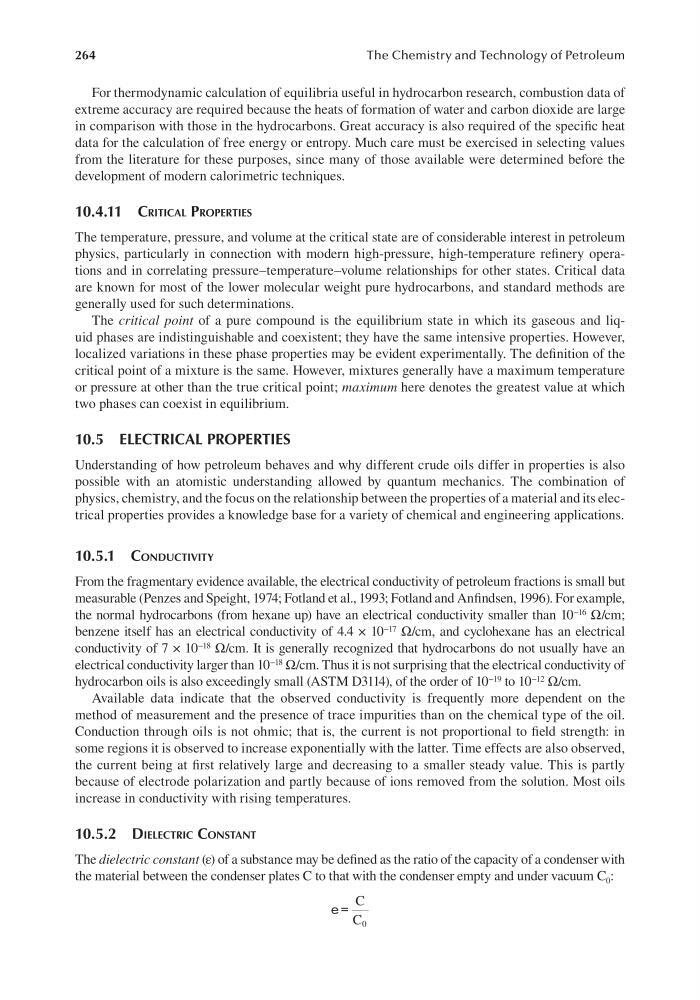
The dielectric constant (ε) of a substance may be defined as the ratio of the capacity of a condenser with
the material between the condenser plates C to that with the condenser empty and under vacuum C 0 :
e=
C
C 0
The Chemistry and Technology of Petroleum
For thermodynamic calculation of equilibria useful in hydrocarbon research, combustion data of
extreme accuracy are required because the heats of formation of water and carbon dioxide are large
in comparison with those in the hydrocarbons. Great accuracy is also required of the specific heat
data for the calculation of free energy or entropy. Much care must be exercised in selecting values
from the literature for these purposes, since many of those available were determined before the
development of modern calorimetric techniques.
10.4.11 CrItICAl ProPertIes
The temperature, pressure, and volume at the critical state are of considerable interest in petroleum
physics, particularly in connection with modern high-pressure, high-temperature refinery operations and in correlating pressure–temperature–volume relationships for other states. Critical data
are known for most of the lower molecular weight pure hydrocarbons, and standard methods are
generally used for such determinations.
The critical point of a pure compound is the equilibrium state in which its gaseous and liquid phases are indistinguishable and coexistent; they have the same intensive properties. However,
localized variations in these phase properties may be evident experimentally. The definition of the
critical point of a mixture is the same. However, mixtures generally have a maximum temperature
or pressure at other than the true critical point; maximum here denotes the greatest value at which
two phases can coexist in equilibrium.
10.5 ELECTRICAL PROPERTIES
Understanding of how petroleum behaves and why different crude oils differ in properties is also
possible with an atomistic understanding allowed by quantum mechanics. The combination of
physics, chemistry, and the focus on the relationship between the properties of a material and its electrical properties provides a knowledge base for a variety of chemical and engineering applications.
10.5.1 ConduCtIvIty
From the fragmentary evidence available, the electrical conductivity of petroleum fractions is small but
measurable (Penzes and Speight, 1974; Fotland et al., 1993; Fotland and Anfindsen, 1996). For example,
the normal hydrocarbons (from hexane up) have an electrical conductivity smaller than 10 −16 Ω/cm;
benzene itself has an electrical conductivity of 4.4 × 10 −17 Ω/cm, and cyclohexane has an electrical
conductivity of 7 × 10 −18 Ω/cm. It is generally recognized that hydrocarbons do not usually have an
electrical conductivity larger than 10 −18 Ω/cm. Thus it is not surprising that the electrical conductivity of
hydrocarbon oils is also exceedingly small (ASTM D3114), of the order of 10 −19 to 10 −12 Ω/cm.
Available data indicate that the observed conductivity is frequently more dependent on the
method of measurement and the presence of trace impurities than on the chemical type of the oil.
Conduction through oils is not ohmic; that is, the current is not proportional to field strength: in
some regions it is observed to increase exponentially with the latter. Time effects are also observed,
the current being at first relatively large and decreasing to a smaller steady value. This is partly
because of electrode polarization and partly because of ions removed from the solution. Most oils
increase in conductivity with rising temperatures.
10.5.2 dIeleCtrIC ConstAnt
The dielectric constant (ε) of a substance may be defined as the ratio of the capacity of a condenser with
the material between the condenser plates C to that with the condenser empty and under vacuum C 0 :
e=
C
C 0