

263
Petroleum Analysis
10.4.9 Pressure–volume–temPerAture relAtIonsHIPs
Hydrocarbon vapors, like other gases, follow the ideal gas law (i.e., PV = RT) only at relatively low
pressures and high temperatures, that is, far from the critical state. Several more empirical equations have been proposed to represent the gas laws more accurately, such as the well-known van
der Waals equation, but they are either inconvenient for calculation or require the experimental
determination of several constants. A more useful device is to use the simple gas law and to induce
a correction, termed the compressibility factor, μ, so that the equation takes the form
PV
RT
= m
For hydrocarbons the compressibility factor is very nearly a function only of the reduced variables of state, that is, a function of the pressure and temperature divided by the respective critical values. The compressibility factor method functions excellently for pure compounds but may
become ambiguous for mixtures because the critical constants have a slightly different significance.
However, the use of pseudocritical temperature and pressure values is generally lower than the true
values, permitting the compressibility factor to be employed in such cases.
10.4.10 HeAt oF ComBustIon
The gross heats of combustion of crude oil and its products are given with fair accuracy by the
equation
Q 12 4
2 1 d
2
=
-
,
,
00
00
where d is the 60/60°F specific gravity. Deviation is generally less than 1% although many highly
aromatic crude oils show considerably higher values; the range for crude oil is 10,000–11,600 cal/g
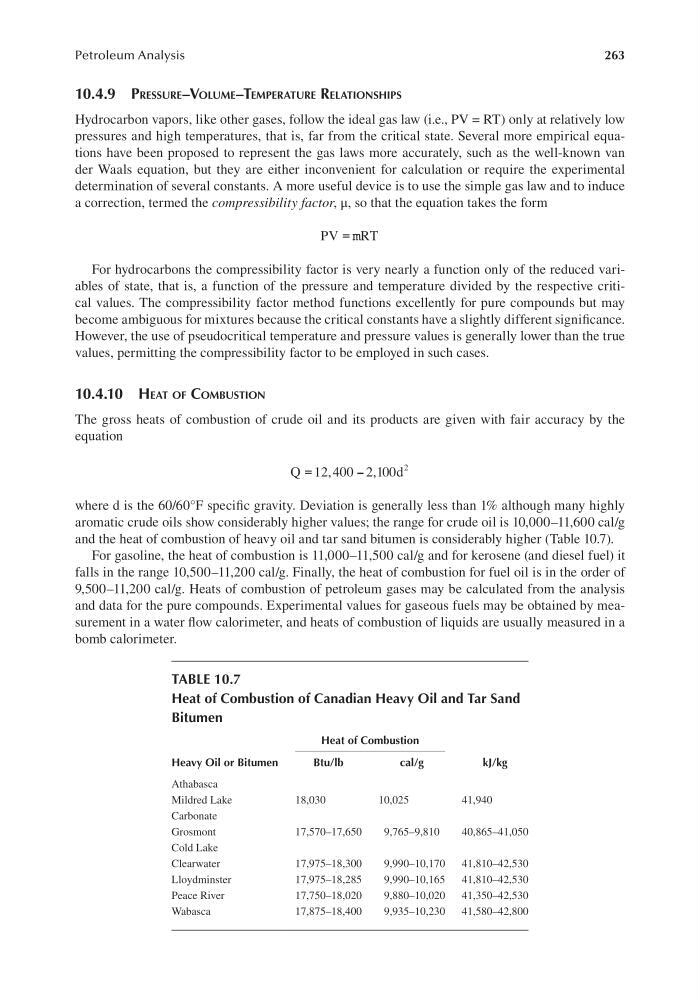
and the heat of combustion of heavy oil and tar sand bitumen is considerably higher (Table 10.7).
For gasoline, the heat of combustion is 11,000–11,500 cal/g and for kerosene (and diesel fuel) it
falls in the range 10,500–11,200 cal/g. Finally, the heat of combustion for fuel oil is in the order of
9,500–11,200 cal/g. Heats of combustion of petroleum gases may be calculated from the analysis
and data for the pure compounds. Experimental values for gaseous fuels may be obtained by measurement in a water flow calorimeter, and heats of combustion of liquids are usually measured in a
bomb calorimeter.
TABLE 10.7
Heat of Combustion of Canadian Heavy Oil and Tar Sand
Bitumen
Heavy Oil or Bitumen
Heat of Combustion
kJ/kg
Btu/lb
cal/g
Athabasca
Mildred Lake
18,030
10,025
41,940
Carbonate
Grosmont
17,570–17,650
9,765–9,810
40,865–41,050
Cold Lake
Clearwater
17,975–18,300
9,990–10,170 41,810–42,530
Lloydminster
17,975–18,285
9,990–10,165 41,810–42,530
Peace River
17,750–18,020
9,880–10,020 41,350–42,530
Wabasca
17,875–18,400
9,935–10,230 41,580–42,800
Petroleum Analysis
10.4.9 Pressure–volume–temPerAture relAtIonsHIPs
Hydrocarbon vapors, like other gases, follow the ideal gas law (i.e., PV = RT) only at relatively low
pressures and high temperatures, that is, far from the critical state. Several more empirical equations have been proposed to represent the gas laws more accurately, such as the well-known van
der Waals equation, but they are either inconvenient for calculation or require the experimental
determination of several constants. A more useful device is to use the simple gas law and to induce
a correction, termed the compressibility factor, μ, so that the equation takes the form
PV
RT
= m
For hydrocarbons the compressibility factor is very nearly a function only of the reduced variables of state, that is, a function of the pressure and temperature divided by the respective critical values. The compressibility factor method functions excellently for pure compounds but may
become ambiguous for mixtures because the critical constants have a slightly different significance.
However, the use of pseudocritical temperature and pressure values is generally lower than the true
values, permitting the compressibility factor to be employed in such cases.
10.4.10 HeAt oF ComBustIon
The gross heats of combustion of crude oil and its products are given with fair accuracy by the
equation
Q 12 4
2 1 d
2
=
-
,
,
00
00
where d is the 60/60°F specific gravity. Deviation is generally less than 1% although many highly
aromatic crude oils show considerably higher values; the range for crude oil is 10,000–11,600 cal/g
and the heat of combustion of heavy oil and tar sand bitumen is considerably higher (Table 10.7).
For gasoline, the heat of combustion is 11,000–11,500 cal/g and for kerosene (and diesel fuel) it
falls in the range 10,500–11,200 cal/g. Finally, the heat of combustion for fuel oil is in the order of
9,500–11,200 cal/g. Heats of combustion of petroleum gases may be calculated from the analysis
and data for the pure compounds. Experimental values for gaseous fuels may be obtained by measurement in a water flow calorimeter, and heats of combustion of liquids are usually measured in a
bomb calorimeter.
TABLE 10.7
Heat of Combustion of Canadian Heavy Oil and Tar Sand
Bitumen
Heavy Oil or Bitumen
Heat of Combustion
kJ/kg
Btu/lb
cal/g
Athabasca
Mildred Lake
18,030
10,025
41,940
Carbonate
Grosmont
17,570–17,650
9,765–9,810
40,865–41,050
Cold Lake
Clearwater
17,975–18,300
9,990–10,170 41,810–42,530
Lloydminster
17,975–18,285
9,990–10,165 41,810–42,530
Peace River
17,750–18,020
9,880–10,020 41,350–42,530
Wabasca
17,875–18,400
9,935–10,230 41,580–42,800