

258
The Chemistry and Technology of Petroleum
properties, as is often the case during refining operations, such data provide a valuable aid to
process control and online product testing.
For a more detailed distillation analysis of feedstocks and products, a low-resolution, temperatureprogrammed gas chromatographic analysis has been developed to simulate the time- consuming true
boiling point distillation. The method relies on the general observation that hydrocarbons are eluted
from a nonpolar adsorbent in the order of their boiling points. The regularity of the elution order of
the hydrocarbon components allows the retention times to be equated to distillation temperatures and
the term simulated distillation by gas chromatography (or simdis) is used throughout the industry to
refer to this technique.
Simulated distillation by gas chromatography is often applied in the petroleum industry to obtain
true boiling point data for distillates and crude oils (Speight, 2001). Two standardized methods
(ASTM D2887; ASTM D3710) are available for the boiling point determination of petroleum fractions and gasoline, respectively. The ASTM D2887 method utilizes nonpolar, packed gas chromatographic columns in conjunction with flame ionization detection. The upper limit of the boiling
range covered by this method is to approximately 540°C (1000°F) atmospheric equivalent boiling
point. Recent efforts in which high temperature gas chromatography were used have focused on
extending the scope of the ASTM D2887 method for higher boiling petroleum materials to 800°C
(1470°F) atmospheric equivalent boiling point.
10.4.2 lIQueFACtIon And solIdIFICAtIon
Petroleum and the majority of petroleum products are liquids at ambient temperature, and problems
that may arise from solidification during normal use are not common. Nevertheless, the melting
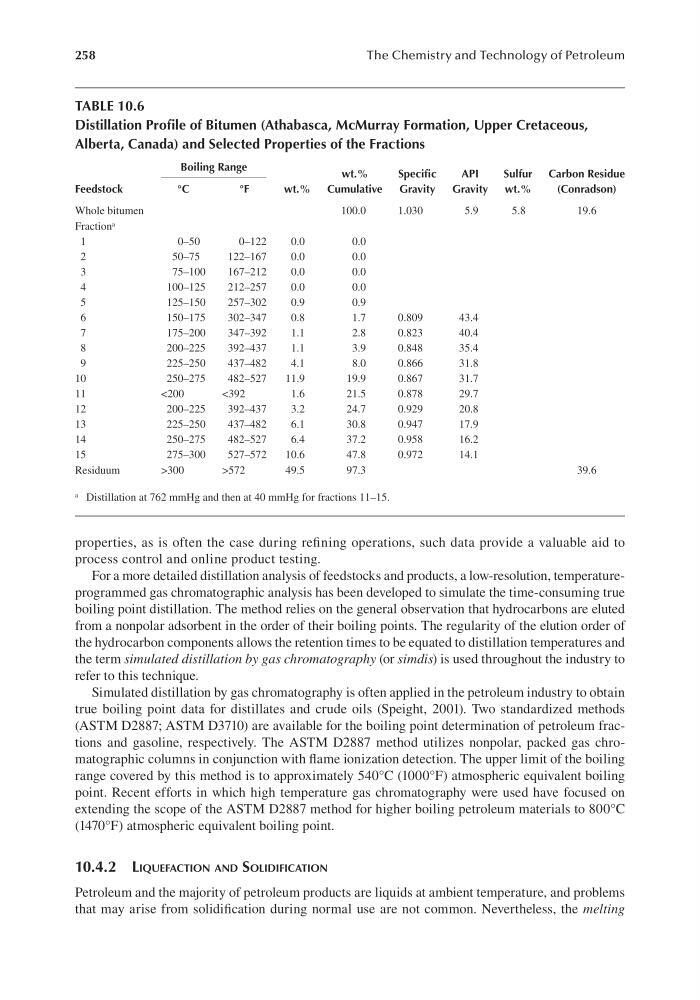
TABLE 10.6
Distillation Profile of Bitumen (Athabasca, McMurray Formation, Upper Cretaceous,
Alberta, Canada) and Selected Properties of the Fractions
Feedstock
Boiling Range
wt.%
wt.%
Cumulative
Specific
Gravity
API
Gravity
Sulfur
wt.%
Carbon Residue
(Conradson)
°C
°F
Whole bitumen
100.0
1.030
5.9
5.8
19.6
Fraction a
1
0–50
0–122
0.0
0.0
2
50–75
122–167
0.0
0.0
3
75–100
167–212
0.0
0.0
4
100–125
212–257
0.0
0.0
5
125–150
257–302
0.9
0.9
6
150–175
302–347
0.8
1.7
0.809
43.4
7
175–200
347–392
1.1
2.8
0.823
40.4
8
200–225
392–437
1.1
3.9
0.848
35.4
9
225–250
437–482
4.1
8.0
0.866
31.8
10
250–275
482–527
11.9
19.9
0.867
31.7
11
<200
<392
1.6
21.5
0.878
29.7
12
200–225
392–437
3.2
24.7
0.929
20.8
13
225–250
437–482
6.1
30.8
0.947
17.9
14
250–275
482–527
6.4
37.2
0.958
16.2
15
275–300
527–572
10.6
47.8
0.972
14.1
Residuum
>300
>572
49.5
97.3
39.6
a Distillation at 762 mmHg and then at 40 mmHg for fractions 11–15.
The Chemistry and Technology of Petroleum
properties, as is often the case during refining operations, such data provide a valuable aid to
process control and online product testing.
For a more detailed distillation analysis of feedstocks and products, a low-resolution, temperatureprogrammed gas chromatographic analysis has been developed to simulate the time- consuming true
boiling point distillation. The method relies on the general observation that hydrocarbons are eluted
from a nonpolar adsorbent in the order of their boiling points. The regularity of the elution order of
the hydrocarbon components allows the retention times to be equated to distillation temperatures and
the term simulated distillation by gas chromatography (or simdis) is used throughout the industry to
refer to this technique.
Simulated distillation by gas chromatography is often applied in the petroleum industry to obtain
true boiling point data for distillates and crude oils (Speight, 2001). Two standardized methods
(ASTM D2887; ASTM D3710) are available for the boiling point determination of petroleum fractions and gasoline, respectively. The ASTM D2887 method utilizes nonpolar, packed gas chromatographic columns in conjunction with flame ionization detection. The upper limit of the boiling
range covered by this method is to approximately 540°C (1000°F) atmospheric equivalent boiling
point. Recent efforts in which high temperature gas chromatography were used have focused on
extending the scope of the ASTM D2887 method for higher boiling petroleum materials to 800°C
(1470°F) atmospheric equivalent boiling point.
10.4.2 lIQueFACtIon And solIdIFICAtIon
Petroleum and the majority of petroleum products are liquids at ambient temperature, and problems
that may arise from solidification during normal use are not common. Nevertheless, the melting
TABLE 10.6
Distillation Profile of Bitumen (Athabasca, McMurray Formation, Upper Cretaceous,
Alberta, Canada) and Selected Properties of the Fractions
Feedstock
Boiling Range
wt.%
wt.%
Cumulative
Specific
Gravity
API
Gravity
Sulfur
wt.%
Carbon Residue
(Conradson)
°C
°F
Whole bitumen
100.0
1.030
5.9
5.8
19.6
Fraction a
1
0–50
0–122
0.0
0.0
2
50–75
122–167
0.0
0.0
3
75–100
167–212
0.0
0.0
4
100–125
212–257
0.0
0.0
5
125–150
257–302
0.9
0.9
6
150–175
302–347
0.8
1.7
0.809
43.4
7
175–200
347–392
1.1
2.8
0.823
40.4
8
200–225
392–437
1.1
3.9
0.848
35.4
9
225–250
437–482
4.1
8.0
0.866
31.8
10
250–275
482–527
11.9
19.9
0.867
31.7
11
<200
<392
1.6
21.5
0.878
29.7
12
200–225
392–437
3.2
24.7
0.929
20.8
13
225–250
437–482
6.1
30.8
0.947
17.9
14
250–275
482–527
6.4
37.2
0.958
16.2
15
275–300
527–572
10.6
47.8
0.972
14.1
Residuum
>300
>572
49.5
97.3
39.6
a Distillation at 762 mmHg and then at 40 mmHg for fractions 11–15.