

245
Petroleum Analysis
The inspection assay tests discussed earlier are not exhaustive but are the ones most commonly
used and provide data on the impurities present as well as a general idea of the products that may
be recoverable. Other properties that are determined on an as-needed basis include, but are not limited to, the following: (1) vapor pressure (Reid method) (ASTM D323, IP 69, IP 402), (2) total acid
number (TAN)—(ASTM D664, IP 177), and (3) the aniline point (or mixed aniline point) (ASTM
D611, IP 2).
The Reid vapor pressure test method (ASTM D323, IP 69) measures the vapor pressure of volatile petroleum. The Reid vapor pressure differs from the true vapor pressure of the sample due to
some small sample vaporization and the presence of water vapor and air in the confined space. The
acid number is the quantity of base, expressed in milligrams of potassium hydroxide per gram of
sample that is required to titrate a sample in this solvent to a green/green-brown end point, using
p-naphtholbenzein indicator solution. The strong acid number is the quantity of base, expressed as
milligrams of potassium hydroxide per gram of sample, required to titrate a sample in the solvent
from its initial meter reading to a meter reading corresponding to a freshly prepared nonaqueous
acidic buffer solution or a well-defined inflection point as specified in the test method (ASTM D664,
IP 177). The aniline point (or mixed aniline point) (ASTM D611, IP 2) has been used for the characterization of crude oil although it is more applicable to pure hydrocarbons and in their mixtures and
is used to estimate the aromatic content of mixtures. Aromatic mixtures exhibit the lowest aniline
points and paraffin mixtures have the highest aniline points. Cycloparaffins and olefins exhibit values between these two extremes. In any hydrocarbon homologous series the aniline point increases
with increasing molecular weight.
Using the data derived from the test assay, it is possible to assess petroleum quality acquire a
degree of predictability of performance during refining. However, knowledge of the basic concepts
of refining will help the analyst understand the production and, to a large extent, the anticipated
properties of the product, which in turn is related to storage, sampling, and handling the products.
Therefore, the judicious choice of a crude oil to produce any given product is just as important
as the selection of the product for any given purpose. Thus, initial inspection of petroleum-using
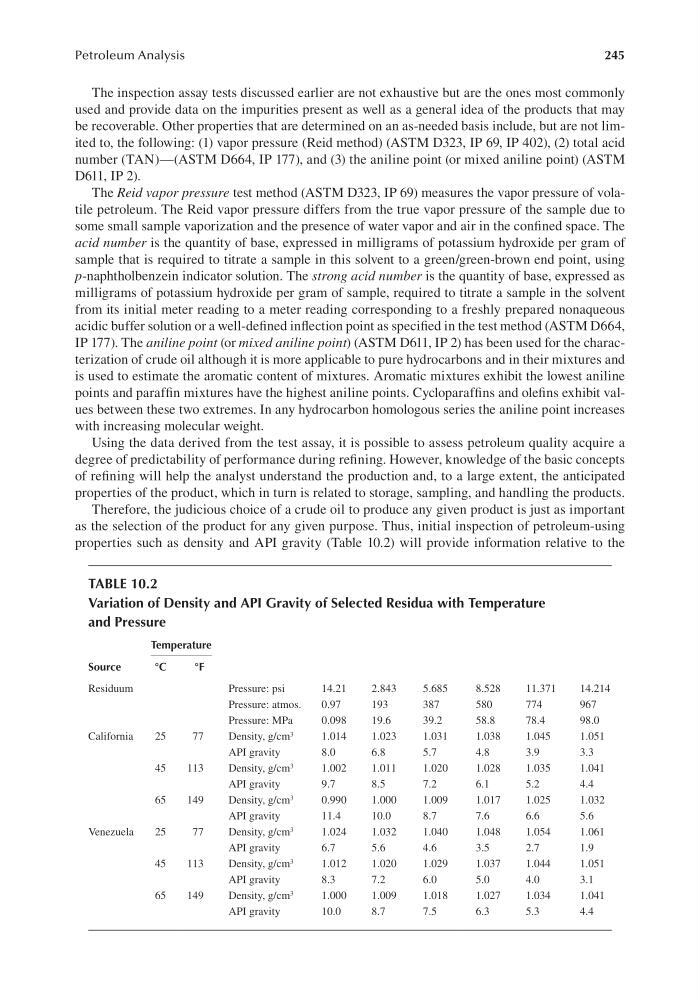
properties such as density and API gravity (Table 10.2) will provide information relative to the
TABLE 10.2
Variation of Density and API Gravity of Selected Residua with Temperature
and Pressure
Temperature
Source
°C
°F
Residuum
Pressure: psi
14.21
2.843
5.685
8.528
11.371
14.214
Pressure: atmos.
0.97
193
387
580
774
967
Pressure: MPa
0.098
19.6
39.2
58.8
78.4
98.0
California
25
77
Density, g/cm 3
1.014
1.023
1.031
1.038
1.045
1.051
API gravity
8.0
6.8
5.7
4.8
3.9
3.3
45
113
Density, g/cm 3
1.002
1.011
1.020
1.028
1.035
1.041
API gravity
9.7
8.5
7.2
6.1
5.2
4.4
65
149
Density, g/cm 3
0.990
1.000
1.009
1.017
1.025
1.032
API gravity
11.4
10.0
8.7
7.6
6.6
5.6
Venezuela
25
77
Density, g/cm 3
1.024
1.032
1.040
1.048
1.054
1.061
API gravity
6.7
5.6
4.6
3.5
2.7
1.9
45
113
Density, g/cm 3
1.012
1.020
1.029
1.037
1.044
1.051
API gravity
8.3
7.2
6.0
5.0
4.0
3.1
65
149
Density, g/cm 3
1.000
1.009
1.018
1.027
1.034
1.041
API gravity
10.0
8.7
7.5
6.3
5.3
4.4
Petroleum Analysis
The inspection assay tests discussed earlier are not exhaustive but are the ones most commonly
used and provide data on the impurities present as well as a general idea of the products that may
be recoverable. Other properties that are determined on an as-needed basis include, but are not limited to, the following: (1) vapor pressure (Reid method) (ASTM D323, IP 69, IP 402), (2) total acid
number (TAN)—(ASTM D664, IP 177), and (3) the aniline point (or mixed aniline point) (ASTM
D611, IP 2).
The Reid vapor pressure test method (ASTM D323, IP 69) measures the vapor pressure of volatile petroleum. The Reid vapor pressure differs from the true vapor pressure of the sample due to
some small sample vaporization and the presence of water vapor and air in the confined space. The
acid number is the quantity of base, expressed in milligrams of potassium hydroxide per gram of
sample that is required to titrate a sample in this solvent to a green/green-brown end point, using
p-naphtholbenzein indicator solution. The strong acid number is the quantity of base, expressed as
milligrams of potassium hydroxide per gram of sample, required to titrate a sample in the solvent
from its initial meter reading to a meter reading corresponding to a freshly prepared nonaqueous
acidic buffer solution or a well-defined inflection point as specified in the test method (ASTM D664,
IP 177). The aniline point (or mixed aniline point) (ASTM D611, IP 2) has been used for the characterization of crude oil although it is more applicable to pure hydrocarbons and in their mixtures and
is used to estimate the aromatic content of mixtures. Aromatic mixtures exhibit the lowest aniline
points and paraffin mixtures have the highest aniline points. Cycloparaffins and olefins exhibit values between these two extremes. In any hydrocarbon homologous series the aniline point increases
with increasing molecular weight.
Using the data derived from the test assay, it is possible to assess petroleum quality acquire a
degree of predictability of performance during refining. However, knowledge of the basic concepts
of refining will help the analyst understand the production and, to a large extent, the anticipated
properties of the product, which in turn is related to storage, sampling, and handling the products.
Therefore, the judicious choice of a crude oil to produce any given product is just as important
as the selection of the product for any given purpose. Thus, initial inspection of petroleum-using
properties such as density and API gravity (Table 10.2) will provide information relative to the
TABLE 10.2
Variation of Density and API Gravity of Selected Residua with Temperature
and Pressure
Temperature
Source
°C
°F
Residuum
Pressure: psi
14.21
2.843
5.685
8.528
11.371
14.214
Pressure: atmos.
0.97
193
387
580
774
967
Pressure: MPa
0.098
19.6
39.2
58.8
78.4
98.0
California
25
77
Density, g/cm 3
1.014
1.023
1.031
1.038
1.045
1.051
API gravity
8.0
6.8
5.7
4.8
3.9
3.3
45
113
Density, g/cm 3
1.002
1.011
1.020
1.028
1.035
1.041
API gravity
9.7
8.5
7.2
6.1
5.2
4.4
65
149
Density, g/cm 3
0.990
1.000
1.009
1.017
1.025
1.032
API gravity
11.4
10.0
8.7
7.6
6.6
5.6
Venezuela
25
77
Density, g/cm 3
1.024
1.032
1.040
1.048
1.054
1.061
API gravity
6.7
5.6
4.6
3.5
2.7
1.9
45
113
Density, g/cm 3
1.012
1.020
1.029
1.037
1.044
1.051
API gravity
8.3
7.2
6.0
5.0
4.0
3.1
65
149
Density, g/cm 3
1.000
1.009
1.018
1.027
1.034
1.041
API gravity
10.0
8.7
7.5
6.3
5.3
4.4