

244
The Chemistry and Technology of Petroleum
contamination during wellhead recovery, storage, or transportation that may increase the processing difficulty (cost). The information required is generally crude oil dependent or specific to a
particular refinery and is also a function of refinery operations and desired product slate. To obtain
the necessary information, two different analytical schemes are commonly used and these are as
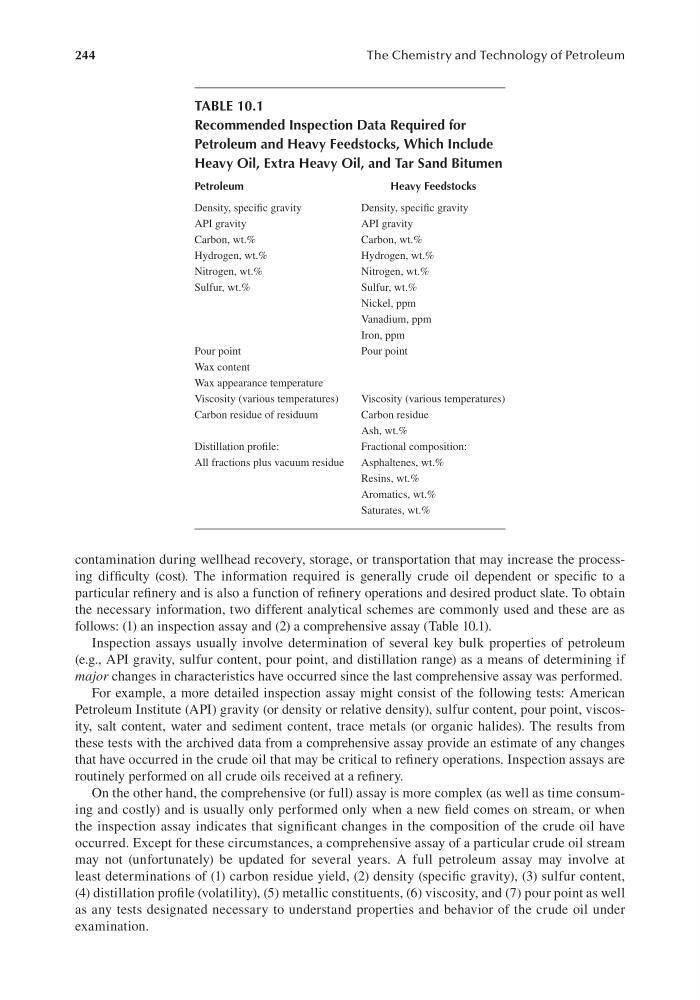
follows: (1) an inspection assay and (2) a comprehensive assay (Table 10.1).
Inspection assays usually involve determination of several key bulk properties of petroleum
(e.g., API gravity, sulfur content, pour point, and distillation range) as a means of determining if
major changes in characteristics have occurred since the last comprehensive assay was performed.
For example, a more detailed inspection assay might consist of the following tests: American
Petroleum Institute (API) gravity (or density or relative density), sulfur content, pour point, viscosity, salt content, water and sediment content, trace metals (or organic halides). The results from
these tests with the archived data from a comprehensive assay provide an estimate of any changes
that have occurred in the crude oil that may be critical to refinery operations. Inspection assays are
routinely performed on all crude oils received at a refinery.
On the other hand, the comprehensive (or full) assay is more complex (as well as time consuming and costly) and is usually only performed only when a new field comes on stream, or when
the inspection assay indicates that significant changes in the composition of the crude oil have
occurred. Except for these circumstances, a comprehensive assay of a particular crude oil stream
may not (unfortunately) be updated for several years. A full petroleum assay may involve at
least determinations of (1) carbon residue yield, (2) density (specific gravity), (3) sulfur content,
(4) distillation profile (volatility), (5) metallic constituents, (6) viscosity, and (7) pour point as well
as any tests designated necessary to understand properties and behavior of the crude oil under
examination.
TABLE 10.1
Recommended Inspection Data Required for
Petroleum and Heavy Feedstocks, Which Include
Heavy Oil, Extra Heavy Oil, and Tar Sand Bitumen
Petroleum
Heavy Feedstocks
Density, specific gravity
Density, specific gravity
API gravity
API gravity
Carbon, wt.%
Carbon, wt.%
Hydrogen, wt.%
Hydrogen, wt.%
Nitrogen, wt.%
Nitrogen, wt.%
Sulfur, wt.%
Sulfur, wt.%
Nickel, ppm
Vanadium, ppm
Iron, ppm
Pour point
Pour point
Wax content
Wax appearance temperature
Viscosity (various temperatures)
Viscosity (various temperatures)
Carbon residue of residuum
Carbon residue
Ash, wt.%
Distillation profile:
Fractional composition:
All fractions plus vacuum residue
Asphaltenes, wt.%
Resins, wt.%
Aromatics, wt.%
Saturates, wt.%
The Chemistry and Technology of Petroleum
contamination during wellhead recovery, storage, or transportation that may increase the processing difficulty (cost). The information required is generally crude oil dependent or specific to a
particular refinery and is also a function of refinery operations and desired product slate. To obtain
the necessary information, two different analytical schemes are commonly used and these are as
follows: (1) an inspection assay and (2) a comprehensive assay (Table 10.1).
Inspection assays usually involve determination of several key bulk properties of petroleum
(e.g., API gravity, sulfur content, pour point, and distillation range) as a means of determining if
major changes in characteristics have occurred since the last comprehensive assay was performed.
For example, a more detailed inspection assay might consist of the following tests: American
Petroleum Institute (API) gravity (or density or relative density), sulfur content, pour point, viscosity, salt content, water and sediment content, trace metals (or organic halides). The results from
these tests with the archived data from a comprehensive assay provide an estimate of any changes
that have occurred in the crude oil that may be critical to refinery operations. Inspection assays are
routinely performed on all crude oils received at a refinery.
On the other hand, the comprehensive (or full) assay is more complex (as well as time consuming and costly) and is usually only performed only when a new field comes on stream, or when
the inspection assay indicates that significant changes in the composition of the crude oil have
occurred. Except for these circumstances, a comprehensive assay of a particular crude oil stream
may not (unfortunately) be updated for several years. A full petroleum assay may involve at
least determinations of (1) carbon residue yield, (2) density (specific gravity), (3) sulfur content,
(4) distillation profile (volatility), (5) metallic constituents, (6) viscosity, and (7) pour point as well
as any tests designated necessary to understand properties and behavior of the crude oil under
examination.
TABLE 10.1
Recommended Inspection Data Required for
Petroleum and Heavy Feedstocks, Which Include
Heavy Oil, Extra Heavy Oil, and Tar Sand Bitumen
Petroleum
Heavy Feedstocks
Density, specific gravity
Density, specific gravity
API gravity
API gravity
Carbon, wt.%
Carbon, wt.%
Hydrogen, wt.%
Hydrogen, wt.%
Nitrogen, wt.%
Nitrogen, wt.%
Sulfur, wt.%
Sulfur, wt.%
Nickel, ppm
Vanadium, ppm
Iron, ppm
Pour point
Pour point
Wax content
Wax appearance temperature
Viscosity (various temperatures)
Viscosity (various temperatures)
Carbon residue of residuum
Carbon residue
Ash, wt.%
Distillation profile:
Fractional composition:
All fractions plus vacuum residue
Asphaltenes, wt.%
Resins, wt.%
Aromatics, wt.%
Saturates, wt.%